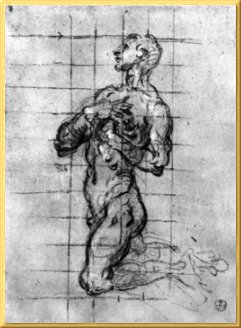
Drawing by Tintoretto,
Image courtesy ClipArt.com
The Enslavement of a Warrior
Many Goreans have a very low opinion regarding male slaves. To them, a man who willingly surrenders himself to
another is going against the Natural Order. In the books, a man was usually expected to embrace death rather than slavery. Below are some passages taken from the Gor books that
pertain to the enslavement of a warrior, and his own feelings about his plight.
In Raiders, Tarl Cabot is captured by the Rence Growers, and is given the choice of death or life as a slave. Afterwards, he chastised himself for
making the choice that he did.
I lowered my head, burning with shame. In my eyes in that moment it seemed that I had lost myself, that my codes had been betrayed, Ko-ro-ba by city
dishonored, even the blade I carried soiled. I could not look Ho-Hak again in the eyes. In their eyes, and in mine, I could now be nothing, only slave.
"I had thought the better of you," said Ho-Hak. "I had thought you were of the warriors."
I could not speak to him.
"I see now," said Ho-Hak, "you are indeed of Port Kar."
I could not raise my head, so shamed I was. It seemed I could never lift my head again.
"Do you beg to be a slave?" asked Ho-Hak. The question was cruel, but fair.
I looked at Ho-Hak, tears in my eyes. I saw only contempt on that broad, calm face.
I lowered my head. "Yes," I said, "I beg to be a slave."
There was a great laugh from those gathered about, and, too, in those peals of merriment I heard the laugh of he who wore the headband of the pearls of the Vosk sorp,
and most bitter to me of all, the laugh of contempt of the girl who stood beside me, her thigh at my cheek.
"Slave," said Ho-Hak.
"Yes," said I, "---Master." The word came bitterly to me. But a Gorean slave addresses all free men as Master, all free women as Mistress, though, of course, normally but
one would own him.
There was further laughter.
"Perhaps now," said Ho-Hak, "we shall throw you to the tharlarion."
I put down my head.
There was more laughter.
To me, at that moment, it seemed to me that I had lost what might be more precious than life itself. How could I face myself, or anyone?
I had chosen ignominious bondage to the freedom of honorable death.
I was sick. I was ashamed. It was true that they might now throw me to the tharlarion. According to Gorean custom a slave is an animal,
and may be disposed of as an animal, in whatever way the master might wish, whenever he might please. But I was sick and I was shamed, and I could not now, somehow, care. I had
chosen ignominious bondage to the freedom of honorable death.
Raiders of Gor, pp. 24-25
(Later, after winning his freedom, Tarl still harbors feelings of self-disgust for having begged to be enslaved.)
I, Tarl Cabot, hating myself, no longer respected, or trusted, human beings. I had done what I had done that day for the sake of a
child, one who had once been kind to me, but who no longer existed. I knew myself for one who had chosen ignominious slavery over the freedom of honorable death. I knew
myself as coward. I had betrayed my codes. I had tasted humiliation and degradation, and most at my own hands, for I had been most by myself betrayed. I could no longer
see myself as I had been. I had been a boy and now I had come to the seeings of manhood, and found within myself, disgusting me, something capable of cowardice, self-indulgence,
selfishness, and cruelty. I was no longer worthy of the red of the warrior, no longer worthy of serving the Home Stone of my city, Ko-ro-ba, the Towers of the Morning."
Raiders of Gor, p. 76
Quotes menu
Main menu
Text, graphics, and design © 2003 arani_CsA
|