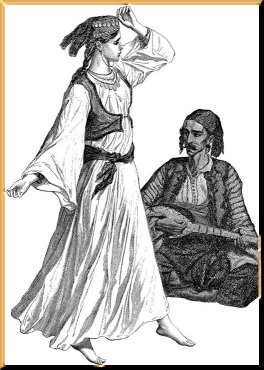
Engraving courtesy ClipArt.com
Music of Gor
|
"Hendow gestured with his head to the musicians, and they made their way, one by one, through the beaded curtain. There were five of them, a czehar player, two kalika players, a flautist and a drummer. In a moment or two, as Mirus solicited further interest among the customers, I heard the sounds of the instruments, the czehar and kalikas being tuned, the flautist trying passages, the drummer's fingers light on the taut skin of his instrument, the kaska, then adjusting it, then trying it again, then tapping lightly, then more vigorously, with swift, brief rhythms, limbering his wrists, fingers, and hands. The music of Gor, or much of it, is very melodious or sensuous. Much of it seems made for the display of slaves before free men, but then, I suppose that is exactly what it is made for."
John Norman, Dancer of Gor, p. 179
|
|
"To stop the flow of music would be like the stopping of time itself, incredible and inconceivable."
Aaron Copeland
|
It is good for a slave to know about the type of music she will be dancing to. What follows is a list of some Gorean instruments, some more common forms of music, and some musicians.
Instruments--
- cymbals--various forms are used, similar to those of Earth
- czehar--an eight-stringed instrument which looks like a large, flat, oblong box. It is held across the player's lap and played with a horn pick. It is similar to a Japanese koto. double flute--a wind instrument
- drum of the Red Hunters--a large disk-like heavy-handled drum which is struck with a stick; it has a frame of wood and a skin of tabuk hide, and has an odd resonance herlit-bone whistle--a whistle made from the bone of a herlit; used by the Kaiila tribe in the performance of the great dance
- kalika--a six-stringed, flat-bridged instrument with a hemispheric sound box and a long neck; its strings are adjusted with small wooden cranks, and it is played by plucking the strings; is similar to an Earth banjo
- kaska--a small hand drum
- notched stick--an instrument played by sliding a polished temwood stick across its surface
- tabor--a small hand drum with a head usually made of verr skin; the tension is adjusted by tightening or loosening small pegs around its perimeter
- tarn drums--drums used during a march in a war; the signals are used to control flying tarn armies
Music--
- Block melodies--songs commonly used in slave markets for the display of merchandise, intended to "set the mood" for potential buyers
- "Blue Sky Song"--a refrain from the Wagon Peoples, which says in part "though I die, yet there will be the bosk, the grass and the sky" (Nomads of Gor, p. 263)
- "Caravans of Tor"--a love song (Assassins of Gor, p. 264)
- "Hope of Tina"--a song of Cos; an expression of the yearning of a young slave girl that she may be so beautiful and feminine and marvelous, that she will prove to be acceptable as a slave (Vagabonds of Gor, p. 38)
- "The Ten Maids of Hammersfest"--a river song of pirates and brawls. (Guardsmen of Gor, p. 93)
- "Song of Tarl of Bristol" (Raiders of Gor, p.225)
Musicians--
- Caste of Musicians--In order of precedence, czehar players have the most prestige, followed by flautists and players of the kalika. Next come the players of the drums, and further down the list is the man who keeps the bag of miscellaneous instruments, playing them and parcelling them out to others as needed. Musicians are never enslaved but they may be exiled, tortured, or slain. It is said that he who makes music must, like the tarn and the Vosk gull, be free.
- Caste of Singers--On Gor, the singer or poet is regarded as a craftsman who makes strong sayings. He has a role to play in the social structure, celebrating battles and histories, singing of heroes and cities. But he is also expected to sing of living , and of love and joy, not merely of arms and glory. It is also his function to remind Goreans from time to time of loneliness and death, lest they should forget that they are men. This caste is also sometimes called the Caste of Poets.
- flute girl--a slave trained in the art of music, specifically the playing of the double flute. They perform at various functions, and are available for sexual use by those free men of their audience.
- Master of Revels--a city's Master of Entertainment
- Pentilicus Tallax--a renowned poet of Ar from one hundred years ago; the Great Theater in Ar is named after him. This is a huge theater which can accomodate a thousand actors.
Information about Gor
Main menu
Text, graphics, and design © 2003 arani_CsA
|