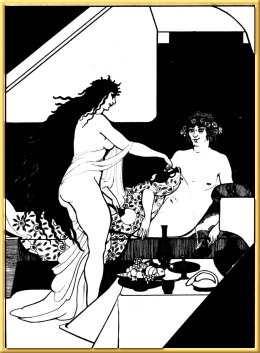
Golden Asse of Lucius Apuleius,
Image courtesy ArtToday.com
Gorean Foods
The following is a list of some foods mentioned in the Gor novels, along with a brief description of each.
Apricot
Fruit enjoyed in the Tahari, and other places.
|
"I brushed away two sellers of apricots and spices."
John Norman, Tribesmen of Gor, p. 45
|
Beans
Although not described, there is mention of these being grown and eaten on Gor.
|
"A great amount of farming, or perhaps one should speak of gardening, is done at the oasis, but little of this is exported. At the oasis, will be grown a hybrid, brownish. Sa-Tarna, adapted to the heat of the desert; most Sa-Tarna is yellow; and beans. . ."
John Norman, Tribesmen of Gor, p. 37
|
Black bread
This is a heavy, dark, yet soft bread that is typically eaten with honey or clotted bosk cream.
Bosk
These are the cattle of Gor. They are a large, shaggy, long-horned bovine similar to the Earth yak or buffalo. The meat is served much the same as Earth beef, in a variety of ways including roasted, in stews, or dried.
|
"It is a huge shambling animal, with a thick, humped neck, and long, shaggy hair. It has wide head and tiny red eyes, a temper to match that of a sleen, and two long, wicked horns that reach out from its head and suddenly curve forward to terminate in fearful points. Some of these horns, on the larger animals, measured from tip to tip, exceed the length of two spears."
John Norman, Nomads of Gor, pp. 4-5
"Though similar in build to the Yak of earth the Bosk bears the heavier form of the buffalo of earth and like him, provides, food, leather and many of the needs of the people of Gor. The meat may be roasted or broiled, dried,stewed or served in a myriad of ways."
John Norman, Nomads of Gor, p. 4
|
Butter
This is made from the milk of the bosk or verr. It is churned and kept in kegs.
|
"Olga," he said, "there is butter to be churning in the churning shed."
John Norman, Marauders of Gor, p. 101
|
Cheese
Made from bosk or verr milk, this is a commonly eaten food on Gor. Bosk cheese, very strong in flavor, is highly favored by travelers, as it travels well and is resilient to mold due to its hard rind. One favorite way to eat it is melted, over broken suls./p>
|
"In the cafes I had feasted well. I had had verr meat, cut in chunks and threaded on a metal rod, with slices of peppers and larma, and roasted; vulo stew with raisins, nuts, onions and honey; a kort with melted cheese and nutmeg; hot Bazi tea, sugared and later, Turian wine."
John Norman, Tribesmen of Gor, p. 48
"The Tarn Keeper. . . brought the food, bosk steak and yellow bread, peas and Torian olives, and two golden-brown, starchy Suls, broken open and filled with melted bosk cheese."
John Norman, Assassin of Gor, p. 168
|
Cosian wingfish
A tiny blue salt-water fish with four poisonous spines on its dorsal fin, it is also called the songfish because of its whistling mating song. Found in the waters off Port Kar, its liver is considered a delicacy in Turia.
|
"This fish is a tiny, delicate fish, blue, about the size of a tarn disk when curled in one's hand; it has three or four slender spines in its dorsal fin, which are poisonous; it is capable of hurling itself from the water and, for brief distances, on its stiff pectoral fins, gliding through the air, usually to evade the smaller sea-tharlarions, which seem to be immune to the poison of the spines. This fish is also sometimes referred to as the songfish because, as a portion of its courtship rituals, the males and females thrust their heads from the water and utter a sort of whistling sound. The blue, four-spired wingfish is found only in the waters of Cos. Larger varieties are found farther out to sea. The small blue fish is regarded as a great delicacy, and its liver as the delicacy of delicacies."
John Norman, Nomads of Gor, pp. 84-85
|
Dates
This fruit is a staple of the diet in the Tahari. They are sold in a tef (a handful with the five fingers closed); six such tefs comprise a tefa, and and five tefas make up a huda. These are used as trade, in large compressed bricks.
|
"The principal export of the oases are dates, or pressed-date bricks."
John Norman, Tribesmen of Gor, p. 37
|
Eggs
The eggs of several species of animals are eaten on Gor. Arctic gant eggs are enjoyed frozen. Small vulo eggs are often fried and served for breakfast. Tiny white grunt eggs are served as a delicacy at banquets or feasts, similar to caviar.
|
"Soon, I smelled the frying of vulo eggs in a large, flat pan. . . Eta piled several of the hot, tiny eggs, earlier kept fresh in cool sand within the cave, on a plate, with heated yellow bread, for him."
John Norman, Slave Girl of Gor, p. 73
". . . and in a tiny golden cup, with a small golden spoon, the clustered, black, tiny eggs of the white grunt. The first wine, a light white wine, was being deferentially served by Pamela and Bonnie."
John Norman, Fighting Slave of Gor, pp. 275-276
|
Honey
Eaten commonly throughout Gor. Torvaldslanders use it to produce the highly potent drink, mead.
|
"In the cafes I had feasted well. I had had verr meat, cut in chunks and threaded on a metal rod, with slices of peppers and larma, and roasted; vulo stew with raisins, nuts, onions and honey; a kort with melted cheese and nutmeg; hot Bazi tea, sugared and later, Turian wine."
John Norman, Tribesmen of Gor, p. 48
|
Katch
A leafy vegetable.
|
". . . a foliated leaf vegetable called Katch"
John Norman, Tribesmen of Gor, p. 37
|
Kes shrub
A shrub that has salty, blue secondary roots. These are a main ingredient in sullage.
|
"The principal ingredients of Sullage are the golden Sul, the curled, red, ovate leaves of the Tur-Pah, a tree parasite, cultivated in host orchards of Tur trees and the salty, blue secondary roots of the Kes shrub, a small, deeply rooted plant which grows best in sandy soil."
John Norman, Priest Kings of Gor, p. 45
|
Kort
A vegetable of the Tahari; it is often served sliced with melted cheese and nutmeg.
|
". . . a large brownish-skinned, thick-skinned, sphere shaped vegetable, usually some six inches in width, the interior of which is yellow, fibrous, and heavily seeded."
John Norman, Tribesmen of Gor, p. 37
|
Larma
There are two kinds of larma. The first is a firm single-seeded fruit, similar to an apple, which is called the pit fruit because of its large single stone. The second has a hard shell which is brittle and easily broken, with a fleshy interior that is very juicy and delicious. It is sometimes served sliced and fried, with a browned honey sauce. It is also a key ingredient in the making of kal-da. The unsolicited offering of a larma, whether real or imagined, by a slave to her Master, is a silent plea for her to be raped. Although, as a side note, any fruit may be served sensually, often from a girl's lips. For example, a girl might kneel in front of a Master, and then lift one leg and point it straight behind her as she stretches forward and offers the fruit from her lips.
|
"The larma is luscious. It has a rather hard shell but the shell is brittle and easily broken. Within, the fleshy endocarp, the fruit, is delicious, and very juicy. Sometimes, when a woman is referred to as a "larma," it is suggested that her hard or frigid exterior conceals a rather different sort of interior, one likely to be quite delicious. Once the shell has been broken through or removed, irrevocably, there is, you see, exposed, soft, vulnerable, juicy and helpless, the interior, in the fruit, the fleshy endocarp, in the woman, the slave."
John Norman, Renegades of Gor, p. 437
"I took a slice of hard larma from the tray. This is a firm, single-seeded apple like fruit. It is quite unlike the segmented, juicy larma. It is sometimes called, perhaps more aptly, the pit fruit, because of its large single stone."
John Norman, Players of Gor, p. 267
"On Gor, the female slave, desiring her master, yet sometimes fearing to speak to him, frightened that she may be struck, has recourse upon occasion, to certain devices, the meaning of which is generally established and culturally well understood. Another device, common in Port Kar, is for the girl to kneel before the master and put her head down and lift her arms, offering him fruit, usually a larma or a yellow Gorean peach, ripe and fresh."
John Norman, Tribesmen of Gor, pp. 27-28
|
Melons
This fruit is enjoyed on Gor as well as on Earth.
|
"Buy melons!" called a fellow next to her, lifting one of the yellowish, red-striped spheres toward me."
John Norman, Tribesmen of Gor, p. 45
|
Nuts
Another Earth food which has a common Gorean counterpart.
|
". . . vulo stew with raisins, nuts, onions, and honey."
John Norman, Tribesmen of Gor, p. 47
|
Olives
Grown in Tor and Tyros.
|
"The Tarn Keeper...brought the food, bosk steak and yellow bread, peas and Torian olives, and two golden-brown, starchy Suls, broken open and filled with melted bosk cheese."
John Norman, Assassin of Gor, p. 168
"Clitus, too, had brought two bottles of Ka-la-na wine, a string of eels, cheese of the Verr and a sack of red olives from the groves of Tyros."
John Norman, Raiders of Gor, p. 114
|
Onions
Common Gorean vegetable.
|
". . . vulo stew with raisins, nuts, onions, and honey."
John Norman, Tribesmen of Gor, p. 47
|
Oysters
Commonly found in the Vosk delta.
|
"Other girls had prepared the repast, which, for the war camp, was sumptuous indeed, containing even oysters from the delta of the Vosk, a portion of the plunder of a tarn caravan of Ar, such delicacies having been intended for the very table of Marlenus, the Ubar of that great city itself."
John Norman, Captive of Gor, p. 301
|
Parsit
A silvery fish having brown stripes, found in the waters of Northern Gor.
|
"The men with the net drew it up. In it, twisting and flopping, silverish, striped with brown, squirmed more than a stone of parsit fish. They threw the net to the planking and, with knives, began to slice the heads and tails from the fish."
John Norman, Marauders of Gor, p. 61
"The main business of Kassau is trade, lumber and fishing. The slender striped parsit fish has vast plankton banks north of the town, and may there, particularly in the spring and the fall, betaken in great numbers."
John Norman, Marauders of Gor, p. 27
|
Pastries
Treats especially enjoyed by slaves.
|
"On the tray were assorted pastries, on the other was a variety of small, spiced custards."
John Norman, Guardsman of Gor, p. 239
|
Peas
Vegetable commonly enjoyed on Gor.
|
"I had tarsk meat and yellow bread with honey, gorean peas, and a tankard of diluted Ka-la-na, warm water mixed with wine."
John Norman, Assassin of Gor, p. 87
|
Plums
Common Gorean fruit.
|
"I had nearly stepped into a basket of plums."
John Norman, Tribesmen of Gor, p. 45
|
Ramberries
Small, succulent purple berries. They are often served with thick bosk cream.
Redfruit
This is similar to an Earth apple, and is sometimes eaten with a slice of bosk cheese.
Rence
This is a water plant similar to Earth rice. The grain may be boiled and eaten, or ground and used as a paste to make a form of pancake.
Salt
A common seasoning on Gor, found in red, white, and yellow varieties. Both the white and red types are mined at Klima. (The red coloration is due to the presence of ferrous oxide.) In Torvaldsland, it is also made from sea water or by the burning of seaweed.
|
"Most salt at Klima is white, but certain of the mines deliver red salt, red from the ferrous oxide in its composition, which is called the Red Salt of Kasra, after its port of embarkation, at the juncture of the Upper and Lower Fayeen."
John Norman, Tribesmen of Gor, p. 238
". . .salt, incidentally, is obtained by the men of Torvaldsland, most commonly, from sea water or the burning of seaweed. It is also, however, a trade commodity, and is sometimes taken in raids. The red and yellow salts of the south, some of which I saw on the tables, are not domestic to Torvaldsland."
John Norman, Marauders of Gor, pp. 186-187
|
Sa-Tarna bread
Made from the yellow sa-tarna, the Gorean equivalent of wheat, this is a light bread, formed in loaves that are round and flat.
|
"I thought of the yellow Gorean bread, baked in the shape of round, flat loaves, fresh and hot."
John Norman, Outlaw of Gor, p. 76
". . .he gave me two generous pieces of bread, two full wedges of Sa-Tarna bread, a fourth of a loaf. Such bread is usually baked in round, flat loaves, with eight divisions in a loaf. Some smaller loaves are divided into four divisions."
John Norman, Kajira of Gor, p. 216
|
Sa-Tassna
A generic term meaning meat, or food in general.
Slave porridge
A cold, unsweetened mixture of water and sa-tarna meal, on which slaves are fed. Pieces of chopped parsit fish are sometimes mixed into it. In Torvaldsland it is called 'bond-maid gruel,' and is often mixed with pieces of chopped parsit fish.
|
"I, mixing the water with the precooked meal, formed a sort of cold porridge or gruel. I then, with my fingers, and putting the bowl even to my lips, fell eagerly upon that thick, bland, moist substance."
John Norman, Kajira of Gor, p. 257
|
Sorp
A shellfish common in the Vosk River, similar to an oyster. It, too, produces pearls.
|
"He sat upon a giant shell of the Vosk sorp, as on a sort of throne, which for these people, I gather it was."
John Norman, Raiders of Gor, p. 14
|
Spices
In addition to salt, many other spices and seasonings are used on Gor.
|
"Some of the peppers and spices, relished even by children in the Tharai districts, were sufficient to convince an average good fellow of Thentis or Ar that the roof of his mouth and his tongue were being torn out of his head,"
John Norman, Tribesman of Gor, p. 46
". . .a kort with melted cheese and nutmeg."
John Norman, Tribesmen of Gor, p. 48
|
Sugar
Goreans commonly used sugar to flavor foods and drinks. While it is referred to in the books that various colors of sugar were used, the only colors actually mentioned are yellow and white.
|
"She carried a tray, on which were various spoons and sugars. She knelt, placing her tray upon the table. With a tiny spoon, its tip no more than a tenth of a hort in diameter, she placed four measures of white sugar, and six of yellow, in the cup; with two stirring spoons, one for the white sugar, another for the yellow, she stirred the beverage after each measure."
John Norman, Tribesmen of Gor, p. 89
"Lola now returned to the small table and, kneeling, head down, served us our dessert, slices of tospit, sprinkled with four Gorean sugars."
John Norman, Rogue of Gor, p. 132
|
Sul
A starchy, golden-brown, tuberous vegetable that resembles a cross between an Earth potato and a tomato. It can be served in many different ways, but is often served sliced and fried, and is the principal ingredient in sullage.
|
"The sul is a large, thick-skinned, yellow-fleshed, root vegetable. It is very common on this world. There are a thousand ways in which it is prepared. It is fed even to slaves. I had had some at the house; narrow, cooked slices, smeared with butter, sprinkled with salt, fed to me by hand."
John Norman, Dancer of Gor, p. 80
"The slave boy, Fish, had emerged from the kitchen, holding over his head on a large silver platter a whole roasted tarsk, steaming and crisped, basted, shining under the torch light, a larma in its mouth, garnished with suls and Tur-Pah."
John Norman, Raiders of Gor, p. 219
|
Sullage
A soup made primarily from suls, tur-pah, and kes, along with whatever else may be handy.
|
"First she boiled and simmered a kettle of Sullage, a common Gorean soup consisting of three standard ingredients, and, as it is said, whatever else may be found, saving only the rocks of the field. The principal ingredients of Sullage are the golden Sul, . . . the curled, red, ovate leaves of the Tur-Pah, a tree parasite, . . . and the salty, blue secondary roots of the Kes shrub."
John Norman, Priest Kings of Gor, p. 45
|
Tabuk
A kind of antelope, yellow with a single horn. Those found in the south stand approximately ten hands at the shoulders; northern tabuks are somewhat larger and faster. They are a favorite food of tarns. When charging, a tabuk can be quite dangerous due to the size of its horn.
|
"At the end of the wall, Inmak wept, seeing the strewn fields of slaughtered tabuk. The fur and hide of the tabuk provides the red hunters not only with clothing, but it can also be used for blankets, sleeping bags and other articles. Too, they may be used for buckets and tents, and for kayaks, the light narrow hunting canoes of skin from which sea mammals may besought. Lashings, harpoon lines, cords and threads can be fashioned from its sinews. Carved, the bone and horn of the animal can function as arrow points, needles, thimbles, chisels,wedges, and knives. It's fat and bone marrow can be used as fuel. Too, almost all of the animal is edible."
John Norman, Beasts of Gor, pp. 169-170
|
Ta-grapes
Purple-colored grapes grown commonly in Turia and Cos, and used to make wine.
|
"The grapes were purple and, I suppose, Ta-grapes from the lower vine-yards of the terraced island of Cos. . ."
John Norman, Priest-Kings of Gor, p. 4
|
Tarsk
Animal similar to the Earth pig, having a bristly mane that runs down its spine to the base of its tail. It is served much like pork. A larger version, the giant tarsk, stands about ten hands high at the shoulder.
|
"I thought of the yellow Gorean bread, baked in the shape of round, flat loaves, fresh and hot; my mouth watered for a tabuk steak or, perhaps, if I were lucky, a slice of roast tarsk, the formidable six-tusked wild boar of Gor's temperate forests."
John Norman, Outlaw of Gor, p. 76
"Before the feast I had helped the women, cleaning fish and dressing marsh gants, and then, later, turning spits for the roasted tarsks, roasted over rence-root fires, kept on metal pans, elevated above the rence of the islands by metal racks, themselves resting on larger pans."
John Norman, Raiders of Gor, p. 44
|
Tasta (Stick candies)
These are made from soft, rounded, succulent candies, often covered with syrup or fudge. They can also include mint sticks. They are usually served at banquets or feasts. The word can also be used to refer to slaves.
|
"He yelled something raucous and ribald. It had to do with 'tastas' or 'stick candies.' These are not candies, incidentally, like sticks, as for example, licorice or peppermint sticks, but soft, rounded, succulent candies, usually covered with a coating of syrup or fudge, rather in the nature of the caramel apple, but much smaller, and, like a caramel apple, mounted on sticks. The candy is prepared and the stick, from the bottom, is thrust up, deeply, into it. It is then ready to be eaten. . . These candies are usually sold at such places as parks, beaches, and promenades, at carnivals, expositions and fairs, and at various types of popular events, such as plays, song dramas, races, games, and kaissa matches. They are popular even with children. . . The expression was sometimes used by men for women such as we."
John Norman, Dancer of Gor, p. 81
|
Tospit
A small, sour, citrus fruit. One of its uses is in the making of
kal-da. The common tospit almost always contains an odd number of seeds, and the long-stemmed tospit usually contains an even number of seeds. Masters sometimes bet on whether a fruit has an odd or even number of seeds. It is also used in throwing games or quiva games, sometimes being held by a slave in her mouth or on her head.
|
"He looked at me shrewdly and, to my surprise, drew a tospit out of his pouch, that yellowish-white, bitter fruit, looking something like a peach, but about the size of a plum."
John Norman, Nomads of Gor, page 149
"A boy passed, spitting out the seeds of a tospit. The thought of Kamchak, of the Tuchuks, passed through my mind. I smiled. Only the rare, long stemmed tospit contained an even number of seeds,on the Plains of Turia, or in the Land of the Wagon Peoples, it was available only late in the summer. Here, in Tor, however, with its two growing seasons, they might be available much earlier. Still, if pressed, I would have guessed that the boy's tospit contained an odd number of seeds. Most tospits do. I would not, however, have been likely to wager on the matter with Kamchak of the Tuchuks. I was mildly surprised that the boy had been eating the tospit raw, for they are quite bitter, but, I knew, that people of the Tahari regions, these bright, hot regions, elished strong tastes."
John Norman, Tribesman of Gor, p. 45
". . . on the top of which was placed a dried tospit, a small, wrinkled, yellowish-white peach like fruit, about the size of a plum, which grows on the tospit bush, patches of which are indigenous to the drier valleys of the western Cartius. They are bitter but edible."
John Norman, Nomads of Gor, p. 59
|
Tur-pah
This is an edible parasite with curly, red, ovate leaves that grows on the Tur tree; it is an ingredient in sullage.
|
. . . the host of the parasite, Tur-Pah, one of the ingredients of sullage. There was one large trunked, reddish Tur tree, about which curled its assemblage of Tur-Pah, a vine-like tree parasite with curled scarlet, ovate leaves, rather lovely to look upon; the leaves of the Tur-Pah incidentally are edible and figure in certain Gorean dishes; such as sullage, a kind of soup."
John Norman, Nomads of Gor, p. 217
|
Vegetables
A large variety of vegetables are eaten on Gor. These include carrots, turnips, radishes, peas, onions, garlic, kort, kes, and so on.
|
". . . and various root vegetables, such as turnips, carrots, radishes."
John Norman, Tribesmen of Gor, p. 37
"I have peas and turnips, garlic and onions in my hut."
John Norman, Outlaw of Gor, p. 29
|
Verr
Mountain goat found wild in the Voltai Mountains, it is agile and has long spiraling horns. It is known for its bad disposition. The verr can also be domesticated, and is kept for its wool, milk, cheese, and meat.
|
"In the cafes, I had feasted well. I had had verr meat, cut in chunks and threaded on a metal rod."
Tribesmen of Gor, p. 48
|
Vulo
A tawny-colored bird similar to an Earth pigeon. It is used for meat, and its eggs are also eaten. Its brain is considered a delicacy.
|
"She was a peasant, barefoot, her garment little more than coarse sacking. She had been carrying a wicker basket containing vulos, domesticated pigeons raised for eggs and meat."
John Norman, Nomads of Gor, p. 1
|
Information about Gor
Main menu
Text, graphics, and design © 2003 arani_CsA
|