
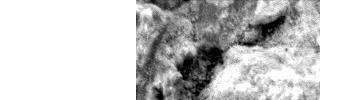


At top is what appears to be a diamond shaped body cast, or molting.
At the far right is a circular 'starfish' shaped object partly buried. 'Starfish' shapes are seen at the soil surface of Eagle crater on Mars; Meridiani Plains, and the surrounding plains. This object changes shape and molds to the surface of objects to which it attaches itself. It changes the arm shape and length much as a modern Earth starfish or octopus does. It apparently moves to a vertical orientation if turned. It appears to be the object which inhabits one end of the functioning, embedded and buried spheres, or 'blueberries'.
At the far left is a tube with a segmented hollow interior, and a mineral crusted exterior. It is still buried where uncovered and it appears to be related to the 'rod and collar' assembly upon which the spheres attach themselves.
The sphere at the bottom of the photo has been broken from the tubule and the attached starfish shape is exposed to view. Only the outline is visible in this example, due to glare. The eight to ten arms double in number as the 'starfish object develops, or, each are comprised of two end parts originally, as the two 'claws' of an insect.
The two 'dimples' and central ridge are easily visible in this sphere. This is a developing 'rod and collar' tubule assembly with the two arching arms formed onto the surface of the sphere coating. The arms sometimes resemble a pair of wings sweeping back from the attachment area of the sphere and tubule. Most do not show the shapes due to the shiney surface coating which is common with the embedded and buried spheres.
Spheres on the soil surface, whether they originated under, or at, the surface, do not have this coating. It apparently weathers away. (Many of the spheres show areas of penetration and surface attack with some of the objects causing degradation still attached. The spheres seem to decay rapidly at the surface. The biological activity on Mars is very effective in conditioning the surface.)
The 'starfish' shapes somtimes resemble termite bodies with starfish arms, a two lobed head with a ridge blade, or 'cockscomb', down the center, and, a multiple lobed body section with perpendicular creases. Others resemble a sphere, hemisphere, or a cubic shaped hemisphere, and 'starfish' arms. The arms can be short round lumps, flower petal shaped and thin, conical and curved of various lengths, or extended as an octopus 'cape'.
Multiple thin threads are found hanging and lying in the soil.
Long 'bead strings' the length of the threads are everywhere throughout this location. They carpet a large part of the soil surface of areas photographed at both locations. Some are crystalline and mineral assemblies, some appear to be plant, fungal, or bacterial.
Worms and tranparent gelatenous masses with light and black toned irregular shaped sections looking like water globules are found near small stones in many of the photos. Ice is common surrounding many plant and insect creatures.
Plant like webbing of various types is in most all photos.
Plaques similar to lichen, and fungi, are seen at the surface in most of the locations traversed.
Further sampling will reveal how many types of spheres, worms, 'starfish', and other plant and animal items can be found on Mars. They comprise a fossil record in stone and are living on the surface and below in protected zones. Entire physical living structures are built underground by some of these currently living creatures.