1810 entered Trinity College, Cambridge
1814 graduated
1817 received MA from Cambridge
1820 founded Analytical Society
1823 started work on the Difference Engine
1833 began work on the Analytical Engine
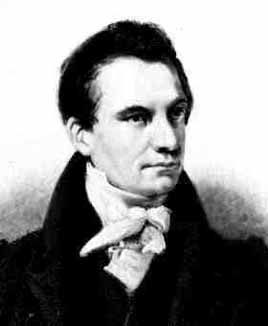
Charles Babbage (1791-1871)
Charles
Babbage was born in Teignmouth, Devonshire on 26 December 1791, son of a wealthy
London banker.
|
|
1810 entered Trinity College, Cambridge 1814 graduated 1817 received MA from Cambridge 1820 founded Analytical Society 1823 started work on the Difference Engine 1833 began work on the Analytical Engine |
Charles Babbage
http://www-history.mcs.st-andrews.ac.uk/history/PictDisplay/Babbage.html
[Accessed 23rd October 2004]
Babbage was
frustrated at the many errors he found while examining calculations for the
Royal Astronomical Society, so much so that he declared “I wish to God these calculations had been performed by steam!”
Inspired by his own words, in 1823, he began trying to automate the
calculating process.
His first steam driven calculating machine, the Difference Engine, was never realised, due to a number of financial and other problems.
|
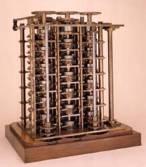
The
design specification for the full size Difference Engine No. 1 required an
estimated 25,000 parts which would have had a combined weight of some
fifteen tonnes.
The Engine, if completed would have stood eight feet high, seven feet long
and three feet in depth. Babbage hired Joseph Clement, a skilled toolmaker
and draughtsman, to build the Engine. This portion of the Difference
Engine, 'the finished portion of the unfinished engine', was completed in
1832 and is among the most celebrated icons in the prehistory of
computing. It is the oldest surviving automatic calculator and among the
finest examples of precision engineering of the time. |
|
This
portion of the engine, assembled by Joseph Clement in 1832, is the first known
automatic calculator. It represents about one seventh of the calculating
mechanism of the full size engine which was not completed. The portion shown has
nearly 2,000 individual parts.
http://www.sciencemuseum.org.uk/on-line/babbage/page3.asp
[Accessed 23rd October 2004]
However,
not to be put off, in 1833, Babbage began work on his next machine, the
Analytical Engine. He worked
closely with his assistant Augusta Ada King, Countess of Lovelace and daughter
of the poet Lord Byron. Again, like
the Difference Engine, this machine was not built in Babbage’s lifetime, due
to the complexity and cost of its 50,000 components, which required precision
engineering.
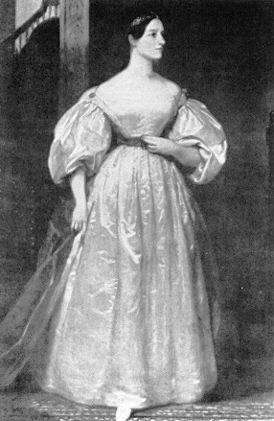
Augusta
Ada, Countess of Lovelace – First female computer programmer!
http://www.agnesscott.edu/lriddle/women/love.htm
[Accessed 23rd October 2004]
|
The
detailed plans drawn up by Babbage described the machines five logical
components: store, mill, control, input
and output. In
Babbage’s own words the store,
which could hold a thousand numbers of up to 50 decimal digits in length,
would contain “all the variables
to be operated upon, as well as all those quantities which had arisen from
the results of other operations”.
The mill was the place
“into which the quantities about
to be operated upon are always brought”. |
 |
Portion
of the mill of the Analytical Engine with printing mechanism, under construction
at the time of Babbage’s death.
http://www.sciencemuseum.org.uk/on-line/babbage/page5.asp
[Accessed 23rd October 2004]
The
control unit was based on a device used in Jacquard looms, and controlled by
punched cards. Each card contained
an instruction, such as “Transfer data
from mill to store”, along with information as to where in the mill
the piece of data was to be retrieved from, and where in the store
it was to be stored.
Each
operation of which the machine was capable (add, subtract, multiply or divide)
was also stored on a punched card. Together
these cards formed a simple set of instructions, or computer program: “Every
set of cards once made will at any time reproduce the calculations for which it
was first arranged”.
This
was therefore the first machine for which the processing was directed by an
external program. Output was also
via punched cards.
Lady
Lovelace created the instruction routines that would have been fed into the
computer, making her the first female computer programmer.
The
Analytical Engine was finally built in 1906 by Henry Babbage, the son of
Charles. It is now housed in the
Science museum in London.
The
Analytical Engine weaves Algebraical patterns just as the Jacquard loom weaves
flowers and leaves.
(Augusta
Ada, Countess of Lovelace, on Babbage’s analytical engine)
To read review of connected sites, click here Website Reviews
References
The
Open University (2003) M150 Data, computing and information, Unit 6 ‘The
structure of hardware and software’, Milton Keynes, The Open University.
http://www-history.mcs.st-andrews.ac.uk/history/PictDisplay/Babbage.html
[Accessed 23rd October 2004]
http://www.sciencemuseum.org.uk/on-line/babbage/page3.asp
[Accessed 23rd October 2004]
http://www.agnesscott.edu/lriddle/women/love.htm
[Accessed 23rd October 2004]
http://www.sciencemuseum.org.uk/on-line/babbage/page3.asp
[Accessed 23rd October 2004]
http://www.bbc.co.uk/history/historic_figures/babbage_charles.shtml
[Accessed 23rd October 2004]