Back to Nazca Land
Back to the Word Zone
Ricard Nixon
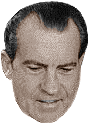
by Dan Rustine
Richard Milhous Nixon was the thirty-seventh president of the United States of America. He brought us out of a war, brought us closer to peace with the Communists, and helped pull us through an economically hard time. Nixon was the only president to ever resign in disgrace, for a small incident his underlings did. Today, presidents do worse things, and are re-elected.
Nixon was born in Yorba Linda, California in 1913. He was the second of five sons. Brought up as a Quaker, he played the church organ. After high school, he went to a Quaker college, and then went on to law school. He graduated with honors, and began practicing law. Then Patricia Ryan, a high school teacher, came into his life. They were married soon after.
World War II began, and Nixon got a commission in the Navy. He served as a Lieutenant Commander in the Pacific. After the war, he went home, and then ran for Congress as a Republican. Nixon used an anti-communist campaign, as his opponent was receiving aid from a leftist group. This gave Nixon the support he needed, and he won.
Once in the Capitol, he was assigned to a commitee that was investigating a pair of men in the government who were suspected of being spies for the communists. Nixon personally insisted that they be further investigated when the others wanted to dismiss the case. This led to the pair being convicted, and this case, called the Hiss Case, won the freshman Congressman national acclaim.
When the chance came up, Nixon ran for one of California�s Senate positions. He again used anti-communist ads, and it again won him the race. He became the US�s youngest Senator at 38.
When Eisenhower ran for President, he chose the upcoming Nixon as his running-mate. This dynamic duo went to the White House, and stayed there for eight years. Nixon was an active Vice President, present at the cabinet and international meetings. Several times when Eisenhower could not rule due to his health, Nixon took over.
In 1960, Nixon decided to run for President himself. Running against John F. Kennedy was difficult, and Nixon lost, by very little. Kennedy received 49.71% of the popular vote, and Nixon 49.55%. Nixon blamed his loss on irregularities in Texas and Florida voting. What with this, and recent voting events, one must wonder about Floridians competence as voters.
Two years after this defeat, Nixon was again beaten. This time his defeat was in his home state of California, where a Democrat took the Governorship Nixon sought. Nixon decided to leave politics at this time, and returned to practicing law.
He spent this time while he was not in office campaigning for Republican candidates all across the country. This campaigning strengthened the party�s position, and earned Nixon more fame and support, as well.
When he decided to run for President, he met with little opposition in the party. He won the nomination, and then went on to run for President. His campaign called attention to all the failures the past Democratic administration had. He beat Hubert Humphrey only barely, and took office in 1969. In his inaugual address on January 20, he said, �Let us go forward, firm in our faith� sustained by our confidence in the will of God.�
Nixon took office in the midst of the Vietnam War. Soon after becoming President, he began pulling troops out of the controversial war. He used his experience in foreign affairs from his days as Vice President and Congressman, and travelled more than any other President. As well, Nixon is remembered for passing a law that made 18 the legal voting age.
During the Nixon Administration, there were many social changes. The Vietnam War was a sources of strife, and from it sparked many protests. At the same time, the hippie movement arose. Moral values all across the board shifted towards being more liberal. The famous Roe versus Wade case was handled during Nixon�s time as President, making abortion legal, though Nixon had nothing to do with it.
The economy was a major problem for Nixon. Inflation was quite bad. Between 1970 and 1980 many prices doubled. The economy was stagnant as well, and this led to an increase in unemployment. It became so severe that Nixon had to freeze all prices and wages so that it would not worsen. His efforts were of little avail, however.
In 1972 Nixon ran for reelection. He was again easily nominated by the Republican party, and ran against the Democratic Governor of Alabama, George McGovern. McGovern promised peace, and more liberal policies. Nixon claimed that peace in Vietnam was at hand, and won the election with 60% of the votes.
During his second term, Nixon did manage to end US involvement in Vietnam. Nixon signed treaties of friendship with China, and as well he signed important agreements with the U.S.S.R., dealing with limiting nuclear weapons. This period of better relations with the communist powers was called the Detente.
On June 17, 1972, five men broke into the Democratic Party�s national headquarters in the Watergate Apartments in Washington. One of these men worked for the commitee for Nixon�s reelection. A security guard there noticed something was going on, and called the police. The police came, and arrested the burglers.
An in-depth investigation followed. The Washington Post, and Judge John Sirica called for this investigation. One of the burglers decided to cooperate. This started the ball rolling, and others confessed. John Dean, a close presidential adviser, admitted to aiding in the attempt to cover up White House involvement in the burglery. The trail of evidence then led to the Attorney General, and other officials close to Nixon, who all were forced to resign, and went to prison.
Nixon fought these investigations as they came closer and closer to him. In a famous televised speech, he said, ��I welcome this kind of examination. People have got to know whether or not their President�s a crook. Well, I�m not a crook.�. It eventually came to his refusal to surrender tapes of his conversations in the Oval Office. Someone attempted to erase parts of them, but finally, the Supreme Court ordered Nixon to give them over to the Prosecutor. On these tapes his voice can be heard, ordering some cover up of the burglery. This was the evidence needed, and Nixon resigned on August 9, 1974, before Congress could vote on bringing impeachment charges to him. The nation was shocked. His Vice President, Gerald Ford, took over. Ford granted Nixon a full pardon soon after he was inaugurated.
Nixon did the nation a great deal of good. Indeed, he did the entire world good with his foreign policy, and good diplomatic ideals. A weak president could not have eased the Cold War as he did. His leadership during the period of economic hardship was admirable, and the results of such were not seen right away. What he did was something that I believe that all Presidents do; using the resources at their disposal. His underling were sloppy, and that was the problem. As far as his lying to the people, I believe that such is necessary at times in politics, to keep the country running. It is tragic, I think, that he was, and, even to this day, is seen as a criminal.
Bibliography
Compton�s Encyclopedia, Volume 16, Comptons Learning Company, 1991
http://www.whitehouse.gov/history/presidents/rn37.html
Theresa Buskey, History and Geography 809, Alpha Omega Publications, Chandler, AR, 1999
The Great Republic, D.C. Heath and Company, Lexington, MA, 1992
World Book, 1991
Back to the Word Zone