
  
Behavior:
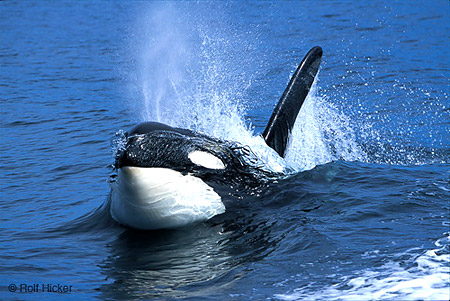
Orcas are highly social animals that travel in groups called pods. Pods usually consist of 5 to 30 whales, although some pods may combine to form a group of 100 or more. Orcas establish social hierarchies, and pods are lead by females. The animals are thought to have a complex form of communication with different dialects (slightly different language) from one pod to another. Killer whales live in cohesive long-term social units called pods. The size of a pod usually varies from fewer than 5 to about 30 individuals. Pod sizes may change with different geographic locations; off Alaska and Antarctica, groups of more than 100 animals have been seen. Pods usually consist of males, females, and calves of varying ages. Females and juveniles generally remain in the center of the pod, while adult males swim at the wings. A pod is not the smallest or largest social group in a killer whale community. Researchers have identified the most fundamental social units in a resident pod as maternal groups. A maternal group consists of a mother and her offspring (not including adult daughters with offspring of their own). One or more maternal groups may travel together in a subpod. Whales in a subpod are likely to be closely related; a subpod contains mothers and daughters, and probably sisters and cousins.
|
 |
Food:
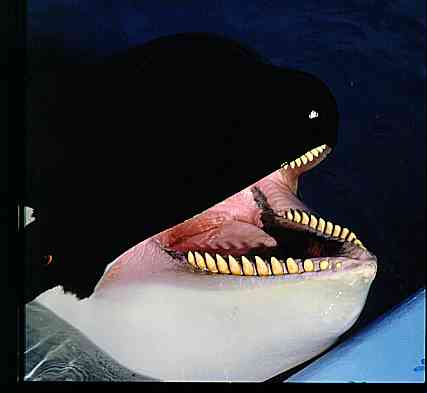
Like dolphins, orcas use echolocation - bouncing sound off of objects to determine their location - to hunt and use a series of high-pitched clicks to stun prey. Orcas feed on fish, squid, birds, and marine mammals. Orca pods often work together to catch a meal. Pods sometimes will force many fish into one area and take turns feeding or will beach (slide out of the water onto the shore) themselves to scare seals or penguins into the water where other whales are waiting to feed. Fishes, squids, seals, sea lions, walruses, birds, sea turtles, otters, penguins, cetaceans (both mysticete and odontocete), polar bears, reptiles, and even a moose - they have all been found in the stomach contents of killer whales.
The diets of killer whales vary from one region to another.
| • |
In the Antarctic, killer whales eat about 67% fishes, 27% marine mammals, and 6% squids. |
| • |
In the Bering Sea near Alaska, they eat about 65% fishes, 20% squids, and 15% marine mammals. |
| • |
The diets of resident and transient killer whales differ as well. Resident pods eat a wide variety of fishes and rarely seek out marine mammals. Transient groups primarily eat marine mammals and occasionally eat fishes. |
|
 |
Threats:
Recent studies have found that orcas are among the most contaminated marine mammals in the world. Pollution and chemical contamination make orcas more susceptible to disease and likely cause reproductive difficulties.
Killer whales have no natural predators (they are the top predators of the oceans) and can live to about 50-80 years old. Killer whales have been hunted by humans but not with enthusiasm as it takes 21 killer whales to produce the same amount of oil as 1 sperm whale |
 |
Habitat:
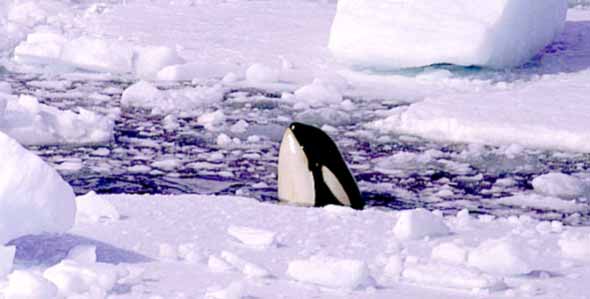
Next to humans, killer whales are the most widely distributed mammal. Killer whales inhabit all oceans of the world but are most numerous in the Arctic, the Antarctic, and areas of cold water upwelling. They can be sporadically sighted along the shores of Washington, Oregon, California, and Baja California and along the eastern coast of the United States.
In addition to cold water areas, killer whales also have been seen in warm water areas such as Hawaii, Australia, the Galapagos Islands, the Bahamas, and the Gulf of Mexico. Such sightings are infrequent, but they do demonstrate the killer whales' ability to venture into tropical waters. Even more surprising, killer whales have been seen in fresh water rivers around the world such as the Rhine, the Thames, and the Elbe. One even traveled some 177 km (110 mi.) up the Columbia River to eat fish.
Although killer whales can be found in both the open ocean and coastal waters, they primarily inhabit the continental shelf in waters less than 200 m (656 ft.) deep. In cold water areas, their distribution is limited by seasonal pack ice.
|
 |
Reproduction:
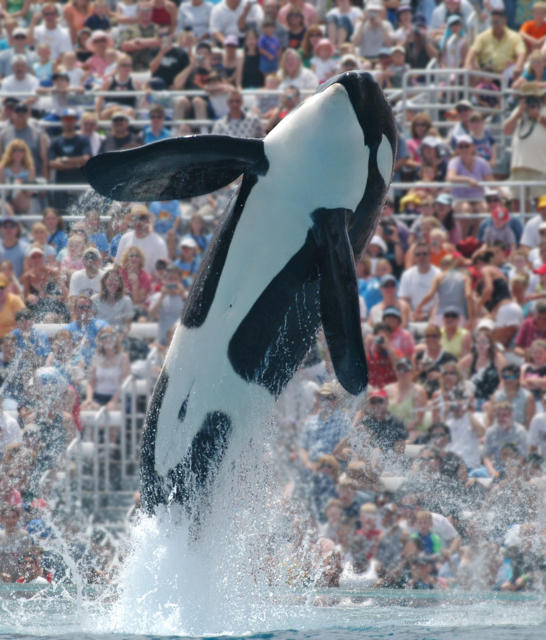
Field studies on many aspects of killer whale reproduction are not available, yet much has been learned at marine life parks. Studies of killer whales in marine zoological facilities suggest that females become sexually mature when they reach 4.6 to 4.9 m (15-16 ft.), at about 6 to 10 years. Males usually become sexually mature when they reach about 5.5 to 6.1 m (18-20 ft.), at about 10 to 13 years. In the SeaWorld Adventure Park system, one male successfully mated at approximately 7.5 to 8 years of age. In the wild, social factors greatly influence a male's breeding success. Males may not successfully reproduce until they are much older, larger, and more able to compete with other males.
|
 |
Resources:
1.http://nmml.afsc.noaa.gov/education/cetaceans/killer2.htm
2.http://www.whaletimes.org/whakw.htm 3.http://www.kidsplanet.org/factsheets/orca.html
|
 |
|