
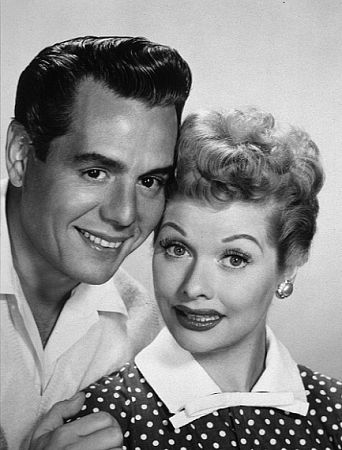
(1911-1989), actor
Her early attempts to find a place in the theater all met with rebuffs, and she took a job as a model under the name Diane Belmont. She was moderately successful as a model, and a poster on which she appeared won her spots in Roman Scandals (1933), Blood Money (1933), Kid Millions (1934), and other movies.
She remained in Hollywood to appear in increasingly larger roles in a succession of movies--Carnival (1935), Stage Door (1937), Room Service (1938), Five Came Back (1939), and Too Many Girls (1940), in which she starred and which also featured the popular Cuban bandleader and actor, Desi Arnaz, whom she married in 1940.
For 10 years they conducted separate careers, he as a bandleader and she as a movie actress who was usually seen in B-grade comedies. She won major roles in The Big Street (1942) with Henry Fonda, Du Barry Was a Lady (1943), Without Love (1945), Ziegfeld Follies (1946), and Sorrowful Jones (1949) and Fancy Pants (1950), both with Bob Hope. All of her comedies were box-office successes, but they failed to make the most of her wide-ranging talents.
In 1950 she and her husband formed Desilu Productions, which, after experimenting with a radio program, launched in October 1951 a television comedy series entitled "I Love Lucy." Starring the two of them in a comedy version of their real lives, the show was an instant hit, and, for the six years (1951-56 and, under the title "The Lucille Ball-Desi Arnaz Show," 1957-58) during which fresh episodes were produced, it remained at or near the top of the TV ratings. "I Love Lucy" proved to be an outstanding vehicle for Ball's exceptional comedic talents.
As the character "Lucy," a wisecracking housewife who regularly concocted schemes to get herself out of the house, Ball showcased her expertise for timing, physical comedy, and range of characterization. The show also introduced several technical innovations to television broadcasting (most notably the use of film instead of videotape) and set the standard for situation comedies, thriving in reruns for decades after.
Meanwhile Desilu acquired RKO Pictures, began producing other shows for television, and became one of the major companies in a highly competitive field. Ball and Arnaz were divorced in 1960, and two years later she succeeded him as president of Desilu, becoming the only woman at that time to lead a major Hollywood production company. She starred in the Broadway show Wildcat in 1961 and returned to television in "The Lucy Show" (1962-68).
She resumed movie work with Yours, Mine and Ours (1968) and Mame (1974). In 1967 Ball sold Desilu and formed her own company, Lucille Ball Productions, which produced her third television series, "Here's Lucy" (1968-74). She continued to appear thereafter in special productions and as a guest star. In 1985 she played a Manhattan bag lady in the television film "Stone Pillow." Her fourth television series "Life with Lucy" aired for two months in 1986.
She died in Los Angeles, California, on April 26, 1989. Bibliography. Biographies include Warren G. Harris, Lucy & Desi (1991); Coyne Steven Sanders and Tom Gilbert, Desilu: The Story of Lucille Ball and Desi Arnaz (1993); and Kathleen Brady, Lucille (1994).
Copyright � 1999 Encyclop�dia Britannica, Inc.