| The Periodic Table |

|
 |
|
|
|
|
|
|
|
|
|
|
|
 |
 |
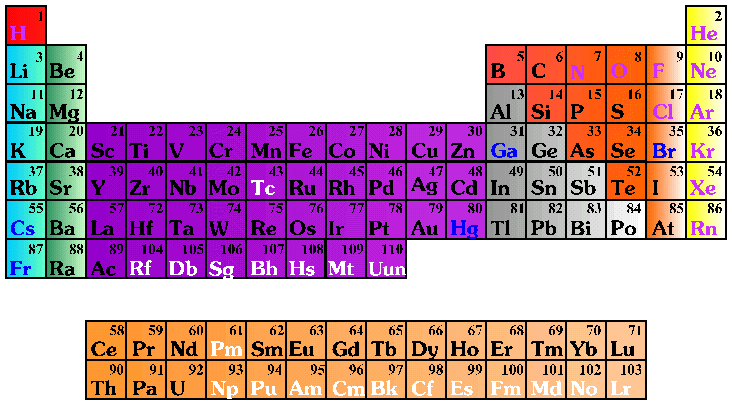
| other nonmetals |
 |
| rare earth metals |
 |
| Synthetic |
 |
| Gas |
 |
| Transition Metals |
 |
| Halogens |
 |
| Liquid |
 |
| Alkali Earth |
 |
| Noble Gas |
| Li |
| Solid |
 |
| Alkali |
 |
| Other Metals |
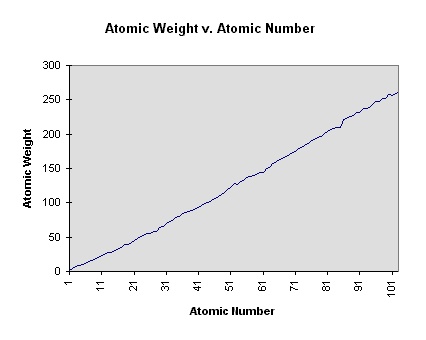 |
| This graph shows the relationship bewtween the atomic number and the atomic weight of an element. As atomic number inreases, so does atomic weight. This is because the atomic number of an element is equal to the number of protons. Elements with a higher number of protons are going to weigh more than elements with a fewer number of protons most of the time. |
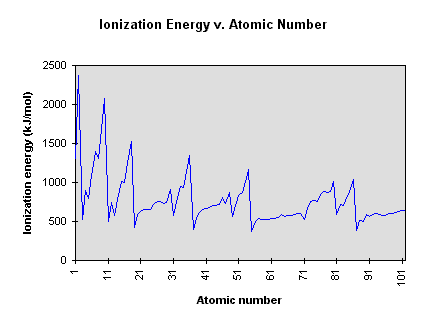 |
| This graph shows the relationship between ionization energy and atomic weight. An element with a ceratin amount of electrons has a certain ionization energy. |
 |
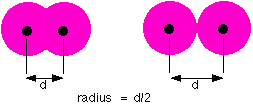 |
| ---D-- ----D----- Radius=D/2 |
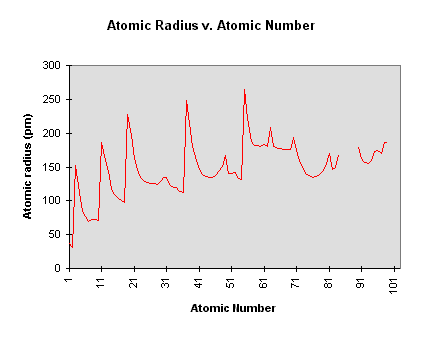
| Unlike a ball, an atom does not have a fixed radius. The radius of an atom can only be found by measuring the distance between the nulei of two touching atoms, and then halving that distance. The diagram on the left shows two bonded atoms. They are pulled closely together and so the radius is less than if they were jsut touching. These two atoms are "squashed" The diagram on the irght shows what happens if the two atoms are jsut touching. The attractive force is much less, so the atoms are "unsquashed" |
| Some Cool Links |
 |
| . |
| . |