"For the Fallen" |
With proud thanksgiving, a mother for her children, Laurence Binyon (1869-1943) |
"For the Fallen" |
With proud thanksgiving, a mother for her children, Laurence Binyon (1869-1943) |
|
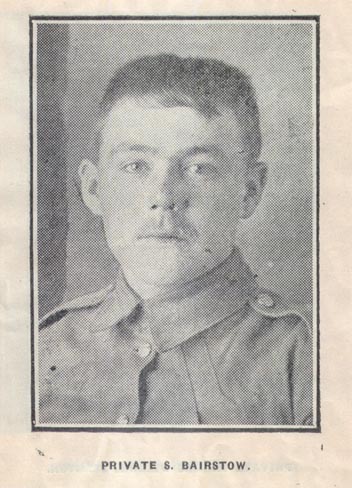
This page is dedicated to the men who fought and died in the Great War (1914-1918), especially one particular soldier, Sutcliffe Bairstow, who died on the 4th of June 1915 in Gallipoli, at the ripe old age of 19, and who's body was never found. Sutcliffe was my great-uncle who had been killed many, many years before I was born. There aren't any people left now who personally knew Sutcliffe, and the living members of my large, extended family know very little about him, only that they had been told he was a 'nice, gentle, well-mannered' young man,(as so many of that day and age were), before he went off to the war he was never to return from. There are no family photographs of Sutcliffe. He has no grave, or grave stone. He is just a name,amongst thousands of others, on the War Memorial in Oldham town centre and on the memorial at the War Cemetery in Helles in Turkey. This section of my homepage is for him. Updated Tuesday, 23rd April 2002 Since Friday of last week I have found quite a bit more information about Sutcliffe. Including a photograph and the announcement of his death in the Oldham Evening Chronicle and a small photograph which appeared in the paper at that time. The archives of the Oldham Evening Chronicle are held on microfilm at the Oldham Local Studies Centre, Union Street, Oldham. (Tele: 0161 911 4654)
Death
Announcement in the Oldham Chronicle (where the above picture first
appeared) Private (1662) Sutcliffe Bairstow, 4 Sarah Moor, off Henshaw Street, Oldham was killed on or about June 21st. He was only 19 years of age and had been in the Territorials for about two years. He had been a member of the Royton Brass Band since he was seven years of age and played at the Royton Cricket Club Sports on the Monday afternoon of the week in last August when the battalion was mobilised, and since he landed in Egypt he had played in the regimental band. In civilian life he was a big piecer at the Industry Mill, Royton. He was the only support of his mother.
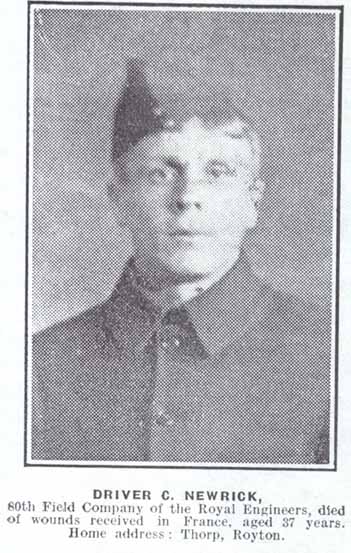
How I came to dedicate this page to Sutcliffe is a story in itself. One week at the end of May 1999, I had been surfing on the internet looking for information and good pages about a musician I am interested in. For some reason, everywhere I went on the internet I ended up at pages about the First World War. No matter where I started from, or where I was hoping to get to, the First World War kept coming back. All week this happened to me. I mentioned this to a friend, and said how strange it seemed that this was happening. On the Friday night of this particular week, it had happened again, I ended up at a page that had a link to the War Graves Commission, which I followed. There's a search facility there, so you can see if there are any details about someone you know. I typed in the name of the only person I do know who had died in any war... Sutcliffe Bairstow. The date I found the information below was Friday the 4th of June 1999, (time 11:55 pm). As can be seen below, Sutcliffe died on Friday the 4th of June 1915. Strange? I think so. Updated again on Tuesday, 5th November 2002 Since finding Sutcliffe's details I have become increasingly interested in researching my family history. This has led to me finding details of Cornelius Newrick, an elder brother of Sutcliffe's, who also died in the first war. Cornelius died aged 37 years old on the 22nd October 1915 in France.
|
This is what I have found: |
In the perpetual care of
the Commonwealth War Graves Commission
|
1st/10th Bn., Manchester
Regiment Friday 4 June 1915. Remembered with honour |
In Memory of 50898, 80th Field Coy., Royal Engineers Remembered with honour |
Commemorative InformationCemetery: HELLES MEMORIALTurkey Location: The Helles Memorial stands
on the tip of the Gallipoli Peninsula. It takes the form of an obelisk
over 30 metres high that can be seen by ships passing through the Dardanelles.
Historical Information: The eight month campaign
in Gallipoli was fought by Commonwealth and French forces in an attempt
to force Turkey out of the war, to relieve the deadlock of the Western
Front in France and Belgium, and to open a supply route to Russia through
the Dardanelles and the Black Sea. The Allies landed on the peninsula
on 25-26 April 1915; the 29th Division at Cape Helles in the south and
the Australian and New Zealand Corps north of Gaba Tepe on the west
coast, an area soon known as Anzac. On 6 August, further landings were
made at Suvla, just north of Anzac, and the climax of the campaign came
in early August when simultaneous assaults were launched on all three
fronts. However, the difficult terrain and stiff Turkish resistance
soon led to the stalemate of trench warfare. From the end of August,
no further serious action was fought and the lines remained unchanged.
The peninsula was successfully evacuated in December and early January
1916. The Helles Memorial serves the dual function of Commonwealth battle
memorial for the whole Gallipoli campaign and place of commemoration
for many of those Commonwealth servicemen who died there and have no
known grave. The United Kingdom and Indian forces named on the memorial
died in operations throughout the peninsula, the Australians at Helles.
There are also panels for those who died or were buried at sea in Gallipoli
waters. The memorial bears more than 21,000 names. There are four other
Memorials to the Missing at Gallipoli. The Lone Pine, Hill 60, and Chunuk
Bair Memorials commemorate Australian and New Zealanders at Anzac. The
Twelve Tree Copse Memorial commemorates the New Zealanders at Helles.
Naval casualties of the United Kingdom lost or buried at sea are recorded
on their respective Memorials at Portsmouth, Plymouth and Chatham, in
the United Kingdom |
Commemorative InformationCemetery: CORBIE COMMUNAL CEMETERY Somme, France Grave or Reference Panel Number: Plot I. Row B. Grave 38. Location: Corbie is a small town 15 kilometres east of Amiens. Go north from the town centre taking the D1 (Rue Gambetta) in the direction of Bray. You will arrive at a set of traffic lights with the hospital diagonally on your left. Continue, taking the second turning on your right onto the Rue des Longues Vignes (VC6). The cemetery lies about 800 metres on the left. Historical Information: Corbie was about 20 kilometres
behind the front when Commonwealth forces took over the line from Berles-au-Bois
southward to the Somme in July 1915. The town immediately became a medical
centre, with Nos 5 and 21 Casualty Clearing Stations based at La Neuville
(the suburb across the Ancre) until October 1916 and April 1917 respectively.
In November 1916 the front moved east, but the German advance in the
Spring of 1918 came within 10 kilometres of the town and brought with
it field ambulances of the 47th Division and the 12th Australian Field
Ambulance. The communal cemetery was used for burials until May 1916,
when the plot set aside was filled and the extension opened. The majority
of the graves in the extension are of officers and men who died of wounds
in the 1916 Battle of the Somme. The remainder relate to the fighting
of 1918. The communal cemetery contains 249 First World War burials,
the extension 918. The extension was designed by Charles Holden. |
Thanks to the Commonwealth War Graves Commission for their very worthy work in keeping the graves of our boys and men in the condition they truly deserve to be in.