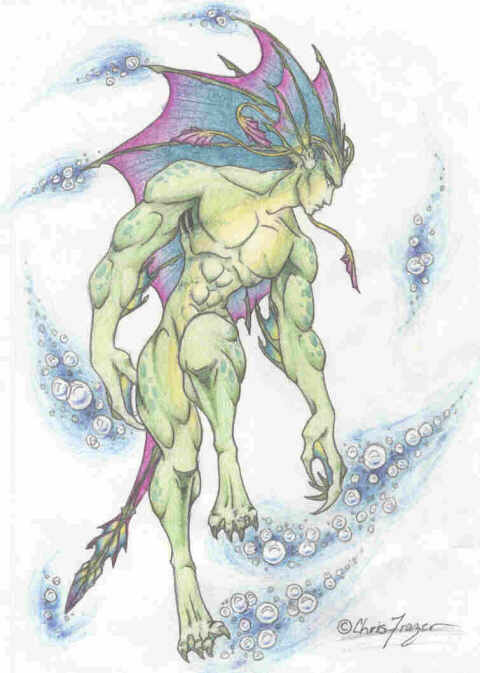
 Triakis
Triakis
It is a dream in the depths.
Everything moves with the slow deliberateness of sleep, from the giant
kelp forests looming shadowy in the distances, to the lazy winding eel in the
underwater caves. From far, far
overhead comes the suggestion of light, but it is lost within a hundred feet of
the surface. The world above is
enshrouded in night. The world
below is as it always is: salt water and invisible currents, cold water and
lethargy.
And then there is movement.
Fast, sleek, agile, a streamlined shape cuts
up from the depths of the dark, vast ocean.
Hunter hunting, it is too quick for the eye to fully realize.
There is a suggestion of fins, of a lean body shaped by and shaped for a
watery life, and then a lash of the—tail?
Legs?—sends it darting in another direction, negotiating waving stalks
of kelp easily. Too late, the eel sees it coming. A lash of its ribbon-thin body loops it about, and already
the undulations that would carry it to safety are working down its body, but
then its pursuer whips its tail-fin as what had once been pectoral fins unfold
from its body. Thus does it resolve
into a man-shape, at least from the waist up, the arms once folded across the
chest, such that the backswept razor-edged fins that lined its forearms had
served to steer its path. Even as
the eel makes this realization somewhere deep in its dull mind,
something—jaws, a harpoon, a taloned…hand?—sears out and closes about the
tail.
The prey thrashes.
The predator holds firm.
Almost silently, gracefully, the pair dance
the death-dance, their movements as muffled and cushioned as sound.
But there is one movement that is not buffered in the slightest bit.
A flick of what must be the wrist; a slash from the opposite arm-fin up,
up, viciously up, and the eel is bleeding.
A reverse-blow, a slice of the arm back down, and the eel is dead,
floating gently on the currents that eddy about the pair.
There is stillness.
Gently, the streamlined fish’s body bends, and what had been a tail-fin
separates into a pair of legs, each bearing a backsloping fin on the outer calf,
and another on the outer thigh. Still
gripping its prey, the water-creature begins its ascent to the dim starlight.
It breaks the surface, water-slicked,
shining, and a toss of its—his—head
scatters crystalline droplets of water in all directions.
Along his neck, the gill slits seal firmly shut.
His nostrils flare and he takes his first breath in seven turns of the
skies, expanding the little-used lungs. His
cephalic fin folds down for a moment, wringing water away, before it snaps erect
to display a crest splashed with reds and oranges.
A slow stroke, arms flashing and glittering, takes him to the
not-so-distant shore. As his feet
touch bottom, the fins along his legs fold back, laying so flat against his body
that they were almost indistinguishable.
There is a wind rising, and it smells the way
it always does: like salt. Like the
ocean. It is a cold wind, but he
does not shiver. His is a cold
world, and his blood, cold as well.
He wades out of the sea that stretches behind
him as far as the eye can see, black and breathing.
He leaves a trail of water, the tail of the eel dragging over the sand.
In the starlight, his body is revealed to be entirely hairless, entirely
covered in shining scales, the iridescent hues ranging from green-tinged yellow
to blue-tinged green to purple-tinged blue, and back.
Starlight?
No. Galaxy-light.
His planet circles far, far from its powerful star, so powerful that
though it hangs no larger than Earth’s Evening Star in the sky, it gives the
light of Sol. His planetary system
is alone, apart, distanced from any other.
In the night, there are no stars to see.
There are galaxies instead, hundreds, thousands, scattered across the
black sky. Some are so distant that
they are naught more than indistinct patches of light; others, great elliptical
glitters, or spiraling pinwheels cast across half the heavens.
He lifts his many-hued eyes to that
magnificent, austere sight now, the great dorsal fin folding flat upon his
spine. The skies of his world have
a bleakness, a solitary and austere beauty, much like the small, scattered
patches of desert that are the only alternative to the vast, vast sea.
Much like him.
Here, all life arises in the ocean.
All life thrives in the ocean. And
all life ends in the ocean.
All life is the ocean.