|
Diego
But the seventh, incendiary bullet ended it all. It struck home in his throat and exploded. Blood and brain and tissue matter splattered everywhere. Johnathan had the good sense to take a step back, but he did not look away. He had waited a long time to see him dead. And the man had been hard to kill. Johnathan had to give him that much: Juarez de Caballero had been very, very hard to kill. Before eating seven bullets, he had been stabbed, crushed, hacked, burned, and staked an inch from his heart. All while blind drunk on intoxicated blood. Johnathan was covered in that blood now. Drenched through. It felt good. Dead at last, you sonofabitch. His mother, god rest her soul, would have an aneurysm to hear him say that, but she was a hundred years dead, and he had not gone to her funeral. He watched Caballero decompose into ash, and then he stuck his gun through his belt and peeled his gloves off, feeding them through the paper shredder in Caballero’s highrise office. Taking the leather strips out the bottom, Johnathan opened the door and walked out, purposefully, not hurrying. The leather strips dripped blood slowly. It was well past midnight and the building was all but deserted. His had been the only car in the parking lot. He was tracking blood, but that didn’t matter. By this time tomorrow night he would be in Anarch California, taking in the moonlight on the beaches of Los Angeles, of San Diego. He passed a trash chute and fed it a third of the leather strips. A while later, he passed another and put another third in. The last half-handful he saved for the broken window across from the elevators. Caballero’s childe had put it there last week. Damn Brujah. No manners. Nonetheless, Johnathan enjoyed the touch of poetic irony in the gesture as he watched the last strips flap away in the wind. Then he frowned. The parking lot was no longer empty. There were four cars down there. He turned his head, looked at the elevator. The lights were moving above the doors. He turned again and looked at the trail of blood he had left. Thought of Caballero, nothing but ashes in an office now; thought of the cars outside. Johnathan didn’t curse. His mother taught him better than that. Nor did he try to run. He looked out the window at the city, his city, his home for the past forty-some-odd years. It might be the last time he ever saw it. The doors slid open behind him and half a dozen hammers cocked back. A woman’s perfume, light and insidious, filled the air. Unmistakably hers: the scent of lilies-of-the-valley. Alicia Reed, Caballero’s righthand woman. "Freeze! Hands above your head!" Oh, Alicia, he thought, laughing and wanting to cry as his gun thudded to the ground, the new Sheriff of Boston should have a better line than that.
***
He was brought before the Prince nearly five weeks later. Five weeks of living in a cage in the sewers, feeding on rats. The Nosferatu gaolers had taunted him endlessly, holding out limp dead mangled humans only to snatch them back when he reached for them. And he had reached, at first. Dead human blood was still better than rat blood, which made his stomach clench and cramp, which left a taste like shit in the back of his throat, which made his larynx burn. He had stopped reaching after the first week. Then they had prodded him with sticks and then blades, daggers and kitchen knives. He had shut his eyes and thought of Los Angeles and San Diego, of Anarchs and lilies of the valley, and eventually they lost interest and he had been left on his own. Until tonight. Tonight the electric lanterns were brought in. More light than he had seen for weeks blinded him, and blind, he was led out, led up, blindfolded and gagged and handcuffed and shoved into the trunk of a car. What seemed like hours later, he was marched down another confusing series of passageways. From the way their footsteps echoed, he could tell when the corridors opened up into a large, high-ceilinged audience hall. He was unblinded then, ungagged and unbound, and found himself blinking up at the stern, greyhaired Samuel D. Walsingham, Ventrue Elder, Prince of Boston. Flanking him were his two huge bodyguards, both aiming guns at Johnathan’s throat. He looked around and saw Alicia and her fellow deputies – no, correction. They were simply her deputies, now – standing in a row. Two more of her deputies stood at his elbows, stakes in hand. "Johnathan Frederick Mallandaine," said Walsingham, musingly, "Childe of Maximillius. Childe of Saul Riverworth, Childe of Fanuccia Gibaldilani, and on and on, back to Ventrue, eldest of all Antediluvians. I knew your Sire, you know. We expected more of you than this – killing poor Juarez in his own office. Have you anything to say for yourself?" Johnathan said nothing. To his right, one of the deputies cleared his throat. After a time, the Prince sighed and steepled his fingers, turning to the new Sheriff.
And she told him. Like a trained poodle barking on command, she told him about everything except herself. She told him about the novocaine in Caballero’s meal that night; she told him about the fire alarm that had emptied out the building. She told him about Johnathan’s contacts, the guns he had acquired, the ammunition. She told him the half-truth, and then she told him blatant lies. She told him how he had confessed his desire to kill Caballero that night, how she had tried to dissuade him, how he had left – ashamed, she thought, but who knew he was walking down Caballero’s hall not an hour later, armed to the teeth? She had gone to gather the other deputies, because Johnathan had not been himself lately, because she was frightened to go alone, being half his age and not nearly as powerful, having only her wits and her mind for defense. She told him how they had walked in too late, just in time to see Johnathan standing blooddrenched, waiting for the elevator. When she was finished, the Prince looked at him, eyebrows raised. He said nothing. If he opened his mouth, he would only damn himself further. There was nothing to say. There was no proof; he had done everything. She had only mentioned, cajoled, begged so prettily, and he had lost himself. He stared straight ahead and imagined Los Angeles, San Diego, Alicia Reed’s blood on his hands. Minutes passed. The Prince exhaled shortly, placed his palms flat on the table. Johnathan opened his eyes and raised his chin. "If you have nothing to say for yourself," said the Prince of Boston, "I have no choice but to consign you to your just and due punishment. Tradition decrees that on the morrow, Johnathan Frederick Mallandaine shall relinquish Our Father’s dark gift and burn until Final Death." The door opened. A cane tapped on the ground. Half a dozen heads swiveled, Alicia’s fastest of all. She looked, her eyes widened, and Johnathan thought he saw fear there. "Tradition decrees such," the Prince continued, "but Tradition can sometimes be bent, especially in times of war." Alicia opened her mouth; a bare gesture of the Prince’s gnarled hand closed it, and sent her and her deputies from the room as well. Johnathan did not dare to turn and look upon his Sire. When the door closed again, all was silent. "We have another use for you, Mr. Mallandaine. Atlantic City. Know of it?" Johnathan thought of Los Angeles and San Diego; he thought of revenge. He barely recognized his own voice when he spoke. Five weeks of silence and rats' blood had rendered it gravelly, rasping. He sounded, he thought, like a man who had killed the Brujah Sheriff of Boston. "Heard of it." "It was recently wrested from our hands by the Giovanni. Then they lost it, and now the Sabbat are encroaching. I have a mind to send you there, Mr. Mallandaine. To claim the city back for the Sect. Can I trust you with that?" Johnathan hesitated. "Yes, my liege." "No," contradicted the Prince, immediately, "I cannot. But it seems that I must, for our forces are pitifully small these days. With Caballero dead, the Sabbat will soon hound our heels as well. I can spare no one…save you. You will go alone, Mr. Mallandaine, unless you have friends who are foolish enough to accompany you. You will go alone and you will reclaim the city and with it, your name and status. Or, you will die. Do not think to escape me. I will have you hunted down like a dog long before you see that beloved California of yours." His shock must have shown, for the Prince smiled at last, and thinly. "You think your thoughts are not known to me? You think I do not know the truth? You think you are a contender in the game, childe? "Enjoy your stay in Atlantic City, Mr. Mallandaine. I suspect it will be rather brief. Good night." Johnathan bowed, perhaps a little stiffly, and turned away. He opened his mouth to thank his Sire, but Maximillius looked right through him. He shut his mouth. Outside, Alicia was waiting for him, alone. She took his arm and her voice was low and sweet. The scent of lilies-of-the-valley spiraled about him. "Johnathan, darling, forgive me. I did everything I could to save you. When you weren’t here, I talked to Samuel, I begged him on my knees – " He looked at her, and something in his eyes silenced her. Carefully, Johnathan extricated his arm from hers. "I may have believed you once, Ms. Reed," he said in his new, gravelly voice. He suspected it would always be with him, "but you have taught me well. There is no honor, no justice, no truth. Only the strong survive. I suppose you always knew that." She stopped walking, stood looking at him. Her eyes were cool. He turned a few paces past and met her gaze. She was beautiful, even now: her dark hair, her pale eyes. "You have always been…" he searched for the word Walsingham had used, "…a contender, Ms. Reed. But when we meet again, you will not be the only one. And it will not save you then." He walked away then, and somehow, he never looked back.
***
Atlantic City, three nights later. Johnathan watched the city roll past the tinted windows of the Escalade. Loud, garish, gaudy, blaring. Blake drove; Nadia took the back seat. His only backup now, and neither of them Kindred. The Escalade took a turn down a quieter street. Another turn, and Blake stopped the car. "Here we are, sir." Johnathan leaned forward and looked up at his new home. A two-story condo, spacious enough and certainly luxurious, but no different from a hundred others just like it gathered all around. He missed his brick-and-ivy apartment in Boston, but that didn’t matter now. "Is it all right?" Nadia asked from the back seat. He turned and offered her a quick smile while Blake got out to unload his suitcases.
Blake appeared by his side, toting three bags and two suitcases. "Should I take them upstairs, sir?" he panted. Johnathan looked at him, barrelchested, husky, greying at the temples. Then he looked at Nadia, tall and lithe, lovely as a bird. "Perhaps it would be best," he said, "if you refer to me as an equal, at least in public. If we are perceived to be a unit of three, rather than one and two servants, it is safer for all of us." They stared at him. Nadia chanced to speak first. She was always the more clever of the two, and he thought perhaps she had had the same idea long before he had. "And what should we call you?" He was quiet for a long time. He thought of Caballero, son of a Spanish prince who had survived the Moors in Granada only to die at his hand; he thought of Alicia and her promises of Southern California, of freedom, of moonlit walks in the streets of Los Angeles, on the beaches of San Diego. Reaching out, he took a bag and a suitcase, and shouldered them himself. "Call me Diego," he said, and led the way into his new home. [Scenes] |
 It
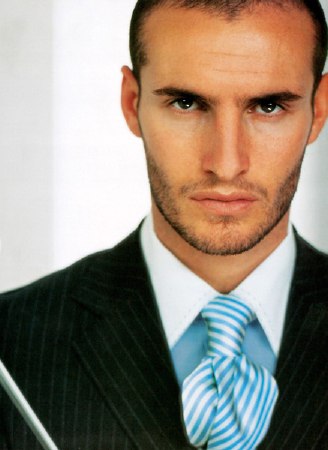
was the seventh bullet that killed him. The previous six had nearly
blasted a hand away, put a hole in each knee, one bicep, his stomach,
and taken off the top of his head. Still he kept coming, shambling on
literally in pieces, the greatsword clutched in his bloody hands still
rising for a final blow, the single blue eye still glaring out of the
ruins of his face. Still he kept coming, and Johnathan thought if he
hadn’t taken out his vocal cords long ago, he would still be roaring
obscenities and threats, too.
It
was the seventh bullet that killed him. The previous six had nearly
blasted a hand away, put a hole in each knee, one bicep, his stomach,
and taken off the top of his head. Still he kept coming, shambling on
literally in pieces, the greatsword clutched in his bloody hands still
rising for a final blow, the single blue eye still glaring out of the
ruins of his face. Still he kept coming, and Johnathan thought if he
hadn’t taken out his vocal cords long ago, he would still be roaring
obscenities and threats, too. "Ms. Reed, tell Mr. Mallandaine what you saw.
Jog his memory a little."
"Ms. Reed, tell Mr. Mallandaine what you saw.
Jog his memory a little." "It’s perfect, Nadia. Thank you."
Johnathan stepped out himself. The air of Atlantic City was warmer than
Boston’s, a little more humid, but laden with the same salt sea. He
opened the door for his female ghoul because his mother had taught him
manners, and to respect a lady.
"It’s perfect, Nadia. Thank you."
Johnathan stepped out himself. The air of Atlantic City was warmer than
Boston’s, a little more humid, but laden with the same salt sea. He
opened the door for his female ghoul because his mother had taught him
manners, and to respect a lady.