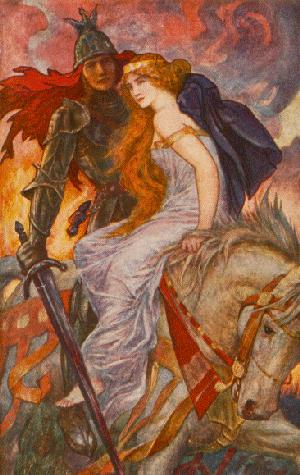
 It is a hovel of a tavern, and he is certain that the foul thin pallets they offer upstairs will be as unappetizing as the sour scent wafting from the matron who periodically emerges from the warm kitchen to snap a few harsh words at the buxom, chestnut-haired serving girl who brought him trenchers of rich meat pies and flagons of sour, bitter ale. Clean? No. Nothing is -clean- in the middle ages, where bathing is at best a luxury, at worst a duty performed perfunctorially a bare few times in a year, if that. Yet, for all the poverty of this shambling structure, the simple food is hearty, and well-prepared, the wench relatively clean, and attractive, with her laughing eyes and sleek dark hair. To be sure, it was discomfitting when a toothless Elder and slender, rat-faced man planted themselves at his table, and began a conversation in their drawling, brawling dialect of French, spilling out their troubles with a devil, a demon, a witch in the forest. Laggard harvests and crouped infants, fouled wells and endless storms, and now - now - the outrage that drives these men, this serving girl, this matron to congregate about the rough-hewn table he had chosen for himself near the comforting blaze of the fire: a young wife, struck down by the jealous demon-lover who lurks within the woods, and her slave-wolves, that crawl from their summer haunts to prowl ever-closer to the refuge of the village, lying so close to death that one wonders that she still breathes. The witch - the damned witch - had been seen hovering over the wife's supine form, gloating over her kill, performing foul enchantments in an unknown language until a shouted summons from her husband, who stumbled upon the terrible scene, had sent the hellspawn scuttling to the black depths of her web.
 The plea comes then, accompanied by the warm press of the serving girl's body against his back. The villagers lean closer, as the old man produces a patched pouch heavy with copper coin. "...please. The lord here does nothing. We're dying at its hands, Sir Knight. This is what we have to offer." ... some few copper coins, a warm peasant girl, a trencher of spiced meat pie. "The priest did say if the witch that made the spell was destroyed or cast out, the spell would lift and my daughter made whole. We beg you..."
He stirs, slowly, as though waking from a dream as the attention of those gathered turn upon him--the knight, who had fought in God's wars only to fall into hopeless sin, only to be cursed with unending youth. Perhaps he had not even heard half the conversation about him. Perhaps his eyes had been lost in the blaze of the fire, and his mind far away--on the trails of the Crusade, by the fires of the camp with Alain at his side, laughing, or even at Alain's castle in those last dark days while he grew progressively weaker, wasting away while his best friend and his beloved wife burned for each other with the fire of the blackest of hells. (Or maybe his mind was caught, snagged, upon the final moments, as Alain's hand gripped his--and hers--with a dying man's strength, and Alain's lips had whispered the words, had laid the blessings upon them, the cursed spawn of Hell that did not deserve such kindness.)
Maybe it is the grave he remembered, as cold as the Rock Alain had guarded so well. Thirty-six years to make Alain the man he was...and just a few hours, no more, for him to disappear forever. And yet--what he would not give for that anonymity; what he would not give to escape this life. What has he left? Gone, was his dearest friend--gone, were all his friends, lost to battles and disease. Gone, was Genevieve--gone from the Rock, thrown to her death in the sea below. Gone, was she whom he had loved with a love so deep it could only have been born of sin. There is nothing left...nothing but this tavern of trusting, simple folk who would never know the darkness that lies within the soul of their brave, gallant knight.
He turns, slowly, to look at the pouch, the girl, the old man. And just as lethargically, he shakes his head. "I do not want your money." I want to die. "But this witch--it is merciless? It kills those who cross its path?"
Perhaps she will kill him. Perhaps she will take her time, killing him slowly, painfully. Perhaps he will be bathed clean again in his own blood.
"Kill? Everything...?" For a moment the old man is taken aback, and eases back to lean against the stone walls, begrimed with the soot of ages, sucking lightly on his gums. "...not everyone, Sir. I am sure you could handle the demon. But if you'd seen what she did to my sweet daughter, you'd know. It's a monster of a thing, but we isn't trained in the arts of war, and..." The tension mounts within the room, and the wench at his back draws away slightly (...does he even notice?), thinking him, perhaps, a coward. The old man rattles the coins again, tapping lightly on the rucked wool.
"I don't want the money." It is almost a snarl, those words, as his hand sweeps in a tight, angry arc, sending the purse skittering from the splintering table, leaving in its wake a scatter of gleaming coins. In the next instant he is on his feet (so fast...), snatching his sword from the table--did he mean to kill them all? Who is the demon after all, and who the angel?
Yet his opposite hand reaches for the flagon as he slides the sword into its sheathe with a familiarity that belied his apparent age. The rest of the wine is thrown down, and the flagon thrust into the hands of the serving-girl (had she drawn away? No matter, he had thrown her off, anyway) as he turns to the door. "If I do not return," are the words he casts over his shoulder, "then you will know your certainties were mistaken."
The heavy door swings open, creaks closed. And he is gone.
Silence. In the ages to come, he will be haunted by the silence of this time, split only occasionally by the sonorous call of church bells rolling across the land like a great fog - to matins or nonce or vespers - silence. And the woods are silent, indeed, beneath hushed, steady fall of fat white flakes of snow, that seem an impossible gift of lightness from the churning, leaden sky in this world of endless grays and browns. Silence, but for the jingle of tack, the occasional chuff of his steed's warm breath (...how many years, how many horses, now? And does he even bother to name them, when they will grow old, old and useless, even as he remains - remains - ever-young?) Silence, the clatter of iron horseshoes is lost to the sound-dampening blanket that coats the land, and as he recedes from the pitiful blaze of the village, huddled just outside the dark growth of groping trees, it seems already dark. (...it is always dark, for once he held the sun is his arms and the moon in his heart. It is forever dark...)
And silence, too, as his winding way through the accusing trees brings him to the cottage - a hovel, really - in which the demon is said to lair. It is a pitiful thing, rank logs chinked poorly, a hinged door held shut - one supposes - by means only of the rather large bit of rock pressed in front of it. A thin stream of smoke curls from the slattern chimney, to swirl and dissipate (...like thready, gossamer webs cast to the cruel fury of the midday sun...) amidst the white, the white, the endless white.
Perhaps the Devil did not offer his wives worldly compensations beyond the chains of their foul and fetid powers, perhaps (...she awaits him even now, readying black magics, cavorting imps and monsters...) it is an illusion to fool the simple folk who walk these lands, perhaps something grander, darker, lies within, hidden by the tangle of dead vines clinging to the walls, by the walls - rough wood - themselves.
...but within? There, too, is silence, but for the hiss and crackle of a few embers dying, now, in the crude hearth. Silence, a seeping cold that hearth does little to warm. The few furnishings are as meager as the dying glow of the fire: a thin, penitential pallet, a small, battered iron cauldron, a few dried herbs, fruits, nutmeats, a bone or two cached in nooks in the crude logs of the walls, a rough trunk with a fine, fine latch, that did not belong upon so poor a vessel, some few, rude wooden buckets of water. Over the surface of the bucket farthest from the sputtering fire, a thin film of ice is already forming.
This is all, nothing more, and if this is the price of a soul, it is a poor one, indeed. This is all - at least - he has time to take in when the door is blown open once more, and a hunched, shrouded figure appears in shadow in the doorway. The devil's eyes are downcast, and the soiled, muted gold of her hair covered by the shrouding hood of the woolen cape, rucked up over her head, hidden from sight. A voice - wreathed in smoke, and heavy with the ice of the day, and empty - empty as the stretch of days before him - but surprisingly young, nonetheless - a voice, then.
"...have you come to run me through? Or will I be allowed to trudge away, into the storm, in some semblance of peace?"
His eyes take in the sight before him--such pale eyes, the pale green of the frost-choked grass--and one can only wonder at the thoughts which stir with him. What, indeed, is the price of a soul? Ask Valerai, and he will give you a low estimate for his own, indeed.
But wait. There is movement. There are words. What a familiar voice...but he has been fooled too many times by his own ears to fall victim to that trick again. Black magic? What had he to fear from it, when the worst it could give him was death and damnation? What had he to fear, when the worst was the greatest of gifts?
She speaks, but he does not. Grimly silent, the (haunted angel) knight turns to face the witch, and draws his sword. No challenge, even? Has he no words for the devil's spawn, and his own kin, before he ended her miserable life? His hand, gloved, goes to his cloak, and cloth brushes against rough cloth as a strap unloosens, and the cloak slips to puddle at his feet. Methodically, then, he loosens the layers of clothing, his wards against the chill--and what use were they, when the chill came from within? At last, he stands unshivering in a thin, open-throated tunic, and he indicates the center of his chest with one gloved hand as the other extends the sword, hilt first, toward the mistress of this pathetic hovel.
"I have made your task simple for you," he says. "You need only strike here, where my hand is. Do not falter. Drive forward hard and fast--and we will see if you, with your dark powers that can be no darker than my own curse, will succeed where I myself have failed."
She knew - she had known - when she first caught a glimpse of the horse's track through the still-falling snow that the small invasion of her terrible, solitary existance could but spell something dark and horrid for her, again. Something - bleak, and horrid, and ever-so-familiar, this gradual turning of even the kindest of folk against the cursed woman who did not age, and from whose hands flowed such power to heal. (...and if to heal, why not to harm? Certainly Old Scratch was not above disguising the true nature of his spawn with a few almost useful gifts?) How long had it been this time? Five years? Ten? The shift of days and seasons and years blurs together, now, in an endless rain of dreary time punctuated by the slow, desperate scrabble for something approaching an existance, and the movement of the year could only be measured in terms of greater and less privation, with individual moments haunted by the sweeping dull ache of loss - endless, neverdying loss - that would rush over her in unguarded moments akin to reflection, and send her stumbling to her knees, lips grasping for prayers that came to her lips like pleas from a drowning man.
Worse, perhaps, was the way she welcomed that soundless ache of mournful, sinful loss, for it shifted for a few moments the texture of the day, and allowed her escape - however momentary - from the daily exigencies of living on the barest margin. She could turn around and leave, and the shifting fall of snow would cover her passage like the night, would cover her sinful, stained passage like a blanket of purity, of virgin virtue, cast over a weak and sinful heart. He could not kill her (...she knew, oh, how terrible was that knowledge...). She would rise from her deathbed, a cursed and unworthy Lazarus from her tomb, as she had so many times before, as whatever unnatural ichor coursed through her veins repaired even the most terrible of mortal wounds. And yet - and yet - was it yet another sin to hope for the few moments of mindnumbing oblivion such an attack would bring? And what would such a small sin be, but a faint scratch against a self-eviscerated soul, betraying and abandoned, endless and lost.
Upon the threshold of her dismal shelter, then, cast into shadow by the reaching grays of the settling storm, is she, and so startled, by his words, his actions, his blessedly haunting voice (...how many times, how many cruel, cruel times had it come to her before, in an unguarded moment? How many times before had she been enraptured, fooled by other similar tones?) that she dares a startled gasp, and a tracking glance upward to settle upon the hilt of the proferred sword. Numbed, nerveless fingers unfurl from the precious bundle of almost-dry sticks hunched over one shoulder and they fall, with a dry, coughing clatter, to the floor of the muddied, frozen threshold. "Oh... oh. Do not mock me, sir."
And further, yet, track her ice-stung eyes, over his strong hand, to seek for a moment the visage of her tormenter. (...it cannot be...) There is a shadowed flash of impossible green, then - the summer sea in impossible turmoil - and a cry, low and mournful as a wounded gull, and already she is turning, is crushing a few precious juniper berries gathered to anoint her hair between the frozen fingers of her clutching hand, is casting them to the wind-lashed snow (...like blood, like staining blood...) and fleeing into the shifting white.
"Oh! Do not mock me!"
Is it his imagination, or does her sudden flight jar the shrouding hood from her coiled hair? Is that the muted shine of soiled sunlight fleeing into the dark heart of the cold wood?
It is his imagination. It is always his imagination. And yet it changes nothing--still, that same catch of breath in his throat; still, that same lurch of pulse in his chest. If only he could stop that hope from rising--if only he could stamp it down when his heart had not so far to fall-- (if only he could know how many more times that illogical recognition would come upon him in the centuries to come, when she lost from him once and for all, forever...cast away by his own hand)--but he could not.
For a heartbeat he is absolutely still, stunned by the retreat of--Genevieve, it was her, it could only have been her--the witch. And then he is exploding into motion: the hunting-hawk leaping from the falconer's fist; the eagle plunging from the sky. He is running after her, through the shambling door, to pound over the crusted white snow of the tomb-silent world.
"Wait!" A word, flung as a dagger, and arrow, shatters the silence even as the crunch of boots, and the rush of white-frosted breath, stirs the stillness. "Stay--" cast away, are all thoughts of duty, of death--thrown away, are all notions of honor and glory and God, in the face of such cruel hope, "--tarry but a moment, lady; let me see your face."
The haunting ghost of her face, a smear of finest ivory amidst the dull wet browns, the shifting gray smoke-swirl of falling dark, as for a fading dream of a moment she glances back, the pure visage of the moon luminous in the velvet night. But she gathers her rough skirts (...rough against the fineness of her frozen hands...), and continues her plunge into the circling trees, a doe flushed from a thicket by baying hounds, fleeing with such terrible, desperate grace.
Heedless of reaching brambles, of the burning cold, she flees, tossing words over her shoulder like a charm against the sweetest pain. "Nay. Nay! Destroy me - or leave, but mock me not!" Cruel as the hope of the sun in midwinter, coaxing tender shoots to the surface, for the amusement of the killing frost, this dream, this nightmare of a moment.
How quick he is to anger, to fury, to desperation. How tightly strung he is, a violin string stretched to the point of breaking, but never allowed to break--
"I mock you not!" he shouts--he screams--after her, the last, desperate cry of a dying man scorned, of an angel cast from heaven only to be offered a glimpse of the paradise lost--only to be cast into darkness again. In that moment she had turned, he had seen her--seen her--and he knew it even as he knew, just as well, that he had know it thusly a thousand times before, only to be proven devastatingly wrong. But no matter. He knew it was her, this time--it could be no other--and he races after her, leaping fallen boughs, slipping on ice only to scramble to his feet without so much as slackening a single step. Yet, as fast as he is, she is faster and with each obstacle he falls farther behind, until she is no more than a flash of muted gold amongst rough brown cloth.
How many times has she escaped like this, running into the woods and leaving nothing more than the fast-filling tracks of her footprints in the snow? How many times has she been accused, betrayed, cast to the elements--fire, water, snow? He falters in his step, slows and stops, flings the last words after the disappearing dream in one final attempt to snare the untouchable, "I know you. I know it is you! Genevieve!"
Her name is flung out into the air, a smoking cloud of white--her name is cast out into the snow, a gleaming bauble, a splash of verdant green as vivid as fresh-spilt blood.
What vicious hope snares her, in this hopeless, barren season, the winter of the world? What trail of words - chill, smoke-wreathed words - could snare the fleeting blue shadows of dawn, retreating before the burn the day? What hunter could snare his prey with but a single, hopeless plea cast into the dark like a jewel, vivid, and lush, and verdant as the haunted forest of her eyes?
...and how long does he wait, panting for bleeding, stabbing breath, alone again, alone in the endless white, the stretch of days and centuries looming before him like a bleak and wearing road (...forever. Save me from forever.) before the icy mist stirs like the breath of some great, sleeping giant, and a shadow of a vision disturbs the graceful, still white of the world.
She does not look up, lest he read the depths of hopeless sin, of sinning hope, write - hieroglyphs - in the depths of her eyes. She stirs not a glance, lest their eyes meet, that shameful fire flare to such burning life once more; lest their eyes meet, that she might find the repudiation that she so richly deserved.
"...it cannot be." White words, and hopeless as the night, hope-filled as the first kiss of dawn, cast into a white, white world.
She does not look up, but he does, so full of hope shattered and reknit that for a moment he is whole and shining, the angel of the season standing amidst the silent trees. He looks at her, takes her in--sees that she is unchanged. Not a wrinkle; not a strand of gray hair in all these years. He might have last seen her no more than a day ago, for all the change that has come upon her, and he knew that he was the same.
It cannot be. "...and yet it is," he finishes for her. So carefully, he reaches forward; so gently, he smoothes her hair from her face, straightens the coarse cloak upon her slender shoulders. "And yet it is. You. Me. I returned to the Rock, but once--they told me you were dead, cast from the cliffs. They told me--"
He breaks off. He cannot go on. For a moment his fingers, yet gloved, linger upon her hair, feeling the texture of silk through worn leather. Then he is pulling his gloves off and, as they drop to the snow, he presses his palms to her cheeks, her jaw, as his thumb traces the delicate curve of her lips.
How long has it been, since his fingers felt the fineness of her skin, that a thousand winters could not roughen? How long has he dreamt of this moment? All duties, all obligations, all faiths are forgotten and lost to the touch of her skin and he moves forward and presses his brow to hers and simply...experiences. Too long. Too long--and still they have not changed.
"...are you, then, a spirit, an angel returned to me by the grace of God?"
It is winter, and the smallest branches of the looming trees are encased in prismatic prisons of ice no more caging than the chill of trackless grief solidified over - how long? how many seasons? - years made meaningless by their unchanging grace. The nobbed, delicate fingers of the branches are caged, but at the melting kiss of the hidden sun, their prison will melt to life-giving water, even as the chains of her isolation liquify before the onslaught of shattering, singing hope. Hope. She is a hope grasped but lightly through the shrouding mists, in ever-shifting retreat from the forging heat of the sun. At once austere and wild, barely grasped by the fickle, wicked world, but burning, suddenly. Oh, burning.
A breath, then, tentative as new buds emerging in early spring, in mortal danger, in supple, bright-won defiance of mortal probabilities of a late, killing frost. A breath, impossibly warm in the cold dark, stolen and remade from his own exhalation, as the smallest tremor quakes her slender form.
"No angel. No angel." Choked, choking breath, that carries the spun-and-tarnished silver of her words. "...Damned. Death will not - death will not take me. Death will not have me. Death will..." The frozen length of her slim white hands seeks his shoulders, clutching - for a moment - with all the fervor of one drowning in quicksand, earth that once seemed solid as the night. "...spit me back as most bitter seed. Always. Oh, always. H-he died. And you left..." And how I watched the churning seas for you return. "...and eventually... eventually, they- they-..."
Some things should not be spoken.
Damned? Damned, had he once thought himself, when arrows, knives, swords and spears alike would not send him to his rest. Damned, cursed to wander this earth when Alain, his blood-brother, was long since dust upon the wind. Cursed, had he thought himself--condemned to wander this earth when even she, Genevieve, had plunged to her death--but now? She is alive. She is alive, and he is with her, and
 (Dawn is such a beautiful time--the birth of the sun, and the birth of a world.)
 hope has returned. Light has returned to a lightless world. "Genevieve." He enfolds her; embraces her; envelopes her as though the mere circle of his arms might dispel all the scars, all the horrors, that she, bewitched, has faced. Dare he apologize? A thousand apologies were not enough. And yet, perhaps... "It will be all right." (When has she heard that before, whilst his arms encircled her, and his breath flushed warm against her cheek?) "I am here. I have found you."
(Dawn is such a tragic time, laced with the knowledge that with the coming of light comes its going, and with the birth of the day comes its death...)
"We will be all right."
How much worse, then, is this simple tenderness, in painful counterpoint to the rage of fifty winters spent alone with her consciousness of her own damnation. How stark and burning, this so-vivid contrast, between the vicious circles of a hundred villages, exclusive, casting her to the vagueries of the bleak night, and the tender circle of his arms? And if she weeps, now, if she allows her weaknesses to bleed into this moment of tenderness, warm as the brush of a mother's lips over a babe's brow, it is with such gentle abandon that an observer would think her laughing in his arms.
Words, come, too, wild and bleak as the cliffs of the Rock, cast over the rage of the see, craggy, silent sentinels guarding the jewel within, the navel of her world. Words - tales, stories, fears, desperate and fierce as her hands upon his shoulders, as her golden head curled upon his chest - words, but never - never of accusation, reprobation.
"...so many nights have I dreamt thus, and prayed, and prayed, that my sinful thoughts would be stolen from my grasping, covetous soul. But - oh - my lord, how you intrude, even yet, upon my prayers, that words cannot form, without a sudden, swimming vision of your eyes upon, of your voice in my hungry ear. And, always..." But no, no, she swallows the guilty truth lest its tender rot break the slender spell of momentary spring cast by the protective wall of his arms. "...but, oh, my lord. Where do we go? What do we do?" ...is this, yet, a staining sin? This bridge of relief wider, even, than the terrible chasm of her endless grief?
Laughter--tears--two sides of the same cosmic coin tossed, end over end, from the palm of God. Laughter, tears, life, death--which would it be? For ones such as them, blessed and cursed all in one, the coin balances, ever, upon its edge, and nothing is ever certain. The world is as the mists of the Rock, shifting and inconstant, dissipating now to reveal a gleam of heartbreaking green; thickening then, until no trace of the recognizable world remains.
Centuries from now, he would stand alone upon the shore and know what it was that she had not said to him, that day. Centuries from now, he might even curse that she had told him at all. And centuries beyond centuries from now...?
Time stretches on, immeasurable, ahead of them--but for this beat of their hearts, for this beat as strong and steady as the beat of some great, fantastic bird's wings, there is nothing but the moment, nothing but trust, nothing but belief that in the end the light will not fade...
"I do not know where we will go," is his reply, as his arms tighten upon her (...strong as an angel...). "But--I believe we can bear whatever must come."
He leads her from that frozen forest, away from the humble village with its suspicious peasants--and thus is the great coin of fate is thrown again to turn, over and over, through the vast, incomprehensible reaches of destiny.