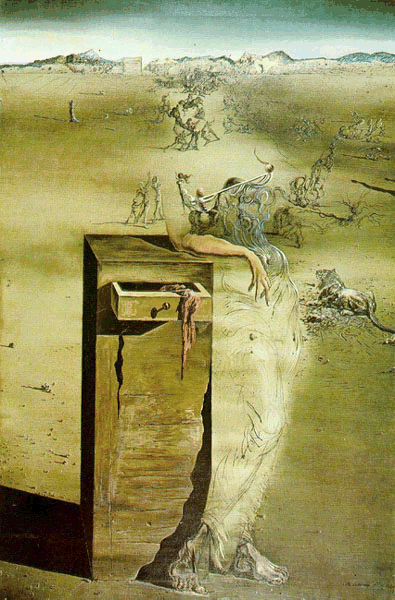
Mother of Spain
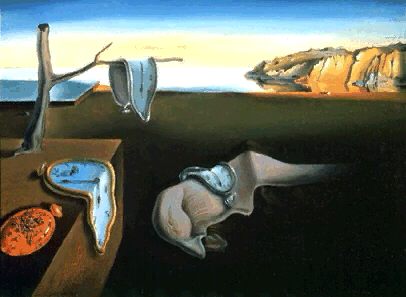
The Persistance of Memory
The Last Supper
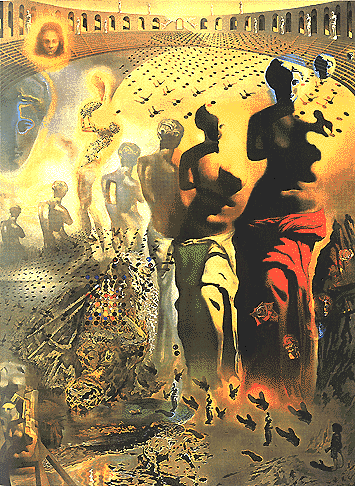
The Halucinating Toreador
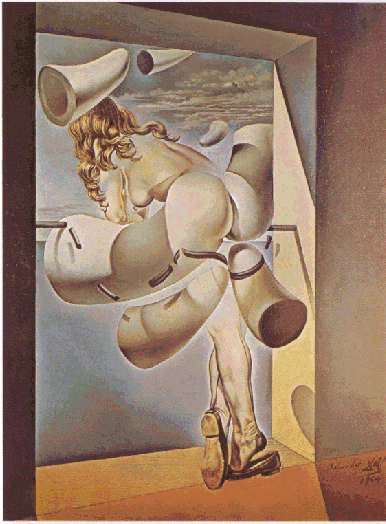
Young Virgin Autosodomized by her Own Chastity....(who else would call a painting this?)
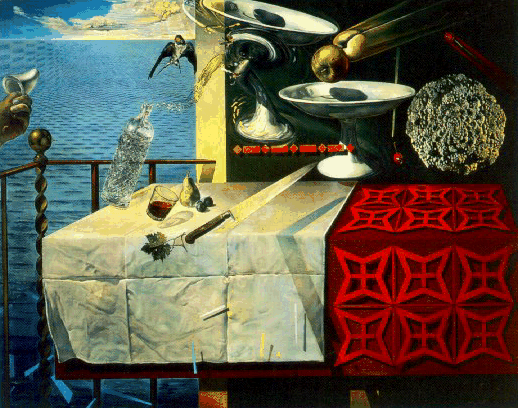
Morte Vivante
Here is an essay I wrote, on the development of modern art in the twentieth
century and the life and work of Dal�, it is as complete as My knowledge allows
and lacks a conclusion. I am open to suggestions.
The twentieth century brought about rapid change in technology, science, and
social values and habits. Although artists may be geniuses guided by their own
creative ideas, they are also largely products of their societies. Despite a
change in public taste an artist's work can be considered a valid aesthetic
statement of a particular time and place . Thus with the rapid scientific,
technological and social development, art itself has evolved greatly in the
twentieth century. Several new styles of art developed including Fauvism,
Expressionism, Cubism, Futurism, Constructivism, Neoplasticism, Precisionism,
and Minimalism.
One of these new art movements was surrealism. Surrealists wrote, painted and
sculpted to set people free of the constraints of society. Their work was based
on Sigmund Freud's theory of, "The unconscious to undermine traditional
conventions." They meant to change the world through their art. Andr� Breton,
the leader of the French surrealist movement, believed rather seriously that
art not only had the ability but the duty to change life. By painting their
dreams and their nightmares, they inspired the world to explore areas not
explored before. By painting what the artist interpreted, rather than what
everybody else saw, the surrealists started of a revolution, which set people
free from constraints of conformity. Previously, artists painted what everybody
saw, e.g. an apple, but the surrealists did not only see the apple but the
whole tree, and so this is what they painted. Artworks were no longer simply
pictures of real objects, but became projections of that which both the artist
and the viewer interpreted in the objects. A sense of individualism developed,
and freedom of thought became increasingly important.
One example of was Salvador Dal�'s
The Persistence of Memory
(Fig. 1) which
was inspired by a dream of runny camembert cheese. Dal� used the images of limp
watches to illustrate the danger of his relationship with the former wife of
the French poet Paul Eluard, "going limp," or losing it's value, over time. The
painting was painted after he had met Gala. Gala had made Dal� feel liberated,
and his fear of losing her, as time progressed, was the theme of
The
Persistence of Memory.
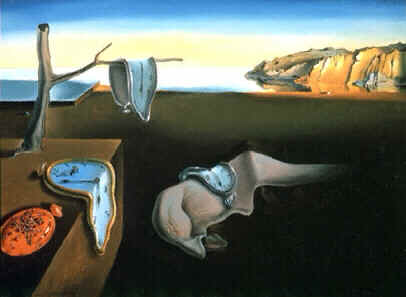
Fig. 1 : The persistence of memory , Salvador Dal� (1931, Museum of Modern Art,
New York City)
In the early twentieth century the visual arts had a kind of social importance
they can no longer claim. Art was looked at in a very different light. Works of
art sent those who viewed them, on new trains of thought. The world relied on
art to set them free from the constraints of conformity. In the late nineteenth
and early twentieth century artists started experimenting. Around this time
cultural and social habits also changed dramatically. Art was not only a way of
explaining and illustrating these changes, but also a source of inspiration.
Artists helped society to explore and understand their changing world.
Artists also changed a great deal due to the fact that they were no longer
commissioned to do work for emperors and kings, but they had to produce work
and make a name for themselves in order to sell their work. Many artists made a
name for themselves, simply by being different. They shocked the public and
became household names. This is how they sold their work and survived.
I recently visited the Peggy Guggenheim collection in Venice and the Salvador
Dal� exhibition in Rome. Salvador Dal�'s work intrigued me greatly, as his work
reflected so much about himself. His artwork gave me an insight into his life,
and I could see myself in similar situations to those depicted in his artwork.
We can see the development of individualism in Salvador Dal�'s life and work,
as he did not promote his work as much as he promoted himself. Both through
self publicizing and through his work. Salvador Dal� became a household name as
he himself became a work of art with his crooked smile and his waxed mustache.
He believed himself to be the modern day reincarnation of Diego Velazquez, who
lived a life of isolation in the court of Philip IV. Dal� himself actually bore
a resemblance to the classical master, and waxed his mustache to resemble
Velazquez's Portraits.
In this essay I will review the development of art in the twentieth century to
give context to the development of Surrealism. I will also discuss the work and
life of Salvador Dal� as one of the greatest Surrealists of the twentieth
century, in my opinion. I will also review the life and work of Joan Mir�, one
of the more lively figures of the surrealist movement in the early and mid
twentieth century. The work of both Salvador Dal� and Joan Mir�, emphasize the
importance of the artist rather than the work of the artist. Their work served
as a reflection of themselves as opposed to the work of earlier artists who's
works were simply depiction's of everyday life.
ORIGINS OF MODERN ART
Modern art started developing, around the 1860's in French 19th-century
avant-garde painting. The avant-garde's methods reflected a fundamental
questioning of political and philosophical assumptions underlying art. They
also became more interested in the styles in which they painted. How the object
was painted rather than what it looked like became the focus. The emphasis was
placed on the artist and how he painted, rather than on the work of art itself.
Later in the century the post-impressionism was born. Members of the
post-impressionist movement, created styles that would largely set the course
of painting in the first years of the twentieth century.
The impressionists, post-impressionists, and cubists, all had something in
common: They were all interested not in realism, but in personal freedom of
expression, although impressionists works were very realistic in that they
played with the effects of light on objects and also looked very closely at the
colors out of which an image consisted. These art movements greatly emphasized
the importance of the artist in the artwork.
It was from this search for personal freedom of expression that Dadaism was
born. Dadaism was an art and literary movement that reflected a protest against
all aspects of Western culture. The word dada, the French word for hobbyhorse
was selected at random from a dictionary.
The Dada movement was established in the middle of World War I in 1916, by
Tristan Tzara a Romanian-born poet, the German writer Hugo Ball, and Jean Arp
in Switzerland. A similar group was born in New York led by Man Ray, Marcel
Duchamp, and Francis Picabia, and another in Paris where it became the
inspiration for the later Surrealist group of Andr� Breton. After World War I
the movement spread to Germany and many of members from the Swiss group joined
the group in Paris.
The Dadaists used artistic and literary methods, that were sometimes
incomprehensible, in order to express their rejection of aesthetic and social
values of their time and society. One example is Marcel Duchamp's
Fountain
, in
which he took a urinary fountain, laid it on it's back and signed it R. Mutt.
(Fig. 2) While doing this he achieved what many Dadaists had striven to do, he
demanded attention, and got it. When he took his "work" to an exhibition, he
outraged the committee. They all disputed whether it could be considered his
work. But the exhibition was open to all and they had to accept his entry.
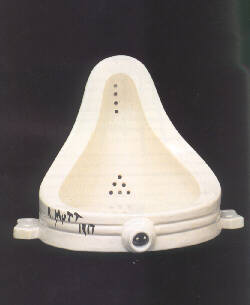
Fig. 2: Fountain, Marcel Duchamp (1917 Indiana University Art Museum)
The Dadaists' performances were written to shock and bewilder their audiences.
They meant to make the public think about their lives and reconsider the
aesthetic values and ways accepted by the societies in which they lived.
The Dadaists used novel materials, for example waste found in the streets and
unexpected everyday objects. They also used new methods to create their works
including letting chance determine certain elements of their works. An example
is the German painter and writer, Kurt Schwitters, who was known for using
waste paper and similar materials.
The French painter Marcel Duchamp used commercial products to create works of
art, which he called ready-mades.
Although the Dadaists used new and surprising methods and materials, their art
was based on the revolt against standards, which came from the belief in the
essential goodness of mankind when not distorted by society. They were against
the labeling of people and felt that stereotypes only corrupted the good nature
of mankind.
Dada had lost its force by 1922, although some of its members joined the new
Surrealist movement. Surrealism was very close to Dadaism as both Surrealists
and Dadaists use the element of chance in the creation of their work.
Giorgio De Chirico's dreamlike paintings of abandoned city squares, from
several years before the start of the movement, were already demonstrating
early Surrealist ideas. It was several years after Giorgio De Chirico's
abandoned city squares made their appearance, in 1924 when the movement was
finally realized and named by the French writer Andr� Breton. He focused on the
importance of dreams and imagination in the creation of art. The group assumed
Sigmund Freud's theory of, "The unconscious to undermine traditional
conventions." They used their artwork to promote freedom of thought.
Although they all shared the fact that the inspiration for their work was
irrational and impulsive, the Surrealists' styles differed greatly from one
another. The Surrealists did however paint in two main styles. The one was
figurative style. The style in which Max Ernst, Salvador Dal�, Ren� Magritte
Paul Delvaux, and Man Ray painted. Other members of the group, including Jean
Arp, Andr� Masson, Yves Tanguy, and the Spaniard Joan Mir�, painted in a more
abstract style.
Salvador Dal�
As mentioned earlier, another big change in the work of an artist during the
twentieth century was the fact that his work became a reflection of himself.
What he painted was not what was there, but what he interpreted in what he saw.
One of the greatest self publicists, and also one of the greatest Surrealists,
in my opinion, of the twentieth century was Salvador Dal�:
"At the age of six I wanted to be Napoleon-and I wasn't. At the age of fifteen
I wanted to be Dal� and I have been. At the age of twenty-five I wanted to
become the most sensational painter in the world and I achieved it. At
thirty-five I wanted to affirm my life by success and I attained it. Now at
forty-five I want to paint a masterpiece and to save Modern Art from chaos and
laziness. I will succeed!"--Dal�
Salvador Felipe Jacinto Dal� was born 11 May, 1904 in the small Spanish town of
Figueres in the province of Catalunya. He was not the first born however and
his name had been given to a older brother who died in infancy. His shadow
always lingered over Dal� and he always felt that he was the second Salvador.
Three years later his sister was born. She often featured in his paintings.
Dal� was Catalan and proud to be. Following the Catalan tradition, Dal� often
included food in his work, as in
Anthropomorphic Bread - Catalan Bread.
(Fig.
3).Other food in his work included eggs carrots and cheese. In Anthropomorphic
Bread - Catalan Bread, we see Dal�'s obsession with limp and firm objects. This
painting very much reflects Dal�'s relationship with his wife Gala, here we see
a seemingly firm piece of bread being kept up with a piece of rope. The rope
can be seen as that which keeps Dal�'s relationship with Gala firm. The limp
watch also makes it's appearance again, reflecting Dal�'s fear of losing Gala
as time progresses.
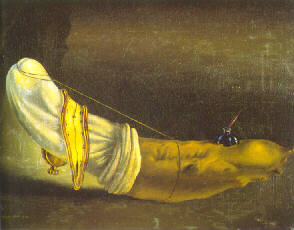
Fig. 3: Anthropomorphic Bread - Catalan Bread, Salvador Dal� (1932, St.
Petersburg (FL), The Salvador Dal� Museum, on loan from E. and A. Reynolds
Morse)
In 1921 Dal�'s mother died and he was accepted at the Escuela Especial de
Pintura, Escultura y Grabado de Bellas Artes de San Fernando in Madrid. This is
where he met Federico Garc�a Lorca and Luis Bu�uel. Later in 1923 Dal� was
expelled from the Academy for criticizing his lectures and disturbing the peace
in the academy. He was also arrested for political reasons. Dal� was not as
politically active as some of the other surrealists but his paintings very
often had strong political messages. As in
The Enigma of William Tell
(Fig. 4)
in which he gave William Tell the face of Lenin. This was meant to shock and
outrage his fellow surrealists as he very often did. In this painting we can
also see Dal�'s preoccupation with limp and in-erect objects which need to be
supported onto reality with crutches. This came from Dal�'s own fear of
impotence.
In 1929 Dal� fell in love with, and married, the former wife of French poet,
Paul Eluard: Dlena Diakonova, known as "Gala". She gave emotional, financial,
and artistic support. With her help, he became established in Paris as a
notable painter
Dal�'s union with Gala was the cause of the final fight between Dal� and his
father. Dal� was disowned by his father and moved into a fisherman's shack in
the small village of Port Llitgat, not far from the French border.
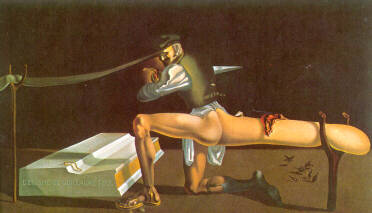
Fig. 4: The enigma of William Tell, Salvador Dal� (1933, Stockholm, Moderna
Museet)
In 1930 Dal� joined the Paris Surrealist group led by Andr� Breton. Nine years
later in 1939, Dal� was excluded from the group after several arguments, about
political issues in his work, with group members. After his separation from
the group Dal� became a serious surrealist and developed his paranoiac critical
method. He defined his paranoiac-critical activity as "spontaneous method of
original knowledge based upon the interpretive-critical association of
delirious phenomena." Dal� sold more paintings and became financially
successful. He bought additional fisherman's shacks and expanded his Port
Llitgat home. The area around his home made a permanent impression on him and
the scenes around Port Llitgat appeared in many of his paintings. The rocky
coastline inspired several of his paintings, including
The Enigma of Desire -
My Mother, my Mother, my Mother
Dal�'s later works displayed a more classical style, and his later themes
included themes such as history, religion and science. As in
The Temptation of
Saint Anthony (Fig. 5). Here is one of the best examples of Dal�'s fascination
with the Christian religion. He included the same theme in several of his
paintings using crosses and other religious symbols.
Other characteristics of Dal�'s work include, high gloss brilliant colors and
high detail. He also incorporated double images in several of his works, as we
can see in
The Hallucinogenic Toreador . In the bottom right corner of
The Hallucinogenic Toreador we can see a small boy dressed in a sailors suit.
Dal� used this boy to represent himself faced with objects which he fears
greatly, mainly sex appeal and women. Although he is frightened he holds a hoop
in his hand, which is a female symbol.
In early 1980, while they were in New York City, both Dal� and Gala suffered
from pneumonia for several months. Dal� was very depressed, and he and Gala
returned to Spain. In 1982 Gala died and Dal� moved into the villa at Pubol,
which he had given to Gala as a gift. In 1984 Dal� was severely burnt in a fire
caused by a short circuit in his room at Pubol. Dal� had successful skin grafts
but died from a heart attack, in 1989 in Figueres.
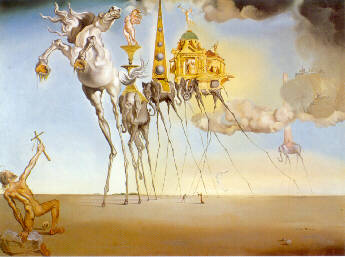
Fig. 5: The Temptation of Saint Anthony, Salvador Dal� (1946, Brussels, Mus�es
Royaux des Beaux-Arts de Belgique)