The Undertones
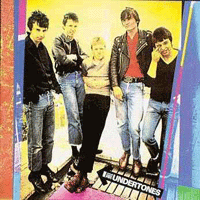
The band formed in Londonderry in late 1975 - five mates playing cover versions in local clubs. There was Feargal Sharkey on vocals, principal songwriter John O'Neill on guitar, his brother Damian also on guitar, Michael Bradley on bass and Billy Doherty on drums.
Snapped into action by punk, by 1977 they were performing their own material, but it would be another year before their debut single - 'Teenage Kicks', famously described by influential DJ John Peel as his 'favourite song of all time' - hit the shops. Their first single became their first chart entry.
The Undertones' most obvious precursors were New York's Ramones, who, after years of bloated stadium rock and flatulent prog-rock indulgence, reintroduced the notion of short, sharp toons to the music scene of the mid-to-late-'70s. By 1978, there were two UK bands excelling at this sort of buzzsaw guitar-pop with lyrics addressing the dilemmas of teen romance: ManchesterÕs Buzzcocks and The Undertones (although the 'Tones themselves always believed they had more in common, oddly enough, with The Skids).
As with The Buzzcocks, love - and how to get it - was the primary lyrical concern. As punk evolved into post-punk and bands like Wire, PiL and Joy Division began experimenting with form, employing oblique strategies and delivering obscure messages, The Undertones - like The Ramones before them - were almost cartoonishly one-dimensional, which many saw as a blessed relief at a time when rock was beginning to get pretentious again.
The Undertones were almost
studiously anti-intelligent. 'We did it under the assumption that other
people would get it,' says Michael Bradley of The Undertones' approach.
'Did we deliberately dumb it down? We certainly had no pretensions towards
art; we were anti- that.'
Of course, even The Undertones couldn't resist the lure of
experimentation, and listened to in straight succession, their four albums
- The Undertones (1979), Hypnotised (1980), Positive Touch (1981) and The
Sin Of Pride (1983) - evince a clear drift towards more complex,
sophisticated territories, with soul and psychedelic influences coming to
the fore by the end. Falling sales and increasing tensions within the band
led to a parting of the ways after the commercial failure of their last
LP. Feargal Sharkey enjoyed a brief but successful solo career, while the
O'Neill brothers formed the highly regarded, pioneering techno-rock act,
That Petrol Emotion.
Now, with a decade and a half's worth of water under the bridge, The Undertones look set to reform for the first year of the third millennium. Whether or not Feargal Sharkey (a part-time member of the Radio Authority who hand out commercial licenses, he also works for a music consultancy firm) will be a part of the reunion line-up remains to be seen ('We'll ask him' says Bradley, 'but I suspect that he won't want to do it').
It also remains to be seen whether or not this will involve the players giving up their day jobs once more (Michael works for BBC Radio Foyle, John works for Stream International giving advice on computers, Billy works for Seagate - who make disk drives - while Damian is a freelance musician/guitarist).
No matter. Whatever the future holds, The Undertones' contribution to British pop has been considerable, and the band can be justly proud of their achievements, even a bunch as self-deprecating as this. As Michael says, 'I'd love to go back and remix some of the songs - and maybe get in a proper bass player!'In the meantime, the bassist - and co-writer of the band's biggest ever hit, 'My Perfect Cousin' - gives a blow-by-blow account of every Undertones A- and B-side, all 32 of them, the recording of the tracks and the memories they evoke.
Teenage Kicks - October '78
(31)
'This still sounds good. John wrote it. The Ramones were an inspiration -
he wrote it in late '77. The twin guitars make it - they still sound good
20-odd years on. John Peel's support surprised us. One night he played it
twice in a row. I was working at the time in a builder's merchants, and
Peter Powell made it his Record Of The Week, which meant it got played at
lunchtime. I was a bit embarrassed, actually. Perfect pop? We never really
liked that term. Perfect pop was Abba.'
True Confessions
'We thought we'd have one shot, not a long career, so we put on (the EP)
what we thought were four decent enough songs. We weren't trying to be
Cole Porter. This was the first song that John (O'Neill) didn't write
alone; it was me, John and Damian (O'Neill). They were all based around
love and relationships. We knew where we stood. This was well before our
own teen romances - which started late due to the fact that we spent all
our waking hours working on the group.'
Smarter Than U
'Myself and Damian wrote this. If ever a song was written as a B-side,
this was it! Prince later used the letter 'U' in the same way - obviously
Damian was onto something here.'
Emergency Cases
'It started off as a punked-up, speeded-up cover of 'Parachute Woman' by
The Rolling Stone's from Beggars Banquet. We loved The Rolling Stones. It
was John's idea. You can still here it ('Parachute Woman') on 'Emergency
Cases'. Luckily, Jagger and Richards didn't call - look what happened to
The Verve (whose 'Bittersweet Symphony' got them sued by the Stones).'
Get Over You - February '79
(57)
'We were very disappointed by the chart position. We thought it was all
over and our career was finished. It was like, 'What are we gonna do?'
Looking back, I think the song could have been better done. It was a bit
too smooth.'
Really Really
'Billy Doherty's song. I gave him a bit of a hand with the arrangement. It
was a great song to play live - I don't know if it was basic or banal, but
it was great.'
She Can Only Say No
'The whole anti-machismo element was evident in John's songs, and really,
this is a prime example of that. Towards the second LP, he developed that.
We certainly weren't hard men. Prototype New Men? Yeah, I wouldn't
disagree with that.'
Jimmy Jimmy - April '79 (16)
'Was Jimmy a real person? No. Nor was he the same person as 'My Perfect
Cousin'. Let's just say he wasn't exactly a heroic figure.'
Mars Bars
'We weren't even vaguely aware of the Mick Jagger/Marianne Faithful thing
(the urban myth centring on rock's former golden couple and a Mars Bar).
'Mars Bars' was about our eating habits. It was a love song to our staple
food at the time - we really did love Mars Bars. Mars Bars with a cup of
tea.'
Here Comes The Summer - July
'79 (34)
'Julie Burchill reviewed this in the NME (where she compared it favourably
to The Small Faces) and our hearts soared. I love 'Here Comes The Summer'.
We re-recorded it from the first LP for the single. It was one of those
really satisfying experiences. The song was great, the recording was
great, even the sleeve was great. It was a great summer, too. Everything
was great with the world. It was our first summer as 'pop stars', of being
famous and getting money.'
One Way Love
'Our homage to (The Monkees') 'Last Train To Clarkesville'. The riff was
great but the verse I always thought was a bit weak. The tune was a bit of
a one-note special. That was always going to be a B-side. Were we ever
approached to star in a Monkees-style TV show? No. Possibly we could have,
though - we had the funny one, the shy one, all that stuff. I think we
possibly would have regretted it very quickly.'
Top Twenty
'John thought it was a good title, because people didn't talk about the
Top Twenty any more. It reminded me, especially the backing vocals, of The
Rezillos, who we supported once.'
You've Got My Number (Why
Don't You Use It?) - October '79 (32)
'John wrote this during summer '79, and he played it for us, and our jaws
dropped to the ground. It was brilliant. Still is. Gets the spine
tingling. It was a progression, musically, for us - we'd left The Ramones
thing behind. Plus, there was a slow middle bit.'
Let's Talk About Girls
'One of the songs we used to play live, taken from the Nuggets LP (classic
compilation of '60s garage psychedelic-punk). It was by The Chocolate
Watch Band. We used to do about half a dozen songs from Nuggets. It's a
very Undertones title, yes.'
My Perfect Cousin - April
'80 (9)
'Was I pleased to have co-written our biggest ever hit? Yes, and I never
let the others forget it! Number 9! I was very pleased with that. Me and
Damian wrote it together. I did most of the words. I had the feeling of
annoyance a long time before we did the song - I had a cousin who I was
always being compared to. So it just came out. It was one of those rare
songs that we didn't feel we were writing for an LP; it was just a good
idea for a song. I never made the connection myself to 'David Watts' (by
The Kinks). Pete Townshend, on (Radio 1's) 'Round Table', really liked it.
That made us happy.'
Hard Luck
'That was our attempt to write a Gary Glitter song - not so much the
words, but the chord structure. We used to do 'Rock'N'Roll' as an encore.
But we also did 'Just For You', which was a Glitter Band B-side, and it
had almost Buzzcocks-like chords, really strange.'
Don't Wanna See (You Again)
'One of the first songs John ever wrote, back in '77. It was a Ramones-type
song, obviously. We liked the fact that it was so short.'
Wednesday Week - July '80
(11)
'John wrote this during a break from recording the second LP (Hypnotised)
- we ran out of songs! So we went home for Christmas and I remember being
down at the O'Neill's house - John and Damian were still living at home -
and I can still picture John coming down the stairs singing this song. It
was brilliant. The chord progression was fantastic. The only thing wrong
with it was the grammar: 'Wednesday Week' means something in the future,
whereas in the song it goes, 'Wednesday week' she loved me/Wednesday week
never happened at all.' Elvis Costello also had a song called 'Wednesday
Week', but it wasn't half as good as ours!'
Told You So
'One of the very first songs we ever wrote. In '76, we were heavily
influenced by Dr Feelgood; it was our R&B period. It was a big song
for Billy - good drums on it.'
It's Going To Happen! - May
'81 (18)
'Damian had the chorus, and I wrote the words for the verse. They were a
wee bit deliberately vague. It was round about the time of the hunger
strikes (in the Maze prison) but, having said that, it was written around
the end of 1980, so . . . It's not one of my favourites, because the
chorus is a bit lumpy. The record company thought it would be a good
single.'
Fairly In The Money Now
'Damian wrote this (it was credited to Tommy Tate & The Torpedoes, a D
O'Neill nom de plume). It was a wee bit of a swipe at the rest of us and
our lackadaisical attitude to being in a band. Very smart. We didn't know
how lucky we were, we were whingeing about this and that, and Damian was
the only one with the sense to say, 'We're in a band, getting paid for
doing what we were doing for nothing, what are you whingeing about?' It
was a well-justified swipe.'
Julie Ocean - July '81 (41)
'We were disappointed by the chart position. Orange Juice supported us in
December 1980, and John always said this song was inspired by Orange
Juice. But then again, John was a big fan of The Velvet Underground as
well, as were Orange Juice - who nicked a lot from the Velvets - so maybe
John went through The Velvet Underground directly. I think the Orange
Juice connection is a wee bit overstated. Typical John, always doing
himself down: in an interview, he said Orange Juice were better than The
Undertones. But they weren't. We liked them, but they weren't as good as
us.'
Kiss In The Dark
'I co-wrote this. For the middle section, we got the chords of the verse
and the chorus and wrote them down backwards and played them like that. We
were trying to do things which were strange and awkward. Sort of, 'Let's
see what that's like.' We were doing things to please ourselves, like
private jokes.'
Beautiful Friend - February
'82 (-)
'A strange one: probably the first song we didn't have live. We hadn't
properly played it before going in the studio. There's a sort of sequencer
or synthesizer type thing going on there. It was a big departure for us.
Maybe it wasn't a good idea. But it came at a time when, commercially, we
were down. We were very vulnerable to someone saying, 'This is shite.' Our
confidence had completely gone, because 'Julie Ocean' didn't get into the
Top 40, Positive Touch wasn't as successful as Hypnotised and 'It's Going
To Happen!' was a bit of a disappointment, too. 'Beautiful Friend' was a
good song, and we enjoyed it as an experiment, but it was never going to
set the charts on fire, as they say. The whole New Romantic thing was
happening; suddenly, we were passe. People weren't interested in boys from
Derry playing guitars.'
Life's Too Easy
'Another strange one. It was contrived. Again, it was us doing something
different, possibly for the sake of doing something different. I wasn't
happy with that one.'
The Love Parade - October
'82 (-)
'Mike Hedges (producer) was chosen because of the sound he got on Wah!'s
'The Story Of The Blues'. The Sin Of Pride LP was a difficult one, and the
whole atmosphere was different because of the commercial thing. We were
very aware that the record company were not happy - whenever you're not
having hit records you're under pressure from the record company. Although
we put that aside in the studio, it wasn't quite as light-hearted. A lot
of work went into those songs - a lot of overdubs, experimenting with
different types of music. The usual pattern for bands: they start off
simple, things get a wee bit more complicated, then they make their big
Sgt Pepper type thing, after which they make their back-to-basics White
Album. We never got to our back-to-basics thing! Mentally, we were ready
to pack it in. Still, we had lots of different ideas for this album. The
soul thing was possibly a mistake, though - technically, I wasn't really
up for it; I'm more Dee Dee Ramone than James Jameson. 'The Love Parade'
was a title that came from this sheet music we saw for an old (1920s) song
called 'The Love Parade'. It was an attempt to write a Nuggets type song.
It was possibly a mistake to bring in a woman for the backing vocals.'
Like That
'Another awkward song that was always going to be a B-side.'
Got To Have You Back -
February '83 (-)
'A cover version of an Isley Brothers song. John always was a big Motown
fan, and heard this song and thought we should try it. The singing's good
- Sharkey did a good job - and we really did work to move it along. But
sometimes I think, 'What's the point?' I think it was probably us trying
to prove we could make a record like that ('white soul' groups like ABC
and Culture Club was popular at the time). Then again, you could probably
say that of most of our records from Hypnotised onwards. Thankfully, most
of them did come off.'
Turning Blue
'This was on both the 12-inch and seven-inch (of 'Got To Have You Back'),
and 'Bye Bye Baby Blue' was on the 12-inch only. We were into the word
'blue' - it was our blue period. 'Turning Blue' had a good, slow swing to
it. Nothing to do with Bowie/Iggy's 'Turn Blue' (from Lust For Life), no.'
Bye Bye Baby Blue
'This always reminded me of Simon & Garfunkel's 'Baby Driver', another
great record. 'Blue' is a great songwriting word.'
Chain Of Love - May '83 (-)
'Our last single. This was a great record; a good song to do live. A wee
knock 'em out song. It could nearly have been on Hypnotised. Things were
winding down by now, though. It was only a matter of time. At that stage,
we were talking about what we were going to do next.'
Window Shopping For New
Clothes
'John wrote it and asked me to sing it, and so I sang it. I couldn't say
no, I said I'd try it - I think that was symptomatic of all the trouble in
the band at the time, the fact that relations had broken down to such an
extent between John and Feargal that John deliberately asked someone apart
from Feargal to sing it. I did it, and I did my best at it, but I thought,
'Why isn't Feargal singing this?' And it was because John was pissed off
with the whole thing.'