Biography
Biography
|
|
In June, they served as the backing group for vocalist Tony Sheridan on six
songs, including the single "My Bonnie." By this time, John and Paul were
regularly writing their own songs. In November of 1961, Brian Epstein, who
managed his family's local NEMS record shop, went to see The Beatles at the
Cavern Club, and he thought they showed potential. He offered to manage the
group, and arranged for their audition with Decca two months later. Despite
their failure to win a contract from Decca, The Beatles signed a management
contract with Epstein, and he set about refining their image. Epstein
convinced them to give up their scruffy outfits and wear suits onstage, and he
sent copies of their failed Decca audition to other record labels. In June,
they auditioned for George Martin, the head of A&R at the EMI subsidiary
Parlophone Records, who offered them a contract the following month. They
didn't tell Pete about the contract and let him go. When Ringo showed up with
the other Beatles for their first official recording session at EMI Studios on
September 11, 1962, he was told by George Martin that his services would not
be required. Martin had hired seasoned studio drummer Andy White for the
session, and the humiliated Ringo ended up playing tambourines and maracas on
"Love Me Do" and "P.S. I Love You," the two sides of the first Beatles single.
Their second single, "Please Please Me," went straight to No. 1 in February of
1963, and The Beatles were on their way to superstardom. In March, their debut
album, also titled Please Please Me, was released, and it remained at the top
of the charts for thirty weeks, until it was dislodged by their follow-up,
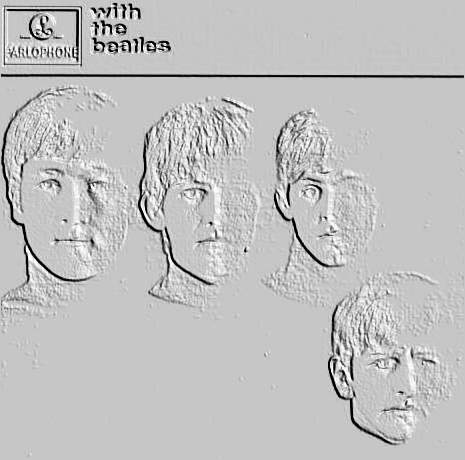
With the Beatles. The Beatles had yet to make any inroads on the American
music scene; neither the single "Please Please Me" nor the album Introducing
the Beatles made the U.S. charts. But in January of 1964, with the release of
the single "I Want To Hold Your Hand," the record had sold more than one
million copies after 2 weeks of it's release. In February, The Beatles made
their first, phenomenal appearance in the U.S. on the Ed Sullivan Show. By the
end of the month, The Beatles practically owned the Billboard charts: in
addition to having the No. 1 single, they had four other 45s on the singles
chart and three albums on the album chart, including Meet the Beatles in the
No. 1 spot. Over the next two years, they had twenty-six singles in the
Billboard Top 40 and seven No. 1 albums. They also made two hit movies, A Hard
Day's Night and Help!
Not surprisingly, given the artistry they'd displayed on Rubber Soul, 1966 was
a watershed year for The Beatles, both professionally and personally. In
January, George became the third Beatle to tie the knot, and Paul, the last
bachelor among their ranks, was seriously involved with actress Jane Asher.
They were tired of spending all their time on the road, and decided to stop
performing following their summer tour of the U.S When John said "I don't know
which will go first--rock and roll or Christianity." This comment caused a
frenzy in the southern part of the U.S., where Beatles records were burned,
John received numerous death threats, and fans were urged to boycott the
band's concerts. In Chicago, the day before their final tour was to begin, a
visibly shaken John apologized for his comments about the relative stature of
Jesus and The Beatles, but the death threats continued to roll in, and by the
end of their final show, at San Francisco's Candlestick Park on August 29,
1966, they'd had enough. It was just as well. Their concerts had long since
devolved into events where the fans' screaming was louder than the music,
while their studio work was becoming more and more amazing. The same month
they toured America for the last time, they released Revolver.
The remainder of 1966 was a period of great personal growth for The Beatles.
While Ringo returned to Surrey to spend time with his family, Paul immersed
himself in London's "underground" scene and composed a score for the film The
Family Way , George went to India to study the sitar, yoga, and Indian
culture, and John went to West Germany and Spain to film How I Won the War, in
which he played a large supporting role. Late in 1966, The Beatles reunited at
EMI Studios to record their next album. The first song they cut was John's
"Strawberry Fields Forever." The song eventually ended up not on the album,
but on a single, paired with Paul's cheerfully nostalgic "Penny Lane." The
album that followed, Sgt. Pepper's Lonely Hearts Club Band, continued in the
same vein, alternating between Paul's chipper mid-tempo numbers ("Getting
Better," "Fixing a Hole," and "When I'm Sixty-Four") and John's moodier
psychedelic pieces ("Lucy in the Sky With Diamonds" and "Being for the Benefit
of Mr. Kite"). Their increasingly disparate approaches to songwriting came
together on the album's last track, "A Day in the Life. " Musically, it far
surpassed anything anyone else in pop music had ever attempted, and it quickly
became the most critically and commercially successful rock album of all time,
holding the No. 1 spot on Billboard's album chart for a record-breaking
fifteen weeks. In August of 1967, the Beatles manager died of a drug overdose.
Now, in the wake of Brian's death, they started branching out, starting their
own record label. Early in 1968, The Beatles followed the Maharishi to his
ashram in Rishikesh, India The Beatles distanced themselves from the Maharishi
after they heard rumors that he had attempted to seduce actress Mia Farrow;
utterly disillusioned, John penned the song "Maharishi," but eventually
changed it to "Sexy Sadie." These were confusing times for The Beatles, and
that confusion showed in Magical Mystery Tour, a one-hour television film that
aired on the BBC in December of 1967. Dull and muddled, it was the band's
first critical failure, despite containing some great music, including "I Am
the Walrus" and "The Fool on the Hill." They bounced back with the 45 "Hey
Jude," making it far and away the longest No. 1 single of all time; the
B-side, John's political rocker "Revolution," was just as great.
A couple of months later, they released an eponymous two-record set called
"The White Album." Packed with great songs. "The White Album" spurned the
conceptual pretensions of Sgt. Pepper in favor of straightforward rock- and
folk-based material. Paul's best songs were "Back in the U.S.S.R." and
"Blackbird," John's "I'm So Tired" and "Happiness Is a Warm Gun," George's
"While My Guitar Gently Weeps." At this point, they were three solo artists
using each other as session musicians. Ringo quit the band for a few days,
George brought in Eric Clapton to play lead guitar on "Gently Weeps." By the
time The Beatles reconvened in Twickenham Film Studios in January of 1969,
Paul had a new companion of his own. Having broken his engagement to Jane
Asher the previous summer, he was involved with Linda Eastman. Unlike John,
Paul was not so obsessed with his lover that he was willing to forsake The
Beatles. The Twickenham sessions were set up to film The Beatles at work for a
documentary tentatively titled "Get Back" after the band's new single. But the
sessions didn't go well, and the band members didn't get along. Despite a
loose, joyful concert on the rooftop of their Apple Corps building, the tapes
for the proposed album and the film were temporarily shelved. On March 12,
1969, Paul and Linda were married, and eight days later John and Yoko tied the
knot. John returned in April to record the new Beatles single, "The Ballad of
John and Yoko." That summer, the Fab Four reunited at EMI Studios to record
Abbey Road, their final album of new material.
But despite the success of the Abbey Road sessions, The Beatles continued to
disintegrate. Business problems led John to seek out Allen Klein, the Rolling
Stones' manager, to represent The Beatles, while Paul wanted his
father-in-law, attorney Lee Eastman, to manage the band. George and Ringo
sided with John, but the point was moot, as The Beatles effectively split up.
Eventually, it was Paul who announced the breakup, in a "self interview"
included with his first solo album, McCartney, which was released in April of
1970. A month later, the Get Back sessions, which had been retitled Let It Be,
were finally released. In the years after the split, the four ex-Beatles
achieved varying degrees of success. But two days after Double Fantasy entered
the charts, John was gunned down by a deranged ex-fan in front of his Central
Park apartment building, and any chance of the Fab Four reuniting was lost.
But in 1995, the remaining Beatles got together to record new backing tracks
to some rudimentary Lennon demos, and "Free as a Bird" and "Real Love" were
included as part of the Beatles Anthology albums and documentaries. That
project earned Paul, George, and Ringo three Grammys and introduced their
music to a whole new generation of fans. Forty years after John and Paul's
first, fateful meeting, no one doubts their place in the history books: they
were the greatest band in rock-and-roll history, and the most important
musicians and composers of the twentieth century.
Source: The
Internet
 |
|
 |
|
Go Back |
Home |
Go Forward |