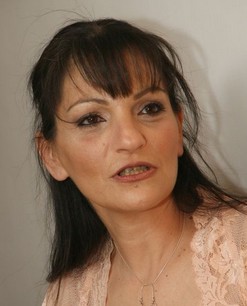
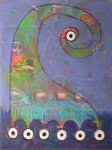
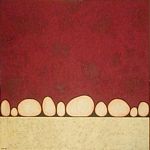
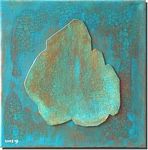
I was born in Israel, 1959. I'm a self-educated artist, and I first encountered art as a young girl. My talent was noticed while still in elementary school by my art teacher, who encouraged me to acknowledge my abilities. By the age of 11, one of my paintings was sent to an international children exhibition in Holland. In my teens I became familiar with canvases and oil paint, and began experimenting different styles and techniques. And still, painting was only a hobby at the time. As an adult I designed jewelry, mostly of silver and gems. This was my major interest and a source of income for many years. Recently I closed a full circle and resumed painting, and made it my main occupation. All the paintings shown on this website are from this late period.
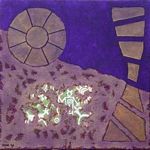
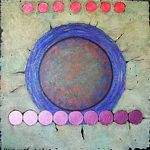
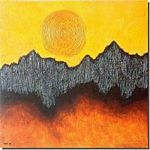
It is evident that my career as a jeweler influences my canvases. It often happens that elements I use for jewelry find their way into my paintings, not to mention my strong attraction to metallic tint and textures.
Artist Statement
Art has chosen me. Ever since I was a child it became my way of life. Artistic expressions accompanied every period in my life: Jewelry, drawings and others - but painting was always there. The main sources for my paintings are images and visions that flash in front of my eyes for a fraction of a second, usually just when I am awaking from sleep. Most of them are swept away from my memory and I can't sketch them all. If I only had a "dream camera" to save them�
The same curiosity that characterized the little girl I used to be is still with me today, and it tastes the world, touches it, feels it, smells it, and listens to its sounds. But most of the work is done by the eyes. Most of the elements in my paintings come from ceaseless observation - usually unconscious - of the world around me: from planets and landscapes to people, leaves, crystals or sand grains. These elements find their way to the canvas as subjects or as textures.
To a great extent I am a "serial painter". I use these themes again and again, while applying different translations, interpretations or techniques. I paint while listening to music and singing along, or while talking to other people. This enables me to divert my attention from the painting itself and to allow sub conscious flow unhindered by logic thought. This flow dictates the painting, and as a matter of fact my body is just a tool for the painting to materialize. My creation is very basic, somewhat naive, and maybe even primitive. There is no academic processing of symbols, measured compositions, nor an attempt to convey a verbal message using graphic means. What you see is what there is. I myself don't always know "what did the artist want to say". I often find myself looking at my own paintings, surprised to find in them things I was not aware of. Thus, for example with my "ancient connections" series of paintings: first came the paintings and only later came the understanding that I tried to establish through them a dialogue with the ancient cave painters, through the ages, one painter to another.
When empty canvases and images find each other - comes the time to work. In many cases I am guided by a sketch I made from one of the images I mentioned earlier. But sometimes I start painting one element without knowing how the rest of the painting will look like. Only later I find the right image and I paint it around that particular element. Usually I sign a painting when I am generally satisfied, even if there is still finishing and refining work to be done.
A painting is a two dimensional medium, mostly used to express three dimensional images - mainly in realistic paintings. I too used it in such a way for a long time. However, it often happens that i prefer to use use this medium to create depthless two dimensional expressions. What might look as a contradiction - but not in my eyes - is my strong attraction to use materials with different textures such as sand, fibers, modeling gels and construction materials. Thus people can not only see my paintings - they can - and encouraged to - touch them, too. This is my way to share my inner world with others.
The creative process
Anyone defining himself or herself as an "artist" must supply solid proof for their creativity. This can take the form of a novel, a poem, a paining or a sculpture, but the secret behind creativity is Creative Thinking.
Creative Thinking is a mental tool that all humans own, although not all of us are aware of it or know how to use it.
Creativite Thinking is the tool that helps us improve ourselves, provides a fresh look on situations in life and helps us solve problems.
Improving that tool can take the form of not only an artistic creation but also the form of healthy life in both body and soul.
It is never too late to be creative. Anyone of us, no matter how intelligent, can learn how to use this tool and teach others, adults and children, how to benefit from creativity.
The language of Art
I often claim that science and art are two sides of the same coin, although they use very different languages - science uses the language of mathematics and art uses the language of the senses: vision through colors and shapes, touch through textures, hearing through sounds ect. Both science and art require a unique observation of the universe, though the outcome is very different. Nevertheless, there's a very significant difference between science and art: various scientists will observe the universe and often reach the same conclusion using mathematical calculations, but various artists will each create a completely different expression which is influenced by their own interpretation. This interpretation is in fact the artistic creation, which derives from both outer world and the inner world of the artist. I believe that this duality finds its expression in my work, too.
Anything goes...
When I first started painting I believed that paint is all that was needed to make a painting. For many years I thought that adding any other material to a painting is wrong, and a proof of the painters lack of artistic skills. Now, many years later, I find that my artistic language benefits from the wide choice of extra textures that enhance the effect of my paintings. In my work I use many substences, such as constructing materials, sand, stones, paper, ink, metallic tint, modeling pastes - anything goes...