
The same day the British surrendered at Yorktown the British fleet that might have broken the siege left New York. They didn't find out they were too late until October 24 when they reached the Chesapeake Bay.
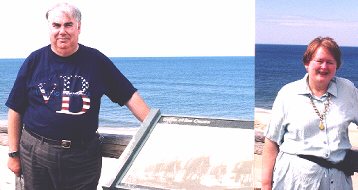
June 1999 -- At Cape Henry between Virginia Beach and Norfolk, where the Battle of the Capes took place before the Yorktown siege, Brendan and Carolyn Daily O'Connor took turns taking pictures. At age 4, Carolyn lived near Cape Henry while her father was stationed at the U.S. Naval base in Norfolk.
Carolyn did most of her research about why the last battle of the American Revolution was fought at Yorktown in 1992 when she was assigned to write an encyclopedia article for the Dictionary of Historic Places of North America. On her 1999 visit to the area, she traveled down the Northern Neck of Virginia, home in the 18th century to George Washington and Carolyn's six times great grandfather Presley Thornton whose eldest son served as a Washington aide. Reaching Gloucester Point across the York River from Yorktown at dusk, she took the river photos used for this web site. A few days after visiting Cape Henry, she and her husband toured the Yorktown battlefield and took the photos of Redoubt 10 and the earthworks of the outer defense ring. The terrain of the land with a ravine to the north of Yorktown and a swamp to the south provided cover for the American and French forces during the siege -- keeping casulties much lower than they otherwise would have been.
The most exciting find at the Chicago Public Library was a book published in London in 1888 -- The Clinton-Cornwallis Controversy by Benjamin Franklin Stevens. The volume contained the full text of the correspondence between Sir Henry Clinton and Lord Charles Cornwallis between 1779 and 1881 that is quoted at this web site.
