Suchomimus, The Spinosaurs, And Ridged Backs.
In November of 1998, an expedition by an international team to the Sahara turned up the fossilized bones of a previously unknown species of large predatory dinosaur: Suchomimus tenerensis, which has been placed in the group known as Spinosaurs.
Spinosaurs, untill the last ten or fifteen years, were rather poorly known animals. The first specimens where discovered in central Egypt in 1915, in a formation dating back to the Cenomanian stage of the Cretaceous. That is, around 97 to 90 million years ago.
The skeletons that were collected were frustratingly (and characteristically) incomplete. They were called Spinosaurus aegypticus, and Spinosaurus B. They consisted of incomplete peices of the jawbone, teeth, some vertebrae from various parts of the spine, some ribs, bits of the three main leg bones (tibia, fibula, and femur), and some phalanges (finger and toe bones).
The few parts of the skeleton which where found where enough to indicate that Spinosaurus was different from other theropods ("theropods" are the familiar two-legged meat-eating dinosaurs, like Tyrannosaurus).
For example, the teeth where cone-shaped, straight, and had no serration (serration = microscopic jagged bits on the edges). The most obivous unique aspect of the animal was, however, the fact that the spine on the back of some of the vertebra (called a "nueral spine") was elongated to eleven times the size of the vertebrae themselves! This meant that Spinosaurus probably had a tall 'hump' or 'sail' upon it's back.
Then, during World War II, all the specimens of Spinosaurus were destroyed in bombing raids.
More fragments of spinosaur skeletons have been found since, in Niger rather than Egypt. In fact, 25 years ago, French palaeontologists were collecting them intensely.
1986 came along, and brought good news for dinosaur enthusiasts and palaeontologists: the discovery of a unusual, large, and fairly complete skeleton of a new theropod: Baryonyx walkeri. It wasn't untill this decade that some palaeontologists became reasonably sure that Baryonyx was related to Spinosaurus. The new theropod was discovered in England, in rocks dating to the Barremian stage of the early Cretaceous, from about 130 to 125 million years ago.
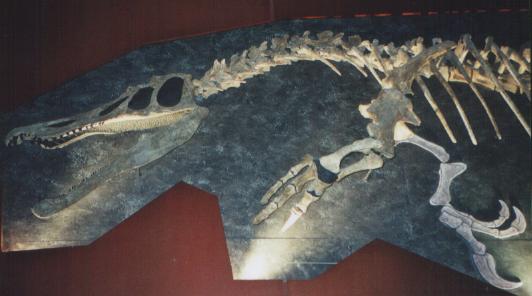
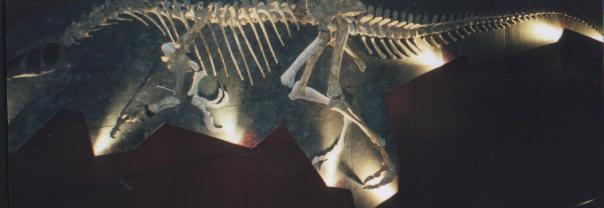
Baryonyx can be seen today in the British Museum Of Natural History (above), and is quite a beautiful skeleton. The animal features large curved claws on both hands and feet, with arms shorter than the legs, and a somewhat crocodile-like head, with a neck extending from the large body and a long tail extending behind. It was suggested Baryonyx was a fish eating animal, due to the crocodile-like skull: long and narrow, with teeth made for gripping and holding a slippery fish rather than slicing through a hunk of meat, and a crown of larger teeth near the front of the jaw.
The next great find in this group of dinosaurs was in 1998, with the unearthing of the remains of Suchomimus tenerensis. Suchomimus was discovered in Niger (west Africa), in the Tenere region of the Sahara (hence the 'species' or 'specific name' of 'tenerensis'). Like Baryonyx, Suchomimus features a very crocodile-like skull (probably an adaptation for eating fish - sometimes similar structures appear in widely different animals, and the similarities are because the structures were evolved for the same purpose (this is called "convergence" - watch out for more potential examples of this phenomenon further on)), hence the 'genus' or 'generic name' of 'Suchomimus' ("sucho-" = crocodile, "-mimus" = mimic).
The 11 metre-long Suchomimus is another fantastic find, like Baryonyx, for being almost 85% complete. It has the crocodile-like skull Baryonyx also features, it also sports the giant claws on its hands, the long tail, but unlike Baryonyx it features the dramatically impressive structure that those Spinosaurus fragments from 1915 hinted at: the ridge or 'sail' along the back.
Check out Paul Sereno's site: http://dinosaur.uchicago.edu/Suchomimus.html, and the national geographic report of 1998: http://www.nationalgeographic.com/events/releases/pr981112.html.
At http://dinosaur.uchicago.edu/, the dinosaur family trees (in the highlights of Paul Sereno's "Dinosaur Evolution" article) places the Spinosaurs alongside the Allosaurs, making them roughly "Carnosaurs" (and not the more advanced "Coelurosaurs", like Tyrannosaurus rex, the 'ostrich dinosaurs', and the recent movie celebrity Velociraptor).
Suchomimus shared it's environment with another giant fish-eater - crocodiles. Crocs of unprecendented sizes where found in Niger along with the Nigerian dinosaurs. As mentioned above, and as with Baryonyx, Suchomimus had a crocodile-like skull and an array of teeth that may indicate a predilection for slippery fish. The large claw probably had something to do with fish-eating also.
Suchomimus matched the tyrannosaurs as far as size goes, and according to Sereno and the expedition team was probably the most common predator in it's environment.
Now, onto the ridged back. Suchomimus was not the only dinosaur known to have a ridge-like or sail-like structure along the back. The African herbivore Ouranosaurus had a ridged/sailed back, and so did Egyptian Spinosaurus itself of course, and the North American allosaur Acrocanthosaurus. Many prehistory fans will probably compare these ridges or sails with the sails of some members of the "pelycosaurs", a group of synapsid 'reptiles'. Edaphosaurus and Dimetrodon are the two i'm thinking of. However the sails of these sail-backed dinosaurs where a little different to the sail-backed pelycosaurs - which is why i've used the word "ridge" instead of "sail" in some places above.
Dimetrodon's 'neural spines' (the bones coming up from the backbone, that supports the 'sail') where a lot thinner, for example. The ridge-backed dino's neural spines are more solid looking and wider. Dimetrodon's spines were also a bit longer in comparison to the rest of the body. But the same purposes have been proposed for both forms of sail-back or ridge-back.
In his book "The Dinosaur Heresies", Robert Bakker, for example, supports the idea that they were sexual display devices, kind of like a peacock's tail. In this model, it would be likely that the sail or ridge was brightly coloured perhaps, to attract a mate with. Earlier suggestions have been based on the idea that dinosaurs (and the pelycosaurs) where "cold-blooded" (or "ectothermic") animals. It was proposed that blood vessels would run through the skin of the sails/ridges, and the animal could warm itself up by turning the sail to face the sun (and the sun would warm the blood) - like a lizard sunning itself on a rock. Thus, the sails/ridges could have been heat-regulating devices. But palaeontological thought of the past couple of decades has moved away from the idea of dinosaurs as 'cold-blooded' - in fact, in his book Bakker even throws some doubt on the idea that pelycosaurs were cold-blooded.
Personally, i like a slightly different idea - a modification of the earlier proposal for sails as heat-regulating devices:
Modern-day elephants are large, warm-blooded animals of similar size to some of these dinosaurs. Now, the larger an animal gets, the easier it is for that animal to overheat. Large animals tend to increase their surface area somehow, to prevent overheating. Elephants have large ears, and the purpose of the enlarged ears is to provide extra surface area for them to cool down with. Dinosaurs, if they had been warm-blooded, are likely to have found a way to cool themselves down as well. So the ridges on the backs of Suchomimus, Spinosaurus, Acrocanthosaurus, and Ouranosaurus were probably methods of increasing the giant animal's surface area, to make it easier for the aimal to cool itself down. Not too diferent from the cold-blooded proposal.
In fact, any situation in which you find a large animal that has some portion of their body given a larger surface area (eg// the long necks of sauropod dinosaurs, or the broad plates of the bigger stegosaurs), its possible that was for the purpose of cooling.
That doesnt rule out other uses, of course. Evolution makes use of whatever material it has available. Its likely the ridge/sail on Suchomimus's back did not just serve a single role. That's evolution for you.