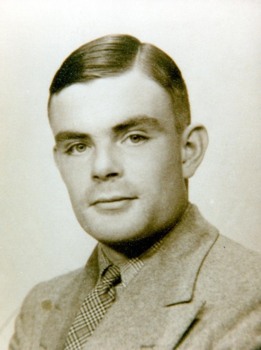
"Science is a differential equation. Religion is a boundary condition."
English mathematician and logician, Turing is often considered to be the father of
modern computer science. He provided an influential formalization of the concept of the
algorithm and computation with the Turing machine. With the Turing test, meanwhile, he
made a significant and characteristically provocative contribution to the debate
regarding artificial intelligence: whether it will ever be possible to say that a machine is
conscious and can think. He later worked at the National Physical Laboratory, creating
one of the first designs for a stored-program computer, the ACE, although it was never
actually built in its full form. In 1948, he moved to the University of Manchester to work on
the Manchester Mark I, then emerging as one of the world's earliest true computers.
During the Second World War, Turing worked at Bletchley Park, the UK's code
breaking centre, and was for a time head of Hut 8, the section responsible for German
naval cryptanalysis. He devised a number of techniques for breaking German ciphers,
including the method of the bombe, an electromechanical machine that could find
settings for the Enigma machine.