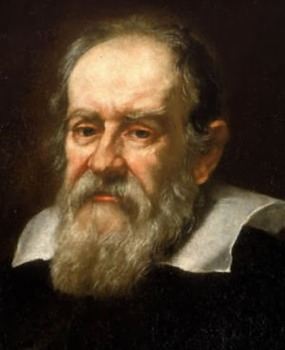
"All truths are easy to understand once they are discovered; the point is to discover them."
Galileo was an Italian physicist and astronomer. His achievements include
improvements to the telescope and consequent astronomical observations, and support
for Copernicanism. Galileo has been called the "father of modern observational
astronomy", the "father of modern physics", the "father of science", and "the Father of
Modern Science." The motion of uniformly accelerated objects, taught in nearly all high
school and introductory college physics courses, was studied by Galileo as the subject
of kinematics. His contributions to observational astronomy include the telescopic
confirmation of the phases of Venus, the discovery of the four largest satellites of
Jupiter, named the Galilean moons in his honor, and the observation and analysis of
sunspots. Galileo also worked in applied science and technology, improving compass
design. Galileo's championing of Copernicanism was controversial within his lifetime.
The geocentric view had been dominant since the time of Aristotle, and the controversy
engendered by Galileo's presentation of heliocentrism as proven fact resulted in the
Catholic Church's prohibiting its advocacy because it was not empirically proven at the
time. Galileo was eventually forced to recant his heliocentrism and spent the last years
of his life under house arrest on orders of the Holy Inquisition.