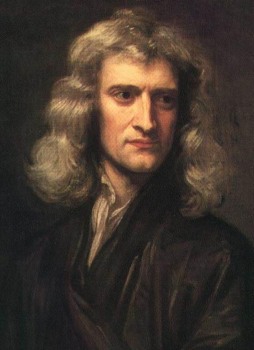
"To myself I am only a child playing on the beach, while vast oceans of truth lie undiscovered before me."
Newton was an English physicist, mathematician, astronomer, natural philosopher,
alchemist, theologian and one of the most influential men in human history. His
Philosophiæ Naturalis Principia Mathematica, published in 1687, is considered to be
the most influential book in the history of science. In this work, Newton described
universal gravitation and the three laws of motion, laying the groundwork for classical
mechanics, which dominated the scientific view of the physical universe for the next
three centuries and is the basis for modern engineering. Newton showed that the
motions of objects on Earth and of celestial bodies are governed by the same set of
natural laws by demonstrating the consistency between Kepler’s laws of planetary
motion and his theory of gravitation, thus removing the last doubts about heliocentrism
and advancing the scientific revolution. In mechanics, Newton enunciated the principles
of conservation of momentum and angular momentum. In optics, he built the first
"practical" reflecting telescope and developed a theory of color based on the
observation that a prism decomposes white light into a visible spectrum. He also
formulated an empirical law of cooling and studied the speed of sound. In mathematics,
Newton shares the credit with Gottfried Leibniz for the development of the differential
developed the so-called "Newton's method" for approximating the zeroes of a function,
and contributed to the study of power series. Newton's stature among scientists
remains at the very top rank, as demonstrated by a 2005 survey of scientists in Britain's
Royal Society asking who had the greater effect on the history of science, Newton was
deemed much more influential than Albert Einstein.