"You live where...?"
...someone once asked incredulously.
(Continued...)Back to Main Page The fact is that history is all around us and the reminders of recent history as well as ancient history are a matter of daily life. Our community, Elazar, was named after one of five sons of the Hasmonean Dynasty. The Hasmoneans, also known as the Maccabees, were direct lineal descendants of King David and they developed a small rag-tag guerrilla force and miraculously expelled the Assyrians from the Land of Israel in about 150 B.C.E. In today's terms this would have been like half the W.W.II Dutch Underground having expelled both the Axis and Allied powers from Holland! The festival of Hanukkah commemorates this achievement. Anyway, our community was named for Elazar the Maccabee because historical records and archeological findings indicate that the battle against the Assyrians where Elazar was killed happened on this spot. The story goes that the Assyrians used elephants as heavy transport vehicles and often put their generals on these elephants so he could get the advantage of height to more effectively see and manage command during the battle. Since the elephant's hide is so resilient (Latin: "pachyderm" = "tough skin") arrows couldn't penetrate it so the way to dispatch an elephant along with the general riding it was for a soldier to run up to a charging elephant, lie down in front of it and point a spear up toward the soft underbelly of the beast. The running animal then forced the spear into it's own frontal torso, usually very near the heart. In this case, Elazar killed the animal and it's rider but was also crushed to death by the falling elephant. Some historical records say that it was all for naught as the Assyrians put a slave tied to the elephant and dressed him up like a general just to foil such a tactic. Either way, our community was built on an empty and fallow field on a hillside where Elazar sacrificed himself.
Some of the more recent historical facts can be quite striking. F'rinstance, it is not wildly known that Harry Potter was killed by Arabs in Israel. It's a demonstrable and irrefutable fact. And to prove it note the following picture taken from a British Commonwealth military cemetery here in Israel...
The date on the above tombstone was a day on which the Arabs rioted en masse throughout the Land of Israel against all whom they regarded as foreigners, i.e.: both Jews who had been living here for many generations as well as against the British Mandate Occupational Forces that were in control.
Having worked as an orchardist for a number of years I found a number of antiques -- although it should be mentioned that, unlike in the States were an object is an antique only if it's at least 100 years old, here objects are not regarded as antique until they're at very least 1,000 years old. In my work and wanderings I've found a bunch of Roman coins, a Byzantine coin that was struck in the year 631 C.E., pieces of decorative glass from bottles of the Roman Period, a bronze pendant and several glass eyes. (Back in the Byzantine Period the officials punished malefactors and even potential rebels by gouging an eye out. For those unfortunate to have gotten such treatment a glass insert was custom-made to fill in the eye-socket so that the eyelid wouldn't hang loose and look quite unseemly.) I also found a section of a base of a large dinner plate. An archeologist who inspected it said that it was made before the pottery wheel was used here, and it was also made from a type of clay and in a style that is not found in any of the major cultures that conquered this land. So he estimated that it was at very latest, from the Late or Middle Bronze Age, as the pottery wheel came to these parts about that period, which was also the time of the Exodus from Egypt, in 1200 B.C.E.
We also have burial caves that were cut into the rock on the terraced hillsides and the orchards I worked in had 19 of these. Burial caves were cut until the Roman Period, but Byzantine monks lived in them in the 4th to the 6th Centuries as they expected the immanent return of Jesus' second coming and felt that they would get into heaven if they completely discarded the material things of this world and occupied themselves wholy with death and the next world.
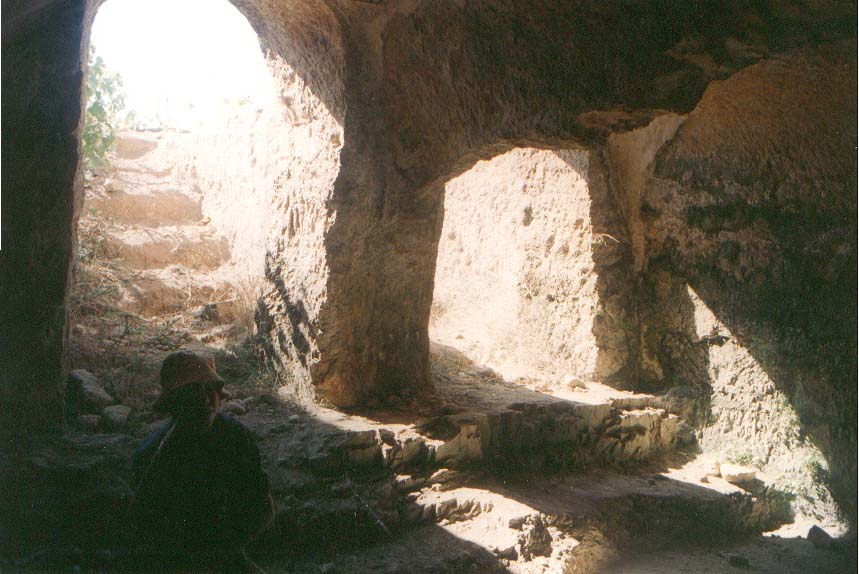
A few years ago a very well preserved ritual immersion pool was found on a hillside within about 400 yards of here. It is located on what used to be the main highway between Jerusalem, Bethlehem, Hebron & Be'ersheva. It was a pool for public use and had a seperate entrance & exit and is among the nicest examples of such items in existance. It dates back to the Roman Period and this is a picture from the interior:
Israel is a interesting place, a land of stark contrasts in both geography and ethnicity:
- Regarding geography, when my parents moved from Illinois to California they drove overland to their new home. My mom wrote regarding the U.S.: "This country is wonderful as the scenery changes completely every 300 to 500 miles." I wrote back: "I know that the US is beautiful, but the truth is that here in Israel one only has to travel within 5 miles from our home for the scenery to completely change. For just a mile to the west the slope of the Judean Mountain Range drops down, in places precipitously, to the coastal plane and the soils and climate are distinctly different from what we have up here. Then if one goes 4 miles to the east of us the eastern slope leads into the Judean Desert and on to the Dead Sea the lowest point on the surface of the earth, which is not more than 12 miles to the east of us. I could go on and on about how this country is so small, about the size of Rhode Island, but it has most every scenic topographical feature in the US but in a vastly reduced scale -- except for great rivers like the Mississippi.
- Regarding ethnicity, we are very much in the 21st Century, however we live within close proximity of Arab villages, the residents of which actively work at maintaining a mentality and culture of the 8th Century Dark Ages. Fascinating!
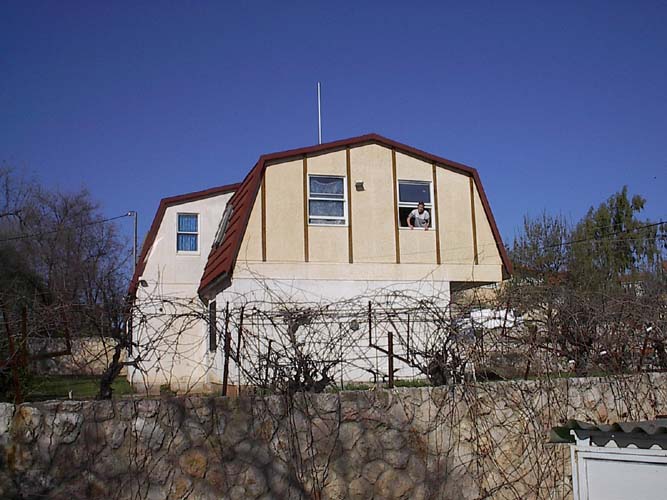
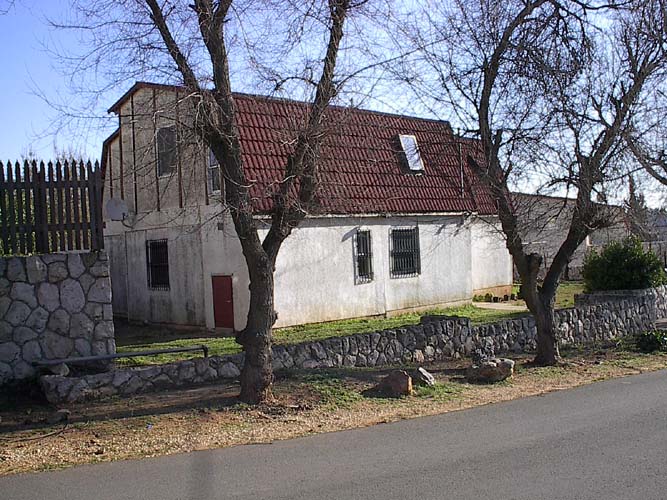
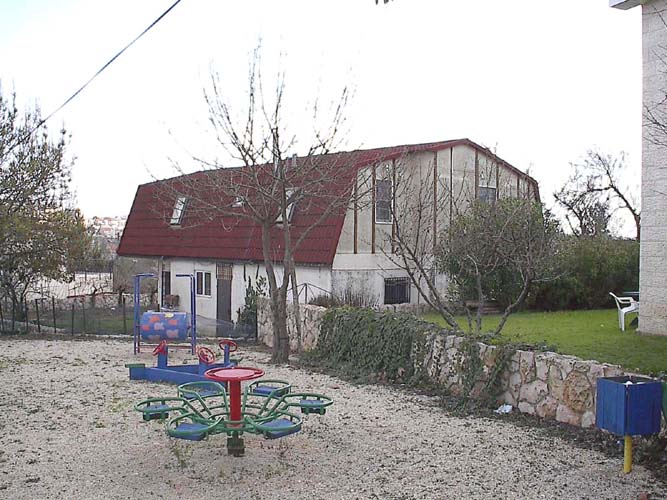
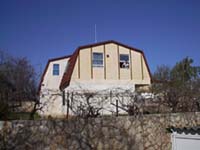
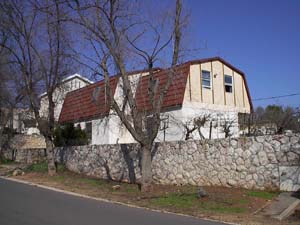
Now for pictures of our home & hearth (click to enlarge)...
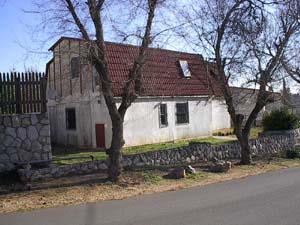
Here's a picture of the side of our house where in the summer of 2002 I grew strawberries in the center bed, grape & cherry tomatoes in the right bed, and wine grapes to the left and background.
Grapes have been grown in this area for the past 5,000 years as viticulture originated in these parts probably in pre-historic times, well before the arrival Caanaites. Our yard contains 17 vines, all wine varieties with one seedless table grape vine. Wine varieties include Cabernet Sauvignon, Sauvignon Blanc, Merlot, White Riesling, Kurvitz and Muscat Kenelly. The seedless grape is a Pearlette that grows over a pergola and entirely covers its 3.5 x 5 meter roof. I also grow red raspberries for commercial sale to diabetics. Here in Israel our summers are cloudless and we get so much sunlight as a result that fruits are typically high in sugar, and diabetics may not eat a majority of them. However, brambles are very low in sugar making them suitable for consumption by diabetics.
I hope to add more pictures of the general scenery of our area to this page in time.