 |
indian locomotives KP Achar Editor Ind Dak |
|
indian locomotives KP Achar Editor Ind Dak |
[Home][About Us][Membership][Member
List][Links][Kids][Feedback][Magazines][Dealers][Societies][Articles][WhatsNew]
| There are still people to-day in India who
have never travelled on a railway, but thanks to the
expansion of Television network in the country they would
have seen the Railway and a Locomotive. The Indian
Railways, with more than 1.6 million employees, is the
largest employer in the country. Established in 1853 when
the first train was flagged from Bombay to Thane, a
distance of 34 km, it has now grown to dizzy heights and
is covering more than 62,484 km across the country,
making it one of the largest networks in the world.
The Indian Railways have a fleet of 8682 steam
locomotives, 1702 diesel locomotives and 729 electric
locomotives. Richard Trevifthick was the first man to produce rail locomotives. The first was completed in 1802, nothing of it is known now except its existence. The first steam locomotive to run on a public railway was manufactured in 1825. The very like of this locomotive is preserved at Darlington Station, England. The era of steam locomotives began in India on December 22, 1851 when a small steam locomotive named "Thompson" started to haul some wagons containing earth during the construction of Solani Aqueduct near Roorkee (U.R). |
| On Saturday April 16, 1853, the first Indian Train (popularly called as Aag Gadi) steamed off from Bori Bunder to Thana a distance of 34 km. The train drawn by three engines covered the 34 km distance in 57 minutes. It had 400 passengers aboard. GIPNO 1 (Shown in 2 Rs. denomination stamp issued on 15 May 1976) is representative of the earliest engines employed in India. To operate the train service between Bori Bunder and Thana, the Great Indian Peninsular Railway ordered eight locomotives from Vulcan Foundry, England. The engines GIPNos 1-8 were manufactured in 1852. The first engine entered service in 1853. The type is 2-4-0. | 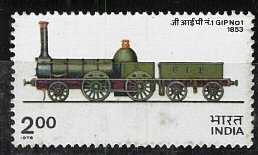 |
 The Fairy Queen is the Guinness certified
oldest working steam locomotive in the service of the
Indian Railway. It stopped service in 1908. It came
back to life in 1997 in Delhi-Alwar route and also won
National Tourism Award for most Innovative and Unique
Project. It was built by Kitson, Thompson &
Hewitson, UK for East Indian Railway in 1855. The
type is 2-2-2T. This special cancellation was
provided on the Historic Rail Journey Delhi-Alwar by
Fairy Queen on 18 October 1997. The Fairy Queen is the Guinness certified
oldest working steam locomotive in the service of the
Indian Railway. It stopped service in 1908. It came
back to life in 1997 in Delhi-Alwar route and also won
National Tourism Award for most Innovative and Unique
Project. It was built by Kitson, Thompson &
Hewitson, UK for East Indian Railway in 1855. The
type is 2-2-2T. This special cancellation was
provided on the Historic Rail Journey Delhi-Alwar by
Fairy Queen on 18 October 1997. |
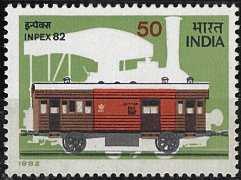
 The other oldest Locomotive is Ramgotty
built in 1862. It can be seen to-day in the National Rail Museum. During INPEX-82 the 50P
stamp issued depicted a vintage composite Railway coach
with Railway Mail Service Van and Silhouette of
Ramgotty. The type is 0.4.0. The other oldest Locomotive is Ramgotty
built in 1862. It can be seen to-day in the National Rail Museum. During INPEX-82 the 50P
stamp issued depicted a vintage composite Railway coach
with Railway Mail Service Van and Silhouette of
Ramgotty. The type is 0.4.0. |
 |
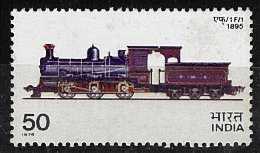 |
F/l - This was the most widely used engine on Indian Railways before Independence. It was extensively used on Rajputana Malwa Railway which became the meter gauge section of the Bombay and Central Indian Railway. The first of these engines was built by Dubs & Company Glasgow in 1875. From 1895 these engines were also manufactured in India at the Ajmer Railway Workshop. These were withdrawn from active service in 1958. The engine depicted on the stamp was Manufactured at Ajmer in 1895. Indigenous manufacture of locomotives was started on a small scale in the Railway workshop at Jamshedpur in 1889. Another workshop was set up at Ajmer in 1895. |
 |
[Home][About Us][Membership][Member List][Links][Kids][Feedback][Magazines][Dealers][Societies][Articles][WhatsNew]
Copyright
(c) Dakshina Kannada Philatelic Association
http://www.geocities.com/dakshina_kan_pa