 |
stamps issued in 2000 july |
|
stamps issued in 2000 july |
[Home][About Us][Membership][Member
List][Links][Kids][Feedback][Magazines][Dealers][Societies][Articles][WhatsNew]
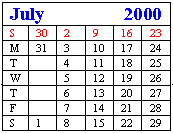
| The VIII Definitive Series was introduced on April 30, 2000. Two stamps were released. Four more stamps in the series Black Buck, Smooth Indian Otter, Saras Crane and the Nilgiri Tahr were released on 20 July 2000. The Kurinji (200p), Tawny Coaster Butterfly (1500p), Amaltars (2000p) and Paradise Fly Catcher (5000p) are yet to be released. |
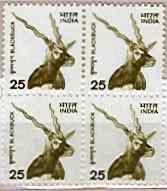 |
Black Buck (25 P) The Black Buck (Antelope cervicapra) (Krishna Saar) is an endangered and fully protected species in India and Nepal. The adult male Black Buck has striking black and white pelage (fur) and long spiral horns. Young males are light brown in colour and after 3 years their pelage turns quite black. Females are beige in colour and hornless. Their habitat is open grass land with thorny and dry deciduous forest. They prefer ectonal region between the forest and grass land. They prefer to be in group ranging 15 - 20 individuals. |
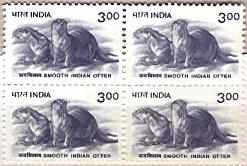
| Smooth Indian Otter
(300 P) The Smooth Coated Indian Otter
(Lutra perspicillata) is medium to large in size. Its
head to body is 655 to 790 mm. The tail is 406 to 505 mm
long. The whole length of the Otter is 1067 to 1300 mm.
They have quite large sized feet and have well developed
webbing that is strong and thick with strong claws.
They are raw umber to smoky grey brown colour. They, like
most Otters, have lighter bellies. They live in mangroves
to freshwater wetlands and large forested rivers. |
 |
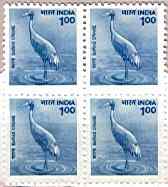 |
Saras Crane (100 P) The Saras Crane (Grus antigone) is the
tallest flying bird on Earth and the state bird of Uttar
Pradesh. The cranes are known to pair for life and are
found near marshes, lakes, village ponds and well watered
fields. Their numbers is however fast declining.
Ironically, they have long been a symbol of fertility and
fidelity in India, the second most populated country in
the world. Mainpuri, in Uttar Pradesh, will have a bird
sanctuary dedicated to the Saras Crane. |
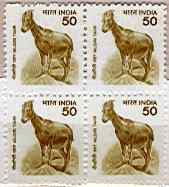
| Nilgiri Tahr (50 P) Nilgiri Tahr (Hemitragus hylocrius) usually occur in large groups of up to 150 animals and generally inhabit the fringes of the grassy plateau, making use of the bordering cliffs, rocky slabs and slopes for refuge and parturition. They tend to avoid entering the sholas, but may forage in their periphery. The Nilgiri Tahr Foundation has been launched in Kerala with the objective of studying, monitoring and conducting research on the highly endangered tahrs (mountain goats) of the Western ghats |
.  |
 |
 |
 |
[Home][About Us][Membership][Member List][Links][Kids][Feedback][Magazines][Dealers][Societies][Articles][WhatsNew]
Copyright
(c) Dakshina Kannada Philatelic Association
http://www.geocities.com/dakshina_kan_pa