 |
printing stamps |
|
printing stamps |
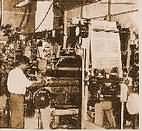
| An advisory committee consisting of officials, philatelists and artists advises the government about the stamps to be brought out. A preliminary design known as essays is brought out and the final design is selected by the committee. The printing of stamp is done at the Security Press where the currency notes are also printed. There are various ways of printing stamps. |
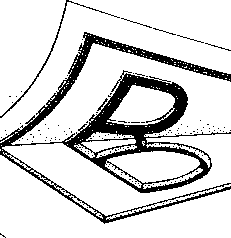
| Intaglio
or Recess Printing
This was the process used to print the first postage stamp. The engraver cuts in the design on a softened steel plate. This is the die. The design is transferred to a rubber roller and from there to steel plates row by row. The printing ink flows into the lines and is wiped clean by a sharp blade. The paper picks up the ink and this can be felt on the paper as a raised surface. |
 |
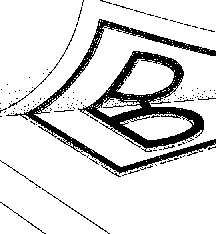 |
Typography The design is engraved on the die such that it stands out rather than being cut into as above. This is something like the typewriter. This makes the paper raise above the ink and can be seen with a magnifying glass. The colour seems to be below the surface. |
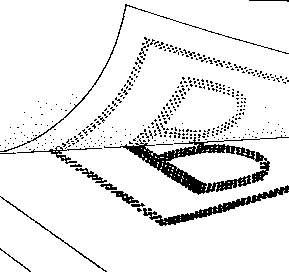
| Photogravure Here the design is photographed through a fine screen so that it is broken up into dots. This is reproduced on a special paper and squeezed on to a copper cylinder. On developing a gelatinous design is left on the cylinder which is then etched. The printing is similar to the intaglio process. The ink remains in the small dot and is transferred to the paper. Separate cylinders are prepared for separate colours. A magnifying glass reveals small dots of colours on the stamp printed by this process. |
 |
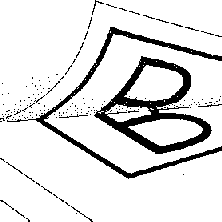 |
Lithography In lithography the design is transferred to a zinc plate with a greasy ink. The zinc plate is fixed on a rotary cylinder. The ink is transferred to a rubber roller and finally to a paper cylinder. |
 Printing Stamps
| [ Glossary of Terms ] | [ Stamp Stories ] | [ Stamp Exhibition ] |
Copyright (c) Dakshina
Kannada Philatelic Association
http://www.geocities.com/dakshina_kan_pa