 |
story of the first airmail YV Jeppu |
|
story of the first airmail YV Jeppu |
| The aircraft was
invented by the Wright brothers in USA but the first
Airmail to fly in the world was flown in India. This is
the story of the First Airmail. In early December 1910, SS Persia, a British merchantship arrived in Bombay with big cases containing dismantled plane parts. Accompanying the cargo were Commander Sir Walter George Windham and two pilots Henri Pequet, a Frenchman and Keith Davies, an Englishman. Along with them were also two mechanics Haffkin (English) and Billon (French). This was the team sent by Humber Motor Company, Coventry, England to exhibit the planes at the Industrial and Agricultural Exhibition to be held at Allahabad UP (United Provinces). |
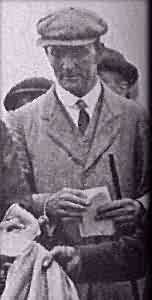 Sir Walter George Windham |
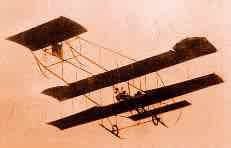 Sommer Biplane
|
The Humber Motor
Company started manufacturing under license Bleriot XI
monoplanes called Humber Bleriot in 1910. Towards the end
of the year they manufactured two Roger Sommer biplanes
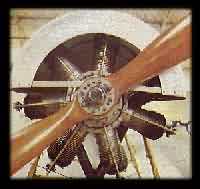
one of which was sent to India with the team. The Roger Sommer biplane was basically a modified Henri Farman biplane with a 50 HP, seven cylinder, Gnome rotary engine. The Gnome engine, developed by two French brothers Laurent and Gustav Seguin in 1908, was an innovation in engine design. Unlike the internal combustion engines of today, The Gnome had a crankshaft fixed to the airplane and the cylinders, arranged radially around it, rotated acting as a flywheel. This system cooled the cylinders effectively and reduced the weight by eliminating the water cooling system. The lighter weight and smooth running made it a popular engine till the end of World War I. The engine was placed behind the propellor which pushed the aircraft. The elevator in the front controlled the pitching movement of the aircraft and the ailerons on the wings controlled the rolling movements. |
| The party left by train
to Allahabad and reached there on December 5. Two planes
were assembled in 5 days in a polo field adjacent to the
exhibition grounds. On December 10, Keith Davies flew his
Bleriot possibly to test it after assembling. "On
the 10th of December Mr. Davies had the machine ready and
early in the morning circled the polo ground at a height
of twenty to thirty feet" quoted one newspaper. Windham was approached by the clergyman in charge of Holy Trinity Church, Allahabad, to see if he could raise some funds for a hostel planned by the church. Windham thought that if he could fly some mail across the river Ganges (Ganga) to Naini and put a special postmark, he could raise the money for the hostel. The Post master General
of United Provinces and the Director General of Post
Office in India approved the idea and a special postmark
was authorized. The cancellation read First
Aerial Post.
A clergyman was appointed as the Postmaster at the parade
ground at Naini. A surcharge of 6 annas (37 paise
today) was made and letters poured in from all over
India. One letter had stamps worth 25 rupees. On February
17th, the day before the event, the Oxford and Cambridge
Hostel at Allahabad was turned into a small GPO. The
sorting of letters and postcards (approximately 6000)
started at 9.00 hours in the morning and lasted till
midnight. Henri Pequet signed some 400 postcards
himself! |
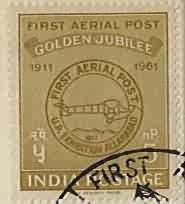 Special Postmark depicted on the stamp issued on the Golden Jubilee of the Event
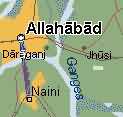
The First Airmail Route |
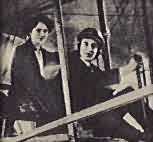 Henri Pequet
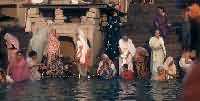
Bathing in Ganges |
It was a fine morning
at Allahabad on the 18th of February, 1911. Henri Pequet
took off with a wrist watch on his right hand and an
altimeter fixed to his left knee. The biplane flew to
Naini at 40 mph at an altitude of 130 feet. He landed at
Naini, 8 Km from Allahabad, to be greeted by the lone
postmaster. Pequet flew back. The whole journey lasted 27
minutes. The occasion coincided with Purna Kumbha, the Hindu festival held once every 12 years. Pequet had a birds eye of a million Indians washing away their sins in the Ganges below. Thus the event was watched by over a million Indians that day! One of the recipients of the first airmail was King George V of England. His secretary wrote to Windham "The King desires me to send you his thanks for the letter he received from India, bearing the inscription "First Aerial Post", which will be an interesting addition to His Majesty's stamp collection". Henri Pequet that day introduced aviation as a Postal Tool at Allahabad. February 18, 1911 will always remain as a Red letter day not only in India but all over the World! |
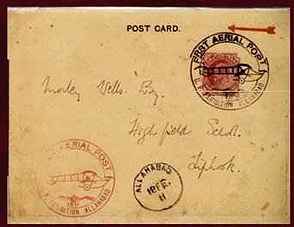 A Post Card on the first airmail - courtsey Wonderland of Stamps
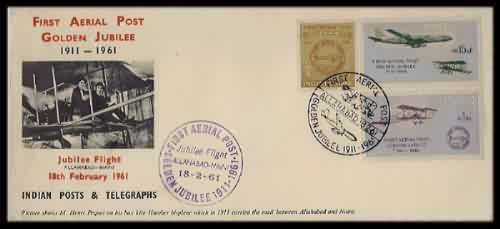
India brought out this
special cover to commemorate the Golden Jubilee of this
event. A DHC Otter aircraft of the UP Flying Club flew
the Allahabad-Naini-Allahad route carrying these covers.
A planeload of invitees flew to Allahabad to witness the
event.
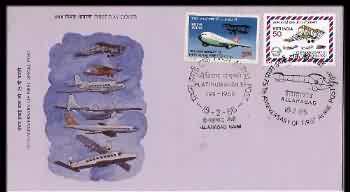
This special cover was issued to commemorate the Platinum Jubilee of the event. |
Copyright (c) Dakshina
Kannada Philatelic Association
http://www.geocities.com/dakshina_kan_pa