 |
glimpses of astronomy in indian stamps YV Jeppu |
|
glimpses of astronomy in indian stamps YV Jeppu |
| Man
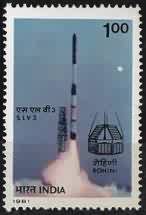
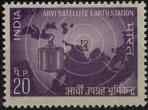
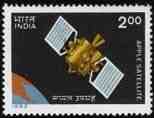
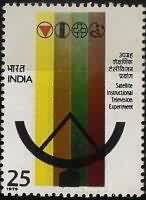
on the Moon ... The successful firing of the Satellite launch vehicles has highlighted India’s Space programme. The first vehicle SLV-3 was launched from Sriharikota on July 18, 1981. The Ariane Passenger Payload Experiment (APPLE) was launched from French Guyana on June 19, 1981. The satellites are monitored from Earth Stations including the one at Arvi in Pune established on February 26, 1971. Satellites have been used for metrology and TV broadcasts. USA launched the American satellite ATS-6 in May 1974. This was placed over Africa to enable India’s Satellite Instructional Television Experiment (SITE) which began transmission on August 1, 1975. For the first time television was brought to the Indian villages via this satellite. These events are highlights of India’s space programme and have been commemorated by the issue of postage stamps.
|
|
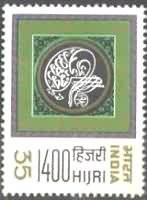 |
The most fascinating phenomenon in the
sky is the waxing and waning of the moon. This has
defined the Hindu calendar from the Vedic times. The
Muslim calendar also follows the lunar cycle. The Muslim
Era is computed from the year of emigration Hegira;
that is, from the year Prophet Muhammad emigrated from
Mecca to Medina in AD 622. The second caliph, Umar I, set
the first day of the month Muharram as the
beginning of the year on July 16, 622 AD. In the Hegira
calendar alternate months have 30 and 29 days except of
the 12th month which has a different rule. In
a thirty-year cycle the 12th month has 30 days
for first 11 years and 29 days in the rest 19 years. The
14th century of the Hegira Calendar
was commemorated on November 3, 1980. |
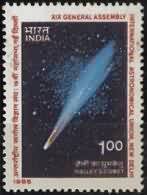
| Another fascinating member of the
family of our solar system is the comet. Edmund Halley
computed the orbit of a comet and predicted that it would
return in 1758. This happened as predicted and the comet
was named as Halley’s comet. The comet has a
period of 76 years and it was first sighted in 240 BC.
The comet has a speed of 128000 km/h and passed by the
earth in November 1985 and April 1986. It was observed by
two soviet space crafts Vega 1 and Vega2. The 19th
general assembly of the International Astronomical
Union was held in New Delhi on 28 November 1985. The
Halley’s comet was a topic of discussion during the
meeting. The IAU stamp issued to mark the occasion has
the alley’s comet depicted on it. |
 |
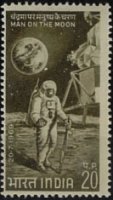 |
"That's one small step for man,
one giant leap for mankind", the famous words of
Niel Armstrong echoed from Moon on July 20, 1969. The
plaque left behind by Apollo 11 mission on the dusty face
of the moon bears a silent witness to man’s
achievement. The plaque reads, "Here Men from The
Planet Earth First Set Foot upon The Moon, July 1969 AD
We Came in Peace for All Mankind". This moment is
imprinted permanently on India postage stamp issued on
November 19, 1969 commemorating the event. |
WB Yeats, Irish poet and playright had this to say about stamps; "Designs in connection with postage stamps and coinage may be described, I think, as the silent ambassadors on national taste." Indian stamps depict this national taste colourfully. It is a pleasure to go out on a clear summer night and look up at the stars and listen to the stories they tell. On cold cloudy nights the stamps too tell the story, but do we care to listen? |
 |
Copyright (c) Dakshina
Kannada Philatelic Association
http://www.geocities.com/dakshina_kan_pa