 |
glimpses of astronomy in indian stamps YV Jeppu |
|
glimpses of astronomy in indian stamps YV Jeppu |
| The
History ... At noon, March 21, 499 AD a great
astronomer of 23 years of age fixed an Epoch in Time. He
was Aryabhata the man who gave the theory that the earth
rotated and the stars were stationary. He gave the rate
of this rotation so accurately that the error compared
with the modern value is only 0.01 second. Aryabhata gave
methods for computing the planetary positions, detailed
designs for instruments to measure astronomical phenomena
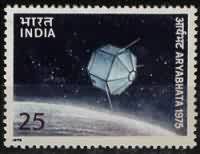
and theories to comprehend Time. India launched her first
satellite Aryabhata on April 19, 1975. This satellite was
instrumented to explore conditions in the earth’s
ionosphere, measure neutrons and gamma rays from the sun
and for the study of X-ray astronomy. A stamp was
released on 20 April 1975 to mark the launching of Aryabhata.
|
 |
 |
The publication of De
revolutionibus orbium coelestium, libri VI (On the
Revolutions of the Celestial Spheres) in 1543 by Nicolaus
Copernicus changed the concept of the heavens for the
Western world. No longer was earth the centre of cosmos.
Copernicus was born Mikolaj Kopernik on February
19, 1473 at Torun in eastern Poland. He was not happy
with the Ptolemic system of astronomy and postulated the
heliocentric system. The work was not published till his
death. A copy of the great work is believed to have been
brought to Copernicus at Frauenburg on the last day of
his life, May 24, 1543. Nicolaus Copernicus was
honoured by India with the issue of the postage stamp on
21 July 1973. |
| Satellites can measure the intensity
of rays in outer space. On earth too we can conduct a
large number of experiments and measure a number of
parameters concerning outer space. The earliest
instruments developed were to measure the sun’s
movements from its shadow on earth. These measurements
were used for time keeping. Aryabhata has described
various shadow instruments in his siddantha. In 1724 Raja
Jai Singh Sawai completed his treatise on instruments
called Yantraprakara. He set up observatories at Jaipur
and Delhi called Jantar Mantar. Sadly, these masonry
structures were used for target practice by his grandson.
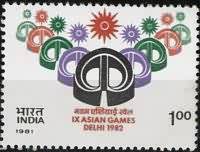
Jantar Mantar was used as a logo for Asian
Games. This logo is depicted on the stamp brought out
in 1981, July 28 marking the inauguration of the games. |
 |
 |
 |
Copyright (c) Dakshina
Kannada Philatelic Association
http://www.geocities.com/dakshina_kan_pa