 |
fragrant stamps
|
|
fragrant stamps
|
[Home][About Us][Membership][Member List][Links][Kids][Feedback][Magazines][Dealers][Societies][Articles][WhatsNew]
| On May 9,
2001 Swiss Post issued a 90-centime stamp to celebrate the centenary
of Chocosuisse,
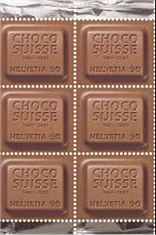
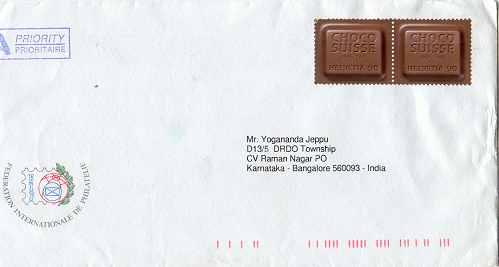
a union of Swiss chocolate manufacturers. The unique feature of
this stamp was that the stamp not only looked like chocolate but
smelled like one too! The full sheet contained 15 stamps resembling
the squares of a chocolate bar and they were framed by crinkled foil.
The stamps were a huge hit not only among stamp collectors but among
the chocolate lovers as well, who lined up to grab a sweet smelling no
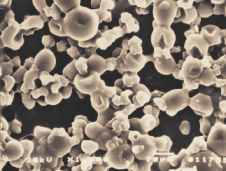
calorie chocolate sheet. How was this done? A technology of the 1940s called micro-encapsulation was responsible for this miracle. This technology, though developed to make carbonless copy paper, is used today to market new perfumes, soaps and now stamps. The paper printed with this technology is used to tickle the nose with the impregnated perfume when a person rubs the surface. It is popularly called "Scratch 'n' Sniff". Micro-encapsulation involves making very small plastic or gelatine sphere or bottles about a few microns in diameter (one micron is 1 millionth of a metre) around the aromatic chemical or perfume. When you scratch the paper these capsules break a few bottles releasing the smell. Fragrance can be preserved like this for years! The fragrance sampler is a delicate balance of four components. They are the microcapsules or bottles, the fragrance, the glue and finally the paper on which these three will be applied. Instead of making the bottle and adding the fragrant oil to it a process called "Coacervation" is used to form small droplets of oil in water. The oil should have certain properties for it to be used for microencapsulation. It should obviously dissolve in water and it should not react with the bottle. A wall of urea-formaldehyde or gelatine is formed around these oil drops and hardened to form a shell. These capsules are again washed and suspended in water for further processing. The capsule slurry is added with the adhesive gently so as not to break the bottles. You cannot use a kitchen blender for this job. The glue used for the process does not have any odour of its own whether wet or dry nor does it react with the capsules. Usually the adhesive and the capsules are stored separately in a cool dry hygienic environment to avoid bacterial attack. |
|
|
|
[Home][About Us][Membership][Member List][Links][Kids][Feedback][Magazines][Dealers][Societies][Articles][WhatsNew]
Copyright (c)
Dakshina Kannada Philatelic and Numismatic Association
http://www.geocities.com/dakshina_kan_pa