 |
stamps issued in 2002 april |
|
stamps issued in 2002 april |
[Home][About Us][Membership][Member
List][Links][Kids][Feedback][Magazines][Dealers][Societies][Articles][WhatsNew]
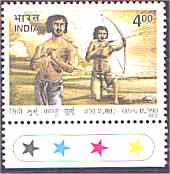
Sido Murmu - Kanhu Murmu The Murmu brothers, Sido and Kanhu, were the leaders who masterminded the famous Santal Hul (liberation movement) of 1855-57, a heroic episode in India's prolonged struggle for freedom. Resistance of the indigenous peoples to British rule in India started almost immediately after the East India Company captured political power in many parts of the country. Discontent had been simmering in the Santal Parganas (presently in the State of Jharkhand) from the early decades of the nineteenth century, on the face of oppression and exploitation of the indigenous Santals by the authorities as well as immigrants. The emergence of Sido and Kanhu, youthful, dynamic and charismatic, provided a rallying point for the Santals. Hailing from the, village Bhognadih in Sahibganj district, Sido Murmu and Kanhu Murmu had long been brooding over the injustices perpetrated by the oppressors. The situation had reached a flash-point and, not surprisingly, a small episode that took place in July 1855 triggered one of the fiercest uprisings that the British administration ever faced in India. Earlier, on 30th June 1855 a large gathering of Santals, under the leadership of Sido Murmu and Kanhu Murmu had declared themselves free and took oath to fight the foreign rulers as well as their agents. The Santals were in this mood of militant enthusiasm when a Police agent confronted them on the 7th July and tried to place the Murmu brothers under arrest. The angry crowd reacted violently and killed the Police agent and his men. The event sparked off a series of confrontations with the Company's Army, and reached the scale of a full-fledged war. Led by Sido and Kanhu, the Santals made tremendous gains initially and captured control over a large tract of the country extending from Colgong on the west to Rajmahal hills on the east and nearly as far as Raniganj and Sainthia on the south. However, they could not hold on to the gains as the mighty military machine of the East India Company came down heavily on them. The courage, chivalry and sacrifice of the Santals were countered by the rulers with veritable butchery. The British Indian Army finally suppressed the rebellion in 1856, though some outbreaks continued into 1857. It is believed that Sido was captured by the British forces though treachery and Kanhu, through an encounter at Uparbanda, and were subsequently killed in captivity. The Santal Nul, however, had a long-lasting impact. Santal Parganas Tenancy Act was the outcome of this struggle.
|
|
|
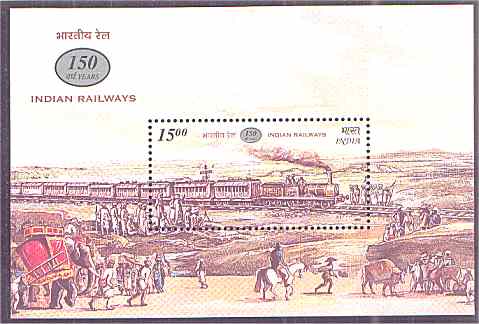
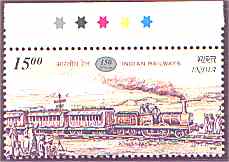
150 Years of Railways
in India
Railways have been a great integrating force in India for more than a century, particularly so after the attaining of independence in 1947. The history of Railways in India began on 16th April 1853, when the first train steamed off from Boribunder to Thane, covering a distance of 34 kilometers. From such a modest beginning, the Indian Railways have grown into a large network of about 7,000 stations spread over a route length of nearly 63,000 kmls. Today it is one of the largest organisations in the world, employing a work force of l6 lakhs. It provides the principal mode of transport for freight and passengers in India. The Railway network runs multi gauge operations with the broad gauge, meter gauge and narrow gauge tracks. The network is divided into nine zones. Seven new zones and nine new divisions are further being set up. Each day about 7500 passenger trains carry more than 11 million passengers in different parts of the country. As the country braces itself to observe an year long celebration to mark the 150th anniversary of India's first train journey which falls in 2003, the Department of Posts tries to capture the spirit of the event with the issue of this commemorative stamp. The design of the stamp (and the miniature sheet) tries to re-create the Indian landscape of 1853, with the first train chugging away in the distance, on its journey to Thane on the l6th of April.
|
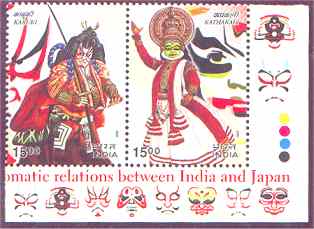
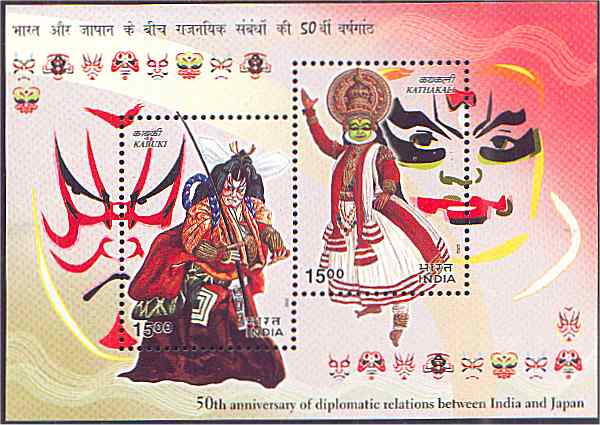
| 50th Anniversary of Diplomatiuc Relations
Between India and Japan Lord Buddha who gave the message of peace and non violence to the world also paved the way for a special bond between India and Japan. For nearly 2500 years the Japanese people have regarded India as a sacred country which has been a source of inspiration to them, through the spirituality of Buddhism. India has in its turn admired the phoenix-like economic reconstruction of Japan rising from the ashes of World
War II. Common values shared by the peoples of the two countries like liberty and parliamentary democracy provide a sound basis to carry forward the constructive partnership into the 21st century. Being two prominent members of the world comity of nations the potential of Indo-Japanese friendship is not limited to bilateral relations but also extends to their joint efforts for maintaining peace and security in the international arena and addressing various issues global concern.
|
|
Ovr Sz - Overall Size Pr Sz - Printed Size
![March [Back]](../art24/mar.jpg) |
 |
 |
[Home][About Us][Membership][Member List][Links][Kids][Feedback][Magazines][Dealers][Societies][Articles][WhatsNew]
Copyright
(c) Dakshina Kannada Philatelic and Numismatic Association
http://www.geocities.com/dakshina_kan_pa