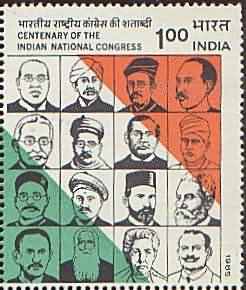
| Romesh Chunder Dutt (1848-1909)
Romesh Chunder Dutt was born in Calcutta on
August 13, 1848, into a family already famous for
academic and literary attainments. He became
President of the Indian National Congress in 1899
and was regarded by the growing politically -
conscious educated public as one of their most
effective spokesmen. He died at the age of 61 in
1909. (go to the
top)
|
| Sir Narayan Ganesh
Chandavarkar (1855-1923) Narayan Ganesh
Chandavarkar was born in Honawar in the North
Kanara District of the Bombay Presidency on
December 2, 1855. His visit to England in 1885
carved out for Chandavarkar a political career,
and he threw himself whole-heartedly into the
work of the Indian National Congress which was
founded in Bombay in 1885 on December 28, the day
on which he and the other delegates returned to
India. Fifteen years later, in 1900, he was
elected President of the annual session of the
Congress held in Lahore. (go to the top)
|
| Dinshaw Edulji Wacha (1844-1936)
Dinshaw Edulji Wacha was born in Bombay on August
2, 1844 in a middle class Parsi family. He was a
founder member of the Indian National Congress,
functioned as its Secretary for several years and
was elected its President in 1901. He was
Knighted in 1917. (go to the top)
|
| Lalmohan Ghosh (1849-1909)
Lalmohan Ghosh was born in Krishnagar, West
Bengal, in 1849. He was elected President
of the Madras session (1903) of the Indian
National Congress. Lalmohan Ghosh died in
Calcutta on October 18, 1909. Lalmohan Ghosh's
particular contribution to the national movement
of India was fearless and cogent criticism of the
established authority. (go to the top)
|
| Sir Henry Cotton (1845-1915)
Sir Henry Cotton belonged to a distinguished
family who served India for five generations.
Henry's father, Joseph John Cotton, was a Madras
Civilian from 1831 to 1863. Henry was born in
1845 at Combaconum in the Tanjore district of
Madras. In October 1867, he came to India to join
the Bengal Civil Service. He returned to India to
preside over the twentieth session of the Indian
National Congress at Bombay, in 1904. (go to the top)
|
| Gopal Krishna Gokhale (1866-1915)
Gopal Krishna Gokhale was born on May 9, 1866 at
Katulk in Ratnagiri. The economic condition of
the family was so bad that on his father's death,
he could continue his studies only because his
elder brother sacrificed his own education. In
1889 he became a member of the Indian National
Congress. In 1895 he became Joint Secretary of
the Indian National Congress along with Tilak.
For nearly three decades Gokhale dedicated his
rare qualities to the exclusive service of his
country and his people in a way which few could
lay claim to. (go to the top)
|
| Dr Rashbihari Ghosh
(1845-1921) Rashbihari Ghosh was born on December
23, 1845 in Burdwan, West Bengal. He did not
associate himself publicly with the Indian
National Congress until 1906. In 1906 he was the
Chairman of the Reception Committee when the
Congress held its annual session in Calcutta.
Next year he presided over the Surat session
which ended in pandemonium. In 1908 be, presided
over the Madras session. (go to the top)
|
| Pandit Madan Mohan
Malaviya (1861-1946) Madan Mohan
Malaviya was born in Allahabad on December 25,
1861. His ancestors were poor but had a social
status and were known for their Sanskrit
scholarship. With few exceptions Malaviya
regularly attended the annual Congress sessions
from 1886 to 1936. In 1887, he invited the
Congress to Allahabad. On account of his services
to the Congress he was elected its President in
1909,1918,1932 and 1933, but owing to his arrest
by the Government of India, he could not preside
over the 1932 and 1933 sessions which had been
banned. (go to the
top)
|
| Pandit Bishan Narayan Dar (1864-1916)
Pandit Bishan Narayan Dar, one of the most
prominent nationalist leaders in the early phase
of the Indian National Congress, was born at
Barabanki (U.P.) in 1864. It was in 1892 that
Bishan Narayan Dar first attended the Indian
National Congress, and from that time on he was a
regular participant in the Congress sessions. He
was one of the most eloquent speakers at the
Congress. In 1911 he presided over the Calcutta
Session of the Congress and his Presidential
address was one of the best in the history of the
Congress. (go to the
top)
|
| Rao Bahadur Raghunath
Narasinha Mudholkar (1857-1921)
Raghunath Mudholkar was born in Dhulia, Khandesh,
in a respectable middle class family on May 16,
1857. He was in the Congress from 1888 to 1917,
and thereafter joined the Liberals. He was in the
Congress delegation of 1890 sent to England to
voice the grievances of the Indians. He was
President of the Indian National Congress held at
Bankipur in 1912. (go to the top)
|
| Nawab Syed Muhammad
Bahadur (? - 1919) Nawab Syed Muhammad
was the son of Mir Humayun Bahadur, one of the
wealthiest Muslims of South India. Humayun
Bahadur was a sincere nationalist-minded Muslim
who helped the Indian National Congress in its
early stages, by giving both financial and
intellectual support. He joined the Indian
National Congress in 1894 and became an active
member of the organisation. A believer in social
uplift of the masses, he was the President of the
Madras Mahajana Sabha from 1903, and his
nationalist views were rewarded by election to
the Presidency of the Indian National Congress in
1913 at Karachi. The date of his birth is not
known from any reliable source; according to the
Hindu he died on February 12, 1919. (go to the top)
|
| Bhupendra Nath Bose (1859-1924)
Bhupendra Nath Bose was born at Krishnagar
(Bengal) in 1859. In 1914 he was the President of
the Indian National Congress at Madras. He
supported the Age of Consent Bill 1891. He was in
favour of western education. Above all, Bhupendra
Nath was a nationalist and wanted self-government
for India. When he died in 1924, he was working
as the Vice-Chancellor of the Calcutta
University. (go to the top)
|
| Lord Satyendra Prasanna
Sinha (1863-1928) Satyendra Prasanna was
born at Raipur in March 1863. He was the first
Indian to become the Advocate-General of Bengal
(1905), also the first Indian to enter the
Governor General's Executive Council (1909).
Satyendra was an active member of the Indian
National Congress from 1896 to 1919 when along
with other moderates he left the organisation. At
the Calcutta session of the Congress in 1896 he
brought forward a proposal that no ruler of any
Indian State should be deposed without an open
judicial trial. In 1915 he was elected to preside
over the Bombay session of the Congress. In 1919
he was raised to the peerage as Baron Sinha of
Raipur and was entrusted with piloting the
Government of India Bill (1919) through the House
of Lords. Satyendra Prasanna was the recipient of
many honours and was Knighted in 1914. (go to the top)
|
| Ambica Charan Mazumdar
(1850 - 1922) Ambica Charan Mazumdar was born at
Sandiya, Faridpur district in East Bengal, in
1850. In 1886 he attended the second session of
the Indian National Congress held in Calcutta. In
1916, as a culmination of his political career,
he became the President of the 31st Session of
the Indian National Congress in Lucknow and in
his presidential speech stated: "Call it
Home Rule, call it selfrule, call it Swaraj . . .
it is representative government." (go to the top)
|
| Dr Annie Besant (1847-1933)
Annie Besant was born in London on October 1,
1847. She first came to India on November 16,
1893. She was a delegate to the Indian National
Congress in 1914. In August 1917 she was made the
President of the Calcutta Session of the Indian
National Congress. In 1917 she started the
Women's Indian Association to which she gave her
powerful support. She was in the forefront of all
constructive work done during the forty years of
her active service in India. (go to the top)
|
| Syed Hasan Imam (1871-1933)
Hasan Imam, son of lmdad Imam, was born at Neora,
District Patna, on August 31, 1871. He presided
over the special session of the Indian National
Congress held at Bombay, 1918, to consider the
Montagu-Chelmsford Reforms Scheme. He died on
April 19, 1933 and lies buried at Japala,
District Shahabad. (go to the top)
|