 |
stamps issued in 2001 june |
|
stamps issued in 2001 june |
[Home][About Us][Membership][Member
List][Links][Kids][Feedback][Magazines][Dealers][Societies][Articles][WhatsNew]
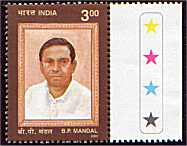 |
B P Mandal BP Mandal (1918-1982), former Chief Minister of Bihar, was born at Madhepura district in Bihar. He had his early education at Darbhanga and higher education at Patna. He worked as a Honorary Magistrate during 1945-51. Though his political career started with the Indian National Congress, he was soon attracted towards the 'Socialist' stream of thought, and joined the Samyukta Socialist Party. He took over as the Chief Minister of the State in 1968. In 1978, he was appointed as the Chairman of the Backward Classes Commission of the Government of India, to investigate the conditions of the socially and educationally backward classes of citizens and report upon ways and means of upliftment of these sections of the society. The Mandal Commission drew sustenance from the Constitution of India, which contained various special safeguards for the historically deprived backward classes. The report submitted by him in 1980 is one among the most significant and forceful commentaries on the socio-political situation of the country.
|
| Samanta
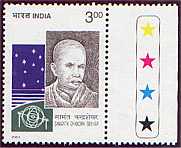
Chandra Shekar Samanta Chandra Sekhar (1835-1904) is a prominent name in traditional Indian Astronomy, who has been placed by some scholars at par with Aryabhata, Varahamihira, Brahmagupta and Bhaskracharya. Chandra Sekhar was taught to identify stars by his father when he was a child. Finding that the stars and planets did not rise and appear at positions predicted by the ancient Siddhantas, he set out for observation, night and day, checking the figures occurring in the earlier works. He began recording his observations and making formulations of the ideas at the age of twenty three and started putting them in the form of a treatise some three years later. The complete script of Siddhanta Darpana, his treatise, was ready by 1869, when he was thirty four. However, the work was checked and refined for twenty three years more, till it was declared by the author to be closed in 1892. The Siddhanta Darpana is divided into five sections, of which the first two deal with the mean motion and true position of the planets respectively. The third section deals with the motion described in terms of space, time and direction. The fourth gives an account of related mathematical topics like spherical trigonometry and the fifth describes different ways of reckoning time. Chandra Sekhar observed, verified and corrected wherever necessary, all that was known to the Hindu astronomers for thousands of years. The Siddhanta Darpana has been written in beautiful, metrical Sanskrit verse and is a fine piece of literary work apart from being of appreciable scientific value. Further, the work enjoys practical importance even today, as the most widely accepted almanac in Orissa is prepared as per the prescriptions of the Darpana. Chandra Sekhar did not know about modern astronomical instruments. It is remarkable that he had used only some rudimentary instruments, some of them devised by himself, for his extraordinary observations. Samanta had made contributions to all the four major aspects of astronomy, namely (i) observation (ii) calculation (iii) method of measurement and (iv) theory and model. The "Nature" and the "Knowledge", famous scientific journals, wrote in praise of Siddhanta Darpana and Samanta Chandra Sekhar, in 1899. The former declared this genius even greater than the famous Tycho Brahe and the latter named him the greatest naked eye astronomer. The stamp design includes Gola Yantra, an instrument used by Chandra Sekhar for measuring planetary positions.
|
 |
 |
Snt
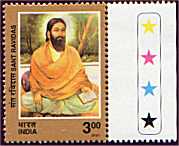
Ravidas Sant Ravidas (circa 15th century AD) was one of the brightest luminaries in the firmament of the Bhakti Movement, which was a religious renaissance in India. He upheld the equality of all mankind, giving the call "deed not the creed makes man high or low". He emphasized the fundamental tenets underlying all religions. He taught in times dominated by the rigidity and narrow-mindedness of the caste system, and illuminated the atmosphere with his enlightenment. As a proponent of the "Bhakti Movement", his contribution was truly great, spreading the philosophy of spiritual self-realization through "Bhakti", and dispelling the darkness of "ajnana", with "jnana" (wisdom). He emerged as a great philosopher-poet and social reformer, for humanity at large. Born in most humble surroundings, in the house of a cobbler, Sant Ravidas had a spiritual bend of mind. even in his early life. His father inspired him to join the family business, but Ravidas, imbued with celestial and humane values, spent the money received from his father for business, in the welfare of the needy. Ravidas being a 'charmkar' by birth was denied entry into temples. The maharaja and rani of Chittor became his disciples. Mira Bai, the famous saint poetess also adopted him as her Guru. Sant Ravidas composed many shabdas. Out of them, about 41 shabdas have been included in the Holy Guru Granth Sahib. His shabdas are packed with divine wisdom and in each of them, he advocates 'Ram nam jap' and extols the efficacy of this great mantra. In his teachings, he says, "God is everywhere'. in you and me."
|
Ovr Sz - Overall Size Pr Sz - Printed Size
 |
 |
 |
[Home][About Us][Membership][Member List][Links][Kids][Feedback][Magazines][Dealers][Societies][Articles][WhatsNew]
Copyright
(c) Dakshina Kannada Philatelic Association
http://www.geocities.com/dakshina_kan_pa