 |
stamps issued in 2001 august |
|
stamps issued in 2001 august |
[Home][About Us][Membership][Member
List][Links][Kids][Feedback][Magazines][Dealers][Societies][Articles][WhatsNew]
|
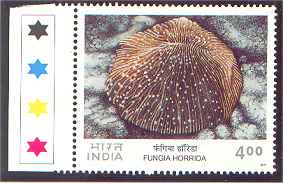
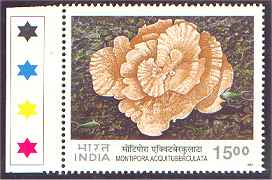
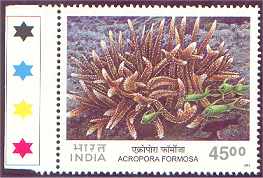
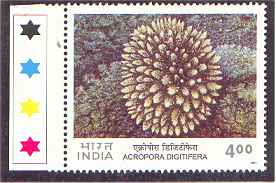
Corals of India
Coral reefs are among the greatest splendours of nature. They are the biggest structures built by living, organisms. Interestingly, tiny coral animals, often so small that they are invisible to the naked eye, build the vast reefs. What is commonly referred to coral is actually the skeleton of the coral animal, which is also called a polyp. Polyps generally multiply by the process of budding, whereby a portion of the parent pinches off to form a daughter polyp. All the daughter polyps along with their skeletons form a colony. Corals on the reefs have algae living inside their cells. The algal pigments are mostly responsible for the spectacular colours of the corals.
|
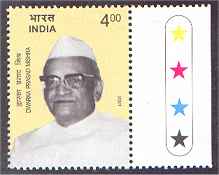
| Dwarka Prasad Mishra Dwarka Prasad Mishra (1901-1988), former Chief Minister of Madhya Pradesh, joined the national movement at a young age heeding the call of Mahatma Gandhi. He was in the forefront of the national movement from 1920 onwards and came into close association with Sardar Vallabhbhai Patel and other national leaders. He exposed the exploitive practices of the British as well as their policy of 'Divide and Rule'. He was jailed for a number of years for his role in the freedom struggle. His tenure as the Chief Minister of Madhya Pradesh saw the all-round development of the state. He was a practitioner of truth and fairness in political life. Dwarka Prasad Mishra was a journalist of repute, having edited the Hindi journals Lokmat, Sharda and Saarthi and used them masterfully to put across his views and messages to the masses. His epic poem, Krishnayan, was highly acclaimed by the critics. In this book, his dream of a happy and free India in which the highest welfare of the people is served has been portrayed.
|
 |
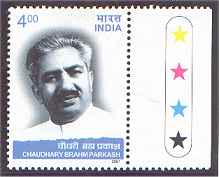 |
Chaudhary Brahm Parkash Chaudhary Brahm Parkash (1918-1993), former Chief Minister of Delhi, was a leader known for his self-less public service, social commitment and organisationa1 abilities. Hailing from the village Shakarpur in Delhi, he started his public life with the local Congress Committee in 1936, at a time when the freedom struggle was moving towards its crescendo. He was imprisoned many times by the colonial rulers. During the 'Quit India' movement of 1942, he was one among the leaders of the 'under ground' activities in Delhi. In the post-independence period, he was a leading light in the political arena of Delhi and served as the Minister in charge of Planning and Development as well as the Chief Minister. He also served as a member of India's delegation to the United Nations in 1966. He also made noteworthy contributions as the Union Cabinet Minister for Food, Agriculture, Irrigation and Cooperatives. He started organising village and agriculture cooperatives as early as 1945. He organised the National Union of Backward Classes, Scheduled Castes, Scheduled Tribes and Minorities in 1977 to work for the welfare of these weaker sections.
|
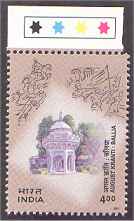
| August Kranti : Ballia The August Kranti (August Revolution), which took place in Ballia in Uttar Pradesh, is one among the most inspiring chapters of the Quit India Movement of 1942. The Indian National Congress at its Bombay session (August 1942) passed the famous Quit India resolution, calling for a mass struggle under the leadership of Mahatma Gandhi. All the major leaders were arrested and the Congress itself was declared illegal. A dismayed India reacted spontaneously against this repressive act. Popular revolts broke out across the length and breadth of the country, with the battle cry of "British Quit India". In Ballia District of U.P. the revolt started with protest demonstrations of the students. The arrest of a few girls and at-random firing by the police in the market sent a wave of indignation into the hearts of the people. The resultant anger and excitement led to spontaneous acts of protest like removal of rails, cutting of telegraph wires and burning of railway and police stations in the rural areas. The authorities surrendered immediately and the national flag was hoisted over these buildings. Having occupied the whole District and disrupted the colonial administrative machinery, the onus of setting up a parallel 'government' fell upon the leaders of the revolt. They undertook the task in a most responsible and efficient manner and a National Government was set up in Ballia on the 19th of August. Chittu Pandey, a charismatic leader described as the "Tiger of Ballia" by Jawaharlal Nehru and Subhas Chandra Hose, headed the Government. The entire population of Ballia supported the National Government and donated thousands of rupees to enable the Government to continue on its administration. Unfortunately, the new Government could not last for more than a few days, in the face of the severe repression unleashed by the British rulers. Though the movement was finally suppressed, it did succeed in demonstrating the depth and fervour of the nationalist feelings.
|
 |
Ovr Sz - Overall Size Pr Sz - Printed Size
 |
 |
 |
[Home][About Us][Membership][Member List][Links][Kids][Feedback][Magazines][Dealers][Societies][Articles][WhatsNew]
Copyright
(c) Dakshina Kannada Philatelic Association
http://www.geocities.com/dakshina_kan_pa