 |
1953 railway centenary stamp: YV Jeppu |
|
1953 railway centenary stamp: YV Jeppu |
[Home][About Us][Membership][Member
List][Links][Kids][Feedback][Magazines][Dealers][Societies][Articles][WhatsNew]
| The history of railways in India is very interesting. In August 1, 1849 the Great Indian Peninsular Railway (GIPR) was formed by an act of the parliament. On December 22, 1851 locomotive Thompson was used for hauling wagons containing earth during construction work for the Solani viaduct in Rourkee. The locomotive was assembled from parts transported from Calcutta. This was the first Indian locomotive. It died a spectacular death, much to the amusements of the workers, when its boiler blew up. This locomotive was built by EB Wilson and was probably a six-wheeled tank engine (perhaps of type 2-2-2WT). |
| The
second locomotive to arrive in India was the Falkland
used by the contractors of GIPR for shunting operations
on the first railway line out of Bombay. It began work on
February 23, 1852. This locomotive was also built by EB
Wilson and was a four-wheeled tank engine of type 0-4-0T.
This became GIPR loco #9 later. On November 18, 1852 the
line was ready and a trial run of the Bombay Thane trip (35-Km)
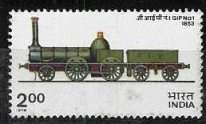
was held. On April 16, 1853 a train with 14 railway carriages, 3 locomotives Sindh, Sultan and Sahib, and 400 guests left Bombay at 15:35 hours. This was India's first rail run. The train left Bori Bunder for Thane with a 21-gun salute and the Governor's band to see it off. The journey took an hour and fifteen minutes. Vulcan Foundry, England manufactured the locomotives used on this run. A total of eight engines, GIP Nos 1-8 and bearing makers numbers 324-331, were ordered from the foundry in 1852 and the locomotives were of the type 2-4-0. These were the earliest known locomotives in service in India then. |
 |
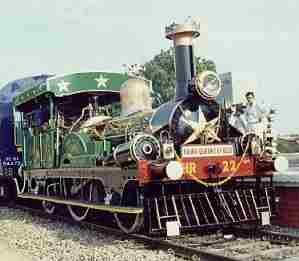 |
The earliest steam
locomotive still in service has been certified by
Guinness as the Fairy Queen. This is a 2-2-2 type
locomotive manufactured by Kitson, Thompson and Hewitson,
UK for the East Indian Railways (EIR). Kitson and Co
supplied these locomotives (2 in number) in 1855. These
were numbered 21 and 22 and later renamed EIR 91 and 92.
They acquired the names Express and Fairy Queen
respectively in 1895. The EIR began service when the first passenger train steamed out of Howrah Station for Hoogly, a distance of 38 Km, on August 15, 1854. This was said to have been hauled by a sister locomotive of Fairy Queen. EIR had 3 locomotives manufactured by Vulcan Foundry in 1853 and one of these could have been used for the train. |
| In 1953 the Department of Posts issued a stamp to commemorate the centenary of the railway in India. The stamp depicts a locomotive said to have been in use in 1853 and also another locomotive in use in 1953. The interesting fact is that the locomotive depicted for 1853 is the Fairy Queen of Type 2-2-2 and not the GIP No 1 of Type 2-4-0 actually used for the train. This is a design error in the stamp as the 2-2-2 type engine was not in use in India in 1853 as the Fairy Queen was imported only in 1855! | 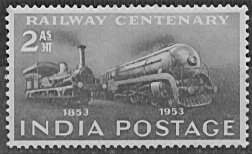 |
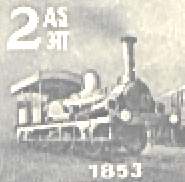 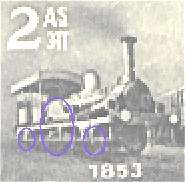 |
The expanded view of the 1853 locomotive shows 3 types of wheels in use on the engine. The front 2 wheels which are small, the middle pair of large wheels and the last pair of smaller wheels. There is no doubt about the 1853 engine shown in the stamp being the same model as the Fairy Queen. The two cylinders in front and the chimney are typical of the Fairy Queen as could be seen in the latest photograph. In any case the engine shown in the stamp is not GIP No. 1 (shown in the stamp issued in 1976). |
[Home][About Us][Membership][Member List][Links][Kids][Feedback][Magazines][Dealers][Societies][Articles][WhatsNew]
Copyright
(c) Dakshina Kannada Philatelic Association
http://www.geocities.com/dakshina_kan_pa