


BY STACEY SHACKFORD
August 17, 2001
WOOLLY beasts, half-human, half-horse, once traipsed about its piney peaks, deflowering virgins. Apollo fell in love with a nymph who lived on its slopes. It was the preferred wedding location of the gods, and the site of the ill-fated nuptials of Hippodamia and Pirithous, which resulted in the battle of the centaurs with the Lapiths. Warriors were trained here: in mythology, it was Jason and the Argonauts in the cave of Chiron; in more recent times, revolutionaries planned the War of Independence.
Based solely on accounts historical and mythological, my image of the Pelion peninsula was of an area remote and wild. Jutting off the eastern coast of Thessaly like a boot, like a teeny mirror image of Italy in fact, I had hardly even noticed it on a map before. I certainly didn't know anyone who had been there. All of this made the place that much more appealing, especially in the stifling heat of summer and the bustle of tourist season.
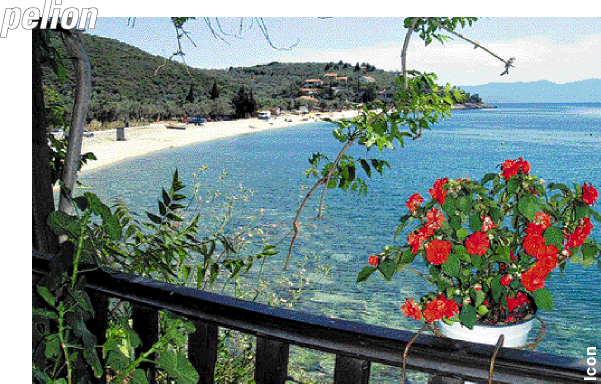
What I discovered was a lush verdant wonderland where mountains cloaked in every shade of green extended their slopes all the way into the ocean. I have come to love the mountains of Greece, enough to prefer them to the beaches and islands of the Aegean. But in Pelion, you don't even have to compromise one for the other. For, nestled below the mountains on the western shore and between the precipitous cliffs of the east, are wonderful beaches.
Golden fleeces aplenty in Volos
My journey to Pelion began in Volos, a city on the northern shores of the Pagasitic Gulf - in the armpit of Thessaly, if you will. I had braced myself for a stinky, unsightly industrial city. While there is an ugly shipping port, it is somewhat removed from the rest of the town. The city itself reminded me of a smaller Thessaloniki, with its meandering waterfront and modern cultural feel. It seemed the perfect size - large enough to be exciting, yet still manageable. A taxi ride to almost anywhere in the city costs less than 500 drachmas.
Jason is said to have set sail from Volos in his quest for the Golden Fleece, a mythological reference present everywhere - in the names of streets, hotels, and the boats that line the harbour, as well as a small bronzed reproduction of Argos mounted near the port. The waterfront is a joy, passing first the predictable strip of cafes, then turning into a wonderful park - stocked with sculpture, playgrounds, and even a skate ramp - punctuated by a small boating harbour and a few beaches. And, I discovered to my delight, people actually ride bicycles here. Old men mount old-fashioned Y-frame bikes with little baskets up front, while children race by on speedy mountain bikes. A long, narrow jetty extending into the bay, connected to the shore by a sparkling arched bridge, seems to be a popular cycling destination.
Most activity is contained to the shore, and at night the place really comes alive. In warm weather, a horse-drawn carriage makes trips along the waterfront, and street performers circulate among those who flock to the cafes after 8pm. I even saw a flamethrower one night.
The rest of the city seems more utilitarian than tourist destination. There are two rather good museums: the Archaeological Museum, which contains artifacts from the nearby extensive Hellenistic site of Dimitrias, also worth a visit in itself; and Kistros Makris Folk Art Centre, where you can be given a personal tour of a collection of paintings, and Mount Athos icons. There is a fantastic pedestrian shopping area on Ermou Street, a few blocks from the waterfront. The city is used mostly as a hub for exploring Pelion and the islands of the Sporades, but it is worth a visit longer than a brief stopover.
Where to eat
The waterfront is the place to eat in Volos. It is roughly broken up into sections. On the side closest to the industrial part are several traditional ouzeries frequented by locals and fisherman. On the other side of the port, extending to the University of Thessaly, is a row of trendy cafes and restaurants. In between lies a strip of touristy cafeteria-type restaurants. For traditional dishes, try Naftilia. For something different, Michelangelo's has great pasta dishes.
In Pelion's villages, stop in at any local taverna and sample the regional specialities, which include fish, 'fasolada' bean soup, 'spetsofai' sausage and pepper dish, 'tiropsomo' cheese bread and 'htipiti', a feta cheese and hot pepper dip.
Where to stay
In Volos, there are several hotels huddled along the pier, including the somewhat expensive but nice Aigli (0421-24471) and the less expensive Hotel Iasson (0421-26075). The stylish Park Hotel (0421-36511) has a more quiet location near the waterfront park. City hotels are actually less expensive than many of the rooms and hostels scattered throughout the peninsula. Perhaps that is because many of the rooms are located in renovated old mansions.
In Makrynitsa, two beautiful traditional mansions house guests - Archontiko Diomidi (0428-99430) and Archontiko Karamarli (0428-99570).
Other lodgings line the roads between villages. In Tsangarada, Domatia Filoxenia (0426-49392), off the main road just south of the fountain, has clean rooms and a super-friendly staff.
How to get there
Volos is easily reached following the main Athens-Thessaloniki highway. Several buses per day also make the 4 ½-hour trip for 5,800 drs. The peninsula is serviced by regular buses from Volos, but the routes are somewhat complicated and the schedule sporadic. The region is best explored by car. There are several rental car agencies in Volos.
From fragrant Makrynitsa to fruity Zagora
If you have only one day to explore the villages of Pelion, head straight for Makrynitsa. The village hovers enticingly above Volos, sparkling at night like a Christmas tree. Less than half an hour from the city, it is one of the most accessible of the villages, and fortunately, one with some truly beautiful traditional architecture. In fact, it has been designated a protected traditional settlement, and is closed to most traffic.
Most of the buildings are angled to the slope of the mountain, with three storeys on one side and one storey on the other. They are built with a combination of stone and wood, with slate roofs, overhanging balconies and intricately carved wooden window frames and shutters. Many have a few large, colourful tiles decorating their outer walls and a few have designs painted on the sides.
The first thing you notice as you enter Makrynitsa, however, is not the architecture but the aromatic scent of the dried and fresh herbs sold at little wooden stands near the car park. The cobblestone road into the village then winds past a few other shops, selling preserves and souvenir trinkets. Makrynitsa is perhaps the most touristy village of Pelion, but not obnoxiously so. And it is truly deserving of all the attention.
The village centre is glorious. An enormous hollowed-out plane tree dominates the large plateia (square). A tiny Byzantine church lies in one corner, near a beautiful carved marble fountain, where you can still find jugs of fiery tsipouro cooling in the flowing spring water. The other end of the plateia offers a spectacular view of Volos and the sea. The village is often referred to as the Balcony of Pelion and it is easy to see why as you sit sipping a frappe at the cafe situated conveniently along the edge.
Behind the plateia is a cobbled path that leads up to the right to the site of the old Monastery of the Panagia Makrynitissa, easily identifiable by its enormous clock tower and arched entrance. It is a quiet, beautiful sanctuary with several fountains, a small garden, and two churches.
The road to Makrynitsa winds up the mountainside like a coiled anaconda, with enough curves to make a race car driver dizzy. It's a good indication of what is to come should you continue along the rest of the peninsula. Despite the somewhat treacherous driving, the best way to explore Pelion is by car. In fact, some of the most rewarding views are afforded in the drive from village to village through the mountains.
Right below Makrynitsa, along the same road, is the village of Portaria, which is also attractive and has a lovely cafe in its far corner, set amid a tiny waterfall. Heading east from Portaria, the road passes between Mt Pliassidi (1,651m) and Mt Pelion (1,455m) to the village of Hania, a popular winter destination, for it lies 16km from the ski resort of Agriolefkes. The ski centre there (tel 0428-39136) has three downhill runs and one cross-country trail. The road then continues to Zagora, the largest of Pelion's villages, whose commerce centres around fruit production.
The scenic Agria-Tsangarada route
Another route through Pelion is along the western coast towards the centre of the peninsula. This route is particularly spectacular, as it alternately skirts seaside resorts and the base of steep gorges. As you set off from Volos, ignore the enormous, unsightly factory right outside the city limits. Also skip the strip of touristy beach villages that immediately follow. The road passes a few other beach areas, like Malaki and Kato Gatzea, before slowly winding through steeply terraced olive groves. Soon it begins to climb, and before you know it, you are high up. It passes the villages of Milies and Vyzitsa, another designated heritage community, with cobbled paths and traditional houses worth exploring. After Vyzitsa, the road ascends even further.
This is where the drive really becomes interesting. The olive groves sparkle across a silvery expanse and the sea glitters pale blue. The mountain slopes now extend out in ridges like a giant paw, and the road winds in and out of the toes, looking down into the deep gorges that fall in between. The landscape is as lush as the forest around Oz, and as green as the Emerald City itself. Every once in a while, chalky white walls of stone rise straight above your head in startling contrast to all the green.
The road passes over bridges and great stone walls as it comes to the next big village, Tsangarada. It is actually a conglomerate of four smaller settlements, formed around churches, spread along the slope all the way down to the small seaside resort of Mylopotamos, noted for its cleanliness. The largest of the settlements is Agia Paraskevi. A popular rest stop, it is marked along the road by a fountain and two cafes. The plateia is set off further down the slope, off the road to Mylopotamos. It is not as impressive as that of Makrynitsa, but its plane tree is possibly the most enormous I have ever seen, and worth a visit for anyone with the urge to do a little climbing. The tree is so large that one of its branches is supported by a stone column. The square also features a pretty church, small cafe, shop and restaurant. The area is worth an overnight stay.
In addition to the beach, there are several hiking trails nearby, marked by yellow signs. Many of them are roughly paved with stone. In fact, wherever you see a cobbled path, take it. They connect many of the churches, winding between old stone houses, and fragrant fields. The entire peninsula is ripe for outdoor exploration in any season. The travel agency Les Hirondelles in Volos (0426-31181) organises group hiking, mountain biking, kayaking, diving and horseback riding trips throughout Pelion. Camping sites are also scattered across the peninsula. The high season is generally in spring and winter, from March to May, and from October to January.
