





By STACEY SHACKFORD
Staff Writer
Friday, December 29, 2000 -- Once a week, Lori-Beth Green has her scars massaged. She has 18 in all, on her stomach, neck, back and arms. Some are deep stab wounds, others are shallow scrapes.
The massage therapy has helped lighten the color of the scar tissue and Green, 30, said she has regained feeling on her left side, something doctors told her might take to two years to happen.
But no matter how much the scars may fade, Green says she is still confronted by them every morning when she looks in the mirror, a vivid reminder of what happened July 16, 2000.
Police say Green's former fiance, Bruce Jenks, attacked her with a knife in July, almost killing her.
Jenks, 37, has pleaded innocent to charges of armed assault with intent to murder, assault and battery with a dangerous weapon, and domestic assault and battery. Jenks is being held without right to bail at the Hampshire County House of Correction until his trial.
He is scheduled to stand trial in January, but his lawyer, Michael Jennings of Springfield, said he will be asking that the trial be postponed while he explores whether to use a diminished capacity or insanity defense.
In legal terms, diminished capacity is a mental condition in which a person is unable to form an intention to commit a crime; insanity is a mental condition that renders one unable to understand the nature of a criminal act or that it is wrong.
Police officers have testified that when they arrived on the scene of the attack, they found Jenks sitting on the front porch, talking on a portable phone, his arms and clothing covered with blood. He had self-inflicted wounds on his wrists, police said.
Green offers this account. She says she was sleeping in the 177 Prospect St. home she shared with Jenks when someone covered her face with a pillow, put a knee across her chest and stabbed her several times.
Green struggled and ended up on the bedroom floor. She remembers having her head slammed against the hardwood floor and held down as she lay on her stomach trying to free herself. The person assaulting her never spoke, and she had no idea who it was.
Eventually, she said, she felt the person press down on her head one last time, as if using it to help him get off the floor. She stopped moving, terrified that he was still there waiting to finish her off, she said. He later picked the pillow off her head, threw it back down and left the room.
Green apparently lost consciousness, and about two hours later, she heard Jenks' voice telling her: "Hold on honey, the ambulance is coming and I can't do it ... I can't ... I'm going now."
Green said she lost 5 liters of blood at the house, 83 percent of her total blood volume. Her lung was punctured and collapsed. Her pancreas was nicked and she developed a life-threatening infection. Her spleen and left kidney had to be removed.
It took 22 liters of blood to revive her, and she said she came very close to death several times. During a three-day medicated coma, she said she saw many images of angels. Green spent 20 days in the hospital. It was three months before she could lift things, bend over, or get herself something to eat, she said.
"Unfortunately, I remember the entire incident," Green said. "I had to deal with hearing myself almost die in my head. It's really scary. But I'm not afraid of the dark. I'm not afraid to go to sleep."
A life is rebuilt
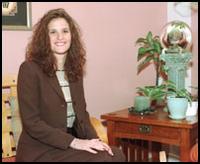
Housed in a converted tobacco barn on Elm Street in Hatfield, Green's office for the advertising business she runs has a bookshelf with a lilac plant, a green candle and a small fountain on it. The lilac is meant to ward off negative energy, Green says; the candle symbolizes prosperity and the fountain peace. Crafted angels are placed all over the office.
As she talked about her recovery, she sat in front of a colorful Dr. Seuss print that had been a gift from Jenks. Even though it reminds her of something painful, she says she's keeping it up because she likes it.
Despite the trauma she has gone through, Green is upbeat and frank about her experience. The only visible sign of her attack is a white scar that runs across her neck, barely noticeable until she displays it by lifting her head and running her finger across it.
"Unfortunately, this is something I'll carry with me for the rest of my life. But I try to use it in a positive way every day," Green said.
She prefers not to harbor ill will towards Jenks. "People probably think Bruce is a monster - in my heart, I don't believe that," she says.
Green and Jenks had been dating for about two years when Jenks proposed marriage Feb. 14. Green said she decided to break off the engagement in April and broke up with Jenks completely in June.
A week before she was to move out, Green said she got into an argument with Jenks and he threatened her. She said she didn't take the threat seriously, but spent a few nights in a hotel anyway. She returned to the house July 16 to pack.
In the months since then, Green said she has read literature about warning signs of domestic abuse, and realized that she had experienced almost every one.
"I didn't know that emotional abuse, verbal abuse was domestic violence," Green said.
In retrospect, Green said she has been able to identify signs that her relationship with Jenks was potentially dangerous. But until the July 16 incident, she had no idea.
"I didn't know anything about domestic violence. If I would have known I would have planned to leave (the relationship) safer," Green said.
Since the stabbing, Green has sought help at Safe Passage, formerly Necessities/Necesidades, a Northampton agency that helps those who are suffering from domestic violence by providing counseling and an emergency shelter.
Through the agency she has received counseling, legal advocacy and help with the little things, like helping her to plan daily activities to avoid loneliness. A counselor also went with her to the district attorney's office earlier this month when she listened to a tape of the 911 call police believe Jenks made after the attack, she said.
Green said Safe Passage counseling services have also been helpful for her mother, who after the attack moved from Florida to be with Green and now spends her days helping out around the office. Green said the incident brought her entire family together, including her father and brother, who live in Springfield.
"It's a scary event, to think about losing someone you love. It makes you evaluate life, and the people and things that are important to you. It makes you appreciate everything more," Green said.
Even with such family support, Green said her recovery, in the emotional sense, is still in process.
"Family and friends kind of forget, because I look good and have a positive attitude," she said. "But there are still days I can't get out of bed."
She said she has gone through different stages after the attack, such as anger, loneliness and even missing Jenks, followed by renewed anger.
"Suddenly you're cut off from the person. You lose a relationship, a friendship. Then there's the memory of the incident itself, which haunts you," she said.
Green went back to work in September, which was difficult in part because she and Jenks had together owned the advertising business, SuperMarket Display. She immediately had sage burned in the office, a Native American ritual thought to remove negative energy, and a ritual was also performed on her two cats, Iggy and Otto, who were in the apartment during the attack and, she says, have been traumatized by it. The cats now live at the office and Green lives in a new Northampton apartment.
Green said sometimes she thinks it would be easier to deal with the attack if it had been done by a stranger, "because you're constantly trying to figure out why - and you'll never know why."
In the meantime, Green says she has anniversaries to cope with - on the 16th of every month, for instance. She had hoped the end of the year would bring resolution because Jenks was scheduled to stand trial in October, but the trial date has been postponed while he undergoes psychological examinations.
Since her attack, Green has become an advocate for quelling domestic violence. She has volunteered hundreds of hours at Safe Passage and she donated $10,000 to help the agency move its community-based services center from Hawley Street into a space at the former Elks Lodge on Center Street. A "Lori-Beth Green Angel Fund" has been set up to take in other donations to the agency. She has also lent her talent to design advertisements for the agency's "Be a Part of the Solution" campaign.
She plans to go through a 30-hour volunteer counselor training in February, and she said her goal is to eventually take time off from work and volunteer full-time for Safe Passage.
"I would do anything right now for domestic violence (prevention), and not just because of what happened to me. I don't want to see it happen to other people," Green said. "It really gets ingrained into the deepest part of your soul. It has become a part of who I am. It's almost as if I was allowed to live because God had a greater purpose for me and maybe that purpose was to help other women."
Betsy Shally-Jensen, program director at Safe Passage, said Green has been an incredible asset to the agency, and her dedication and spirit has been contagious.
"When we first met her, we thought, What an incredible survivor," Shally-Jensen said. "When we got to know her, we thought, What an incredible survivor and an amazing woman."