


BY STACEY SHACKFORD
November 23, 2001
THERE'S something a bit odd about Ioannina. Maybe it has to do with the city's peculiar history, to which residents - and particularly shopkeepers - still cling, even though it involved hundreds of years of Turkish occupation and the insane despot Ali Pasha. Maybe it's the weather; during a summer visit, it rained almost with British punctuality for an hour each day during siesta (2pm-5pm). Or perhaps its the nearby historical wax museum, which proudly displays blood, gore and revolutionary heroes hiding in caves. Then there's the island mascot, Dionissis the Crocodile, and the story of the city patron saint, an illiterate country boy hanged by the Turks because they thought he was one of them and had married a Christian.
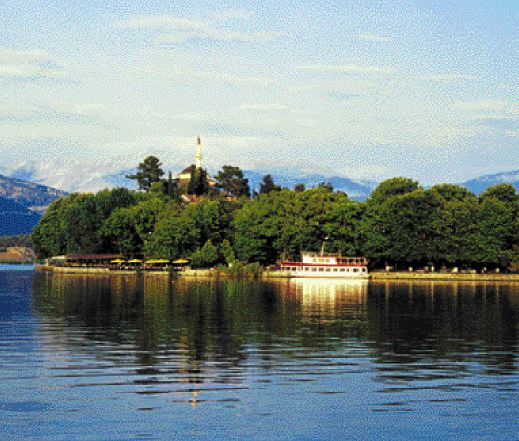
But in spite of this quirkiness, or maybe because of it, the city has a cosy attraction. And its location - no more than a few hours from the Ionian coast or the magical mountains and rivers of Zagoria - makes it an irresistible base for outdoor activities in the fall, winter and early spring. Ioannina, the capital of Epirus, is located along the shore of Lake Pamvotis. It is a relatively small city, in area and population with about 100,000 residents but is still rather bustling, and the nearby University of Ioannina injects a young, trendy element. In warm weather, activity centres around the waterfront and the small nearby island. In January and February, the lake freezes, and many retreat to the city's cosy cafes and restaurants. Most of the city's sights also lie along the waterfront.
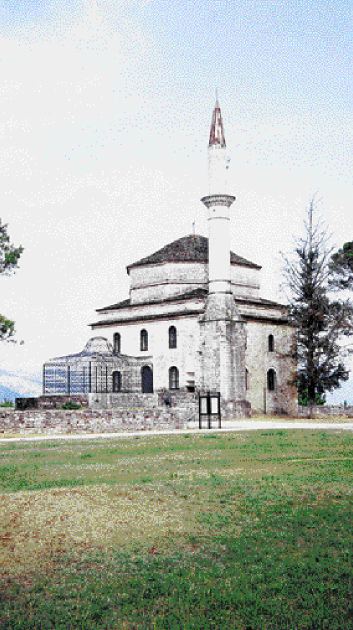
Were you to approach Ioannina by water, the first things you would notice are the two minarets flanking either side of the fortified promontory that juts into the lake. They belong to the Aslan Mosque, on the right, and the Fetiche Mosque, on the left. The former was built by Aslan Pasha in 1618 on the site of the former Orthodox Church of Agios Ioannis Prodromos. The mosque now houses the municipal museum, with a relatively unexciting collection of objects representing the Greek, Jewish and Muslim communities that lived together in the fortress between 1400-1900. It is worth a visit, however, just to see the remnants of the mosque's interior decoration. Around the mosque lie the remains of a Turkish library, a half-destroyed building once a kitchen, and a beautiful arched building once used as a Turkish monastery and now housing a small, fully-stocked war museum.
The Fetiche Mosque is situated in the corner of the Its Kale, the fortress' inner acropolis, where Ali Pasha ruled the city with an iron fist. He had big dreams of creating his own state until accused of high treason in 1822 and was beheaded on orders of Sultan Mahmud II. His tomb lies outside the mosque, covered by an elaborate iron lattice. Ruins of the Seraglio, Pasha's harem and administrative quarters are also nearby, as well as the city's Byzantine Museum and a Byzantine cook-house, which has been conveniently remodelled as a cafe. Behind the buildings lie the remains of the acropolis walls, with its inner hallways and arched rooms ripe for exploring. Connecting the sights are the pleasant meandering streets of the old city, where many families still live. Unfortunately, two enormous fires in 1820 and 1869 destroyed much of the city's traditional architecture.
The island, called simply To Nisi, is easily accessible by any of the boats that make the 10-minute ride every half an hour. Ali Pasha buffs should follow signs directly to the Ali Pasha museum, housed in the Agios Panteleimon monastery, where the 82- year-old took refuge and was eventually killed. The tiny two-roomed museum boasts little more than a few drawings, a costume, a hookah and a set of enormous worry beads. Apparently, Ali had much to worry about, as also evidenced by the bullet holes in the floor. There are four other monasteries on the island, including the Agios Nikolaos Philanthropinos, with its frescoes of the seven ancient philosophers.
Where to stay
There is a cosy hotel inside the fortress walls, the aptly named To Kastro (0651-22866), which has seven rooms in a renovated 150-year-old house. The somewhat expensive price (23,000 drs), includes breakfast and plenty of personal attention from the friendly proprietors. For about the same price, you can stay downtown at the enormous Hotel Palladium (0651-25856), which has large, clean rooms, an enormous lobby, its own restaurant and very accommodating staff. The Hotel King Pyrros (0651-27652), located directly across from the city park, may have some tacky decor, but its rooms are clean and more affordable.
Where to eat
Tons of eateries line the waterfront. Among them, Agnanti is a good choice for area specialties - try some smoked Metsovo cheese and clay jar-baked dishes - and a few novelty items, like the Ali Pasha burger. The island is a good place to go for seafood. Tripe soup, crayfish, eel and fried frog legs are the specialties. There are two dockside restaurants as well as Propodes, tucked away near the Ali Pasha museum. All three feature large aquariums where you can see your supper. Across from the main entrance to the fortress are a few good traditional restaurants, including To Kourmanio. Nearby is the more modern Kouzina Christas, featuring an indoor garden, a wide wine selection and crepes.
Shopping
As the "Welcome to Ioannina" signs cheerfully proclaim, the city is considered the silver capital of Greece. As a result, the road leading to the fortress, Averof Street, is lined with jewellery shops that more likely than not also feature enormous shield-like platters, gaudy hookahs, flashy knife cases and inlaid wood boxes. Most are of the tourist ilk, but there are a few gems among them. Tucked away inconspicuously among the tourist traps on the main drag is Mousafiris, Averof 37a, which has some beautiful antique items. Outside the Its Kale walls, lies the store of Ioannis Kariofillis, which features an amazing selection of both modern and antique jewellery, as well as many other precious items. Tons of cheap jewellery can also be found on the island.
Getting there
Ioannina has an airport, serviced by Olympic Airlines with daily 50-minute flights to Athens (0651-26518). There are 10 buses per day that make the seven-hour journey from Athens, and an expansive network reaching nearby mountain and coastal destinations. There are several rental car agencies along Dodonis Street, and Budget Rent a Car (0651-43901) has a booth at the airport.
Day trips
There are several worthwhile day trips from Ioannina. The first is to Dodoni, site of the oldest oracle in the ancient Greek world. According to ancient sources, the priests of Zeus interpreted the divine will from the rustling of the leaves of the sacred oak tree, by the manner of flight and cries of the sacred doves that roosted in its branches, and the reverberations of copper cauldrons on tripods around the tree. Lying at the foot of Mt Tomaros, 21 km south of Ioannina, the site's well-preserved theatre boasts a stunning view. Unfortunately, it is now closed for restoration. But the rest of the site is still worth a visit. The keepers of the site have thoughtfully planted oak trees everywhere, presumably to make for a more authentic experience. Back in Ioannina, you can check out some of the questions asked of the oracle, preserved on lead tablets displayed at the Archaeological Museum and puzzle over cryptic replies, like this one: Lystas asks whether he should be successful in the sea trade and having a share of the ship, to which the oracle replies, You should not offer anything to the earth.
A few kilometres north of Ioannina lays Perama Cave, one of the largest in Greece at 1,100 km long, with an amazing array of stalagmites and stalactites. Accidentally discovered by villagers in the 1930s, it was used as refuge during the war. It had also been used by bears and in ancient times was a sanctuary to Persephone and Hades; speleologists Ioannis and Anna Petrohilos discovered it during excavations in 1942. A guide will take you on a 45-minute tour through the cave, pointing out some curiously shaped - and named - formations, such as the Manger with Magi or Statue of Liberty. The tour ends with a climb up 163 stairs and a stop at the bust of Ioannis Petrohilos, tucked away eerily inside the cave walls.
The Paul Vrellis Wax Museum, 13 km south of Ioannina, is well worth the drive or 5,000 drachma taxi fare. As you wind through the enormous complex along dark, dank, rock-encased walkways, revolutionary figures peek out of simulated cave environments. There are surprises at every turn, many involving soldiers with ghastly bloody wounds or otherworldly historical figures. Undoubtedly the favourite scene is the Murder of Ali Pasha. Set in Ali's monastery hideaway, it features a regally-dressed woman, presumably Ali's Greek wife who turned him in, walking serenely away from a comically gory scene, a severed head at her feet. In one corner, a man looks in horror at his realistically-rendered severed foot, while overhead, Ali's headless body hangs over a balcony. At the end, you are treated to a hologram of the Acropolis and a reproduction of Vrellis himself, in his workshop creating the wax figure of an Orthodox priest. If you are lucky, Vrellis himself, a former war captive and algebra teacher, might greet you and explain his vision for the museum, the only one of its kind in all of Greece.
Outdoor Activities
The most rewarding trips outside Ioannina, however, are into the mountains. The Vikos Gorge, the deepest canyon in the world, and the surrounding picturesque mountain settlements of Zagoria, are less than an hour away. The Hellenic Mountaineering Club (EOS), Despotatou Ipirou 2, 0651-22138, organises weekend outings of various difficulty levels to several nearby peaks every month except August for a nominal fee, usually about 2,000 drachmas to cover the cost of bussing. Trekking Hellas (0651-71703), Robinson Travel (0651-29402) and Cosmorama (0651-39274), also organise mountain trips. The nearby rivers of Voidomatis and Aoos are also famed for white-water rafting. From October to July, level I-III rafters and level I-IV kayakers can enjoy runs through crystalline water, sharp limestone spires and coloured rock mounds. No Limits (0655-23777) organises expeditions. From November to March, Metsovo is a popular ski destination. An hour from Ioannina, just south of the Katara Pass, the Metsovo ski centre (0656-41211) features two downhill trails and a 5 km cross-country run.