Before there were the Thunderbirds, show-offs like the Acrojets, Red Devils, and Skyblazers were the primary showmen for the United States Air Force.
Forty-four years after the first powered flight, man had broken the sound barrier. Fifty-three years later in 2000, the fastest man to travel in the Earth's atmosphere exceeded well over Mach 6.0. When was this record set? No, it wasn't during the eighties or the seventies, this record was set back in 1967 by Pete Knight in the X-15. How long flight has come.
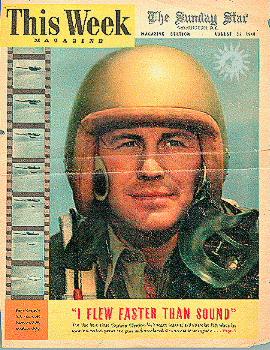
Since World War II, the United States of America has worked its way into the forefront of worldwide aviation. We were the first to exceed the sound barrier (October 14, 1947) and in that same year, the U.S. Army Air Crops were commissioned as a separate military unit, the United States Air Force.
|
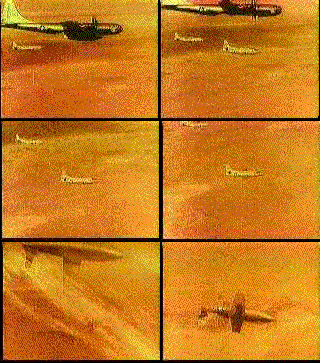
In 1949, the USAF formed a makeshift demonstration team. Named the Red Devils, they lasted for less then a year. Operating off of Las Vegas AFB (later named Nellis AFB), they flew flamboyantly colored red P-51 Mustangs, vintage aircraft from World War II that would serve in many forms until the Vietnam Air War.
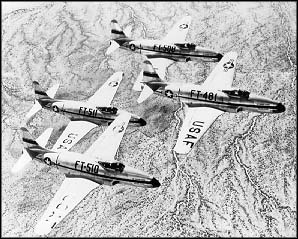
Eventually, the P class of fighters was running short on names so the series took on a new letter designation, the "F" class. One of the early jets of that era, was the F-80. The first aircraft the Acrojets flew in the late forties |
Eventually, the team added an announcer, because as one pilot put it, "nobody knew what was going on unless somebody told them". They also even enjoyed the services of Hollywood as a costume designer there gave them tailored flight suits. Their fame was cut short however with the onset of the Korean War.
|
Before the team received the updated, F-80C model, many pilots in the USAF were volunteering for combat duty and they were needed elsewhere along with their cutting edge planes. The Acrojets disbanded in 1949.
While the Red Devils and Acrojets were ceasing performances to aid in the war effort, a new demonstration squadron was taking shape in Europe. Captain Harry Evans and First Lieutenants Cuthbert Pattillo and his twin brother, Charles, founded the �Skyblzaers� in the skies over Malta. Soon, the team threw together enough maneuvers for a 15 to 20 minute routine. Support for the team however was lacking, and the pilots often had to implore help from the ground crews at many of the bases they performed at. They were immensely popular around |
Republic, the designers of the F-84 took the team under their wing and gave the team funds for flightsuits, amongst other necessities. In 1951, the Skyblazers were recognized as the USAF's primary demonstration team. One year later they had perfomed some 260 demonstrations in 12 countries before an estimated 10 million spectators.
In 1952, while Captain John O'Brien the team's newest member, was performing in an airshow over England, his plane caught fire and he crashed while attempting the pull up in the bomb burst maneuver. The team temporarily ceased flight operations.
In late 1952, the team once again began operating and flew several types of aircraft including the F-100. Rotating pilots, and bases, the wing continued operations until January 1962, when they officially disbanded.
|
In May 1953 an order was given to the wing commander at Luke Airfield, Arizona to form a dedicated jet demonstration team with its own aircraft and ground support team. This team would eventually become the Thunderbirds.
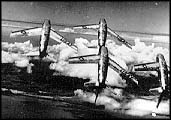
Other teams continued to fly however, amongst which were the Sabre Knights, created by former Skyblazer Vince Gordon. This squad proved that the F-86 could also be flown aggressively in tight formation maneuvers. |
|
The original Thunderbirds gained direction from former Skyblazer pilots, and with dedicated support, gone were the days of borrowed aircraft and tattered flight suits. The Thunderbirds soon began to travel internationally, and became the only jet demonstration squadron for the USAF. Thanks to the pioneering efforts of those before them, the USAF Thunderbirds have awed child and adult alike with their fancy planes gutwrenching maneuvers perfected by the originals, the pioneers of flight.
Back to History Section
