Page 7
Covering tips
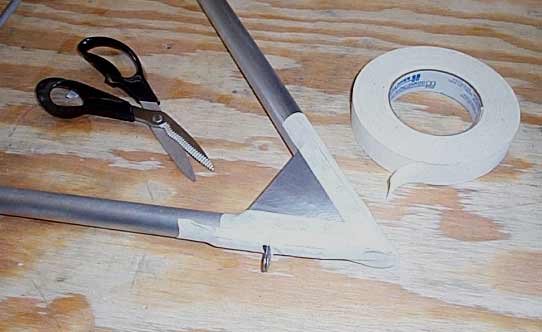
Cover all rivets and corners with fabric tape to prevent chafing of fabric. This also makes a much smoother look of the Poly-Fiber (Stitts) fabric after you are finished.
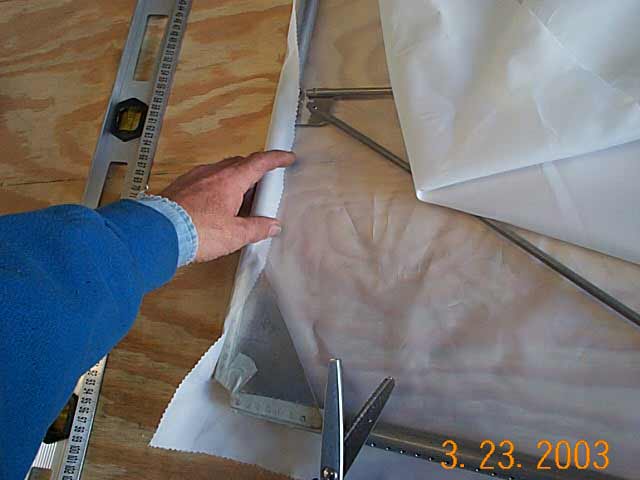
I do the bottom side first, this way the outer overlap of the top piece of fabric will be on the underside. One technique I was shown that works well is to paint on the Poly-tak to the tubing 1st, before you even try to apply the covering. It dries just too dang fast to "glue as you go". Then, cut the fabric to fit as you see here, so it will wrap 3/4th of the way around the tube. Then, as shown below, after you have the fabric all cut to size, simply hold the fabric down on the dried Poly-tak coated tube and brush on MEK thinner right thru the fabric. It will soak thru and instantly soften the Poly-tak and bond easily. (Thanks to Tommy George of American Aero for showing me this trick, it works very well!)
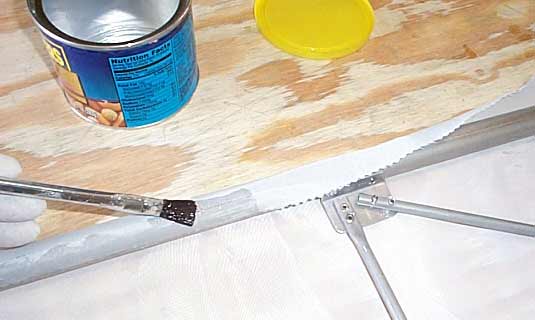
Dont worry too much about small bubbles of fabric at this stage, because when you get the fabric tacked down all the way around, you can go back over it with MEK thinner again and it will loosen up very fast and you can smooth out an/or adjust your fabric nicely. I purchased all my Poly-Fiber components from Jim an Dondi Miller at Aircraft Technical Support, Inc. http://www.aircrafttechsupport.com/ They had a complete FireFly covering package all ready to go, (so I didnt even have to figure up what I needed) and Jim readily accepts phone calls when you are seeking advice and help. He hands out good advice like grandma hands out cookies, I hardily recommend him!
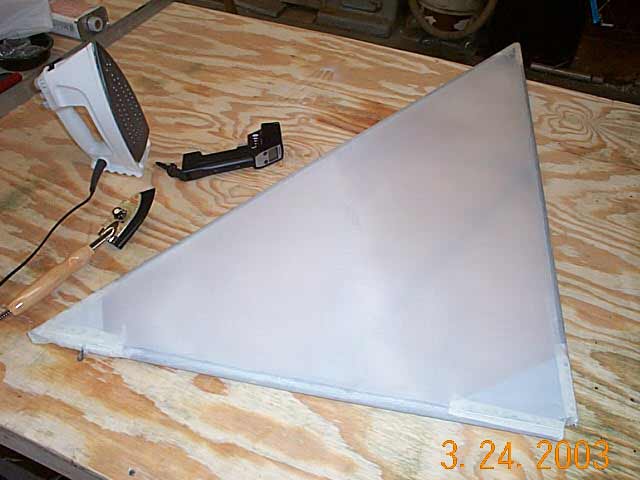
Be sure to calibrate you irons so you don't overheat the fabric! 350 degrees is the max! I heated and stretched in steps, starting about 250 deg. It wont take you long to devolop a technique to take out wrinkles quickly. For instance, on a small area like this, I started in the center, observed where the slack need to be taken up, and moved that direction. The hot iron can also be used to smooth out glue bumps, as it will soften Poly-tak, and take out any remaining fabric bubbles around the tubes. Just "iron it in" so to speak! Here is a stretched horizontal stab with the first coat of Poly-Brush applied.