Hej Slovane!
Hej Slovane, jeste nase Slovenska rec zije,
pokud nase verne srdce pro nas narod bije.
Zije, zije duch Slovensky, bude zit na veky;
hrom a peklo, marne vase proti nam jsou vzteky!
Proti nam jsou vzteky.
Jazyku dar sveril nam Buh, Buh nas hromovladny,
nesmi nam ho tedy vyrvat na tom svete zadny;
i nech at je kolik lidi, tolik certu v svete:
Buh je s nami, kdo proti nam, toho Perun smete,
toho Perun smete.
Nech at take se nad nami hrozna boure vznese,
skala puka, dub se lame, zeme at se trese;
my stojime stale pevne tak jako zdi hradne;
cerna zem pohlti toho, kdo odstoupi zradne,
kdo odstoupi zradne.
I-ORIGINS
II-LANGUAGE
III-RELIGION
I-ORIGINS
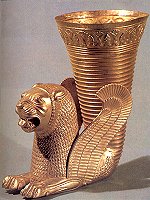
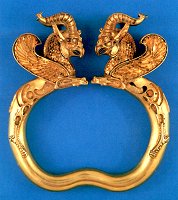
The origins of the Slovan(Slavic) peoples, the Belorussians, Bulgarians, Croats, Czechs, Macedonians, Poles, Serbs, Slovaks, Slovenes, Russians, and Ukrainians can be found on the Asian steppe. Earliest records of the Slovans come from Chinese sources of circa 700BCE. Reference is made to a tribe with a name akin to Aorsi(An Tsai in Chinese) living east of Lake Balkash in present day eastern Kazakstan, this culture is today termed the Andronovo culture. Slovan society was described by the Chinese as a tribal federation and fairly democratic as great mention was made regarding the equality of women and lack of slavery. Among the traditions mentioned are the scalping of enemies and the drinking of their blood, which were common practices among the early Aryan horsemen. Material remains of this culture exist in the form of the Irtish mound burials. The remains in these burials are typically Slovan, brachycephalic Europoids known as the Pamiro-Fergana racial type. From what has been found in the burials, the early Slovans had to have been excellent horsemen as they already had the saddle, stirrups, slings, and bows. The main contact with the Chinese came through trade, as the Slovans supplied the Chinese with gold in exchange for silk and spices. The next written records come from Persia circa 550BCE when the Slovan tribes Parti(historical Parthians) and Aorsi battled the Persian empire on the banks of the Syr Darya and defeated Kurush Shah thus allowing for further Aryan penetration of of Iran and India. The Slovan tribesmen were described by the Persians as people with a similar language, beliefs, and way of life. By around 400BCE the name Khorvati comes into historical records, the name being a reference to the light of the sun, meaning "those like the sun". While other names of minor tribes are known from this time, Parti(people of common blood), Saka(people of the deer), Sarmati(noble ones), it was the name Khorvati which was most used by the Slovans, lasting up to the present day as the name Hrvatska(Croatia). It served as the collective name for the Slovan people up to 1000CE. Circa 350BCE the entire steppe between the Syr Darya and the Ural Mountains was now controlled by the Slovans, forming what is today known as the Prokhorovka culture. The Slovan tribesmen were superb horsemen and warriors, being feared by the Persians and the Chinese alike. The Slovan armoured cavalry had no match during those times. Society was very egalitarian as all considered themselves to be noble, women had equal rights, and the position of chief was more of an honourific title as he was elected from among the elder warriors. However by 214BCE a shift occurred on the steppe which did not favour the Slovans. Turkic and paleo-Siberian(Mongol) people from the north and east began to put pressure on the Slovans. Due to their use of a lighter cavalry, and a shorter, more efficient bow, the Turkic and Mongol peoples were gaining ground and pushing the Slovans further west. By 73CE the Slovans were pushed into Persian lands, which the Parti were able to subdue and form the Parthian empire. By 361CE the Ukraine was reached by the Khorvati, as they were better armed and posessed superior technology the Slovan newcomers were able to subdue the original Germanic(Goth) inhabitants and conquer the land. The Khorvati were repulsed by the Germanic peoples as they wore animal hides and spoke an unintelligible language. As the Slovans took no slaves nor prisoners the Goths suffered greatly and by 375CE were pushed out of the Ukraine. In around 600CE the Slovans crossed the Carpathian Mountains, thus fully establishing themselves in eastern Europe. The earliest western sources referred to them as being warriors living off horses, and described their king as only "nominal", again a reference to the egalitarian spirit of the Slovans. By 1000CE the Khorvati were settled all through eastern Europe and the individual Slovan nations started to establish their seperate identities and characters. However, the name Slovan, meaning "one speaking the same language", was taken up by the peoples to describe themselves and differentiate themselves from their neighbours.
II-LANGUAGE
The Slovan(Slavic) languages belong to the Indo-Aryan family of languages. Although they are divided into 3 branches, Western(Czech, Polish, Slovak), Southern(Bosnian, Bulgarian, Croatian, Macedonian, Serbian, Slovene), and Eastern(Belorussian, Russian, Ukrainian), these divisions are political and geograohical rather than truly linguistic. The term "language" must be used with reserve as as any 2 Slovan people can have an intelligible conversation using their respective languages, or more properly said, dialects of the Slovan language. Using comparative philology is was proven that the Slovan language group is closest to the Iranian group of languages. The Slovan languages are derived from what was an northern Iranian group, which formed a link between the western Iranian group(Kurdish, Persian, Tat) and the eastern Iranian group(Darwazi, Nuristani, Pashto, Wakhi). Through the preservation of Aryan archaisms and language structure the Slovan languages are most closely related to the eastern Iranian languages of Afghanistan and northern Pakistan.
III-RELIGION
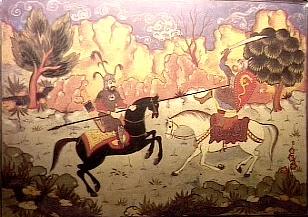
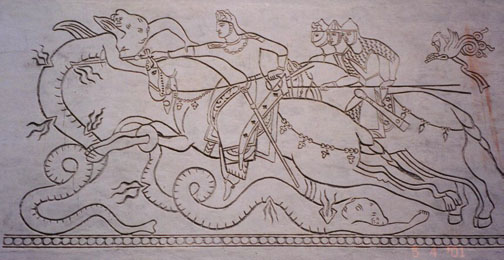
The original religion of the Slovans was very much like the religions of the Aryan peoples who settled in Asia, rather than the religions of the peoples to the west of them. The "baba"was the priest/priestess who presided over feasts and ceremonies. Burial customs reflected the nomadic lifestyle of the people, burials were placed under mounds, which have a startling affect on the landscape of the flat steppe. The bodies were placed in timberlined caskets and always faced east to greet the rising sun, sacrifices of horses and every day items from the peson's life lined the burial chambers. The abode of the dead was called Rai and was said to be on the moon. The moon itself was further represented as Dundra, who came to earth, gave humanity laws, taught the arts of war and horsemanship, and then returned to the skies, then taking on the task of carrying the souls of the dead to the moon. Dundra was celebrated by songs and feasts that took place under the full moon. Khors was the representation of the sun, and was represented as riding a white horse through the sky. He was also the god of justice and order, ruled over the zodiac, the stars being his maidens and the comets his messengers. From Khors came the twins Iarilo and Iarila, gods of fertility. Their efigies were burned during prayer to stimulate fertility. They also represented the union of marriage and sexual pairing off of animals. A purification ritual conducted in their honour consisted of jumping over a flame to allow for purification as the fire represented truth and pure existence. Svarog, whos name means "pure god" was the father of the universe and god of the sky. He was credited with having given mankind the gift of fire and was always depicted as accompanied by Mokosh, godess of birth, sex, and the home. The most important and beloved god of the Slovans however was Perun, god of storms and war, he was represented as fire itself. Ceremonies to honour Perun were conducted by warriors rather than priests and sacrifices of virgin mares were made to the god. Other than the major gods, lesser deities were also represented in the Slovan pantheon, the znakhar(shaman) was the intercessor between humans and these beings. The tree of life was said to hold the seeds of all the plants on the Earth and was gaurded by the Simurg, an animal half dog, half bird. The Sirin, beautiful women who were half bird would lure men with their charms only to torment them for eternity, as it was believed only an impure heart could be tempted by them. The Zaryi were the stars, sisters with each one holding a specific task. They also guarded the being tied to the north star, which wanted to get loose and destroy the world. Like all cultures, the cult of the hero was alive among the early Slovans. Batradz, who was accompanied by a magic sword and a talking horse, was the sbuject of many legends. His demise came when two of his companions betrayed him. Upon being wounded by them, Batradz threw his sword into a lake, the lake turned to blood and great storms came, fairies then took his body and gaurded it until Dundra could take it to paradise.
HOME