 |
| The Ketubah (kah*too*bah) The Ketubah is a religious document signed by the bride, groom, and at least two witnesses immediately before the wedding ceremony. Originally a legal document detailing the rights and obligations of the bride and groom, it talked much about property rights and obligations but never mentioned love or commitment. In actuality it was an extraordinary document because it gave legal rights to woman in an age when they had few. Today, the ketubah has taken on new meanings and forms. Our ketubah is not a legal document but is a written expression of our spiritual and emotional commitment to each other. It will be written in both Hebrew and English and will be signed by us and our witnesses just prior to the ceremony. Yarmalkes (yah*ma*kah) Yarmalkes, the skull caps traditionally worn by Jewish men (now commonly worn by women as well), will be provided at the entrance of Music Hall. It is not required that anyone wear one. The significance of wearting the yarmalke is to humble oneself in the face of God, by covering the head. Women may choose to wear a lace head covering (provided at the entrance) instead of the yarmalke, but neither is obligatory. Please feel free to choose whatever makes you comfortable. The Huppah (hu*pah - short "u" sound) As you enter the Grand Foyer, you will see a structure that looks like a trellis at the end of the aisle. This structure is called a huppah. The huppah represents the promise of a home which we will create together. Just as you have helped us to develop into the individual people that we are, we would be honored if you would help us to create our "home." It is for this reason that we are asking each guest to bring one flower to the wedding to help build our home. You will be escorted by an usher to the huppah, where you will place your flower. |
| Jewish Wedding Traditions |
| The Seven Blessings A special set of seven wedding blessings, known as the Sheva Berachot in Hebrew, has been a part of Jewish weddings for centuries. The number seven is significant because it represents the seven days of creation and symbolically, completion. According to Jewish lore, when two people fall in love, they help each other feel more complete and more whole than they ever felt alone. The seven blessings praise God for: 1. Creating the fruit of the vine: blessing over the wine. 2. Creating the earth and all that is in it. 3. Creating humanity. 4. Creating man and woman in God's image. 5. The miracle of birth. 6. Bringing the bride and groom together to rejoice and live in harmony as did the first couple, Adam and Eve. 7. The joy of the bride and groom and the hope for a world that will one day be filled with the joy of lovers and the laughter of children. Circling Circling is a very old Jewish folk custom for the bride to walk around the groom seven times at some point during the wedding cermony. Although centuries ago it was believed to create an invisible wall of protection for the couple against evil spirits, today, the circle has become a symbol of the couple's new relationship, each now becoming the center of the other's attention. Breaking of the Glass In the Orthodox tradition, the breaking of the glass symbolizes the destruction of the Temple in 70c.e. and all of the subsequent sufferings of the Jewish people. As in many Jewish traditions we are asked to recall those that came before us as well as take on responsibility to help relieve some pain and suffering that exists today. Other explanations include: 1) To symbolize the irrevocable change in the lives of the couple. 2) The fragility of the glass suggests the frailty of human relationships and it is broken with the implied prayer, "As this glass shatters, so may our marriage never break." 3) And our favorite, as a symbol of our interfaith marriage, is that the glass is broken to symbolize the breaking down of barriers of prejudice and ignorance between people of different cultures and faiths. Hora (hor*ah - long "o" sound) A traditional Jewish dance. (It's easy and everyone can learn) |
|
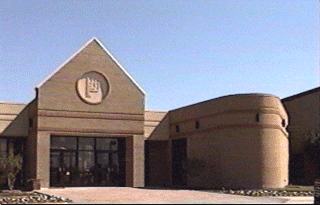
| Our synagogue in Dallas, Congregation Beth Torah |