|
It started a few years ago. I was moving into an apartment and wouldn't be able to crank my trusty Fender 30 watt amp to playable levels. I also wanted to record myself playing and had just discovered stereo guitar in the Yamaha REX-50. My solution sparked a search that began with primitive headphone amps, a full blown rack of gear and continues today with some of the latest amp modeling processors. While I only play to amuse myself and I admit I've never been very good at guitar, I thought I'd publish a subjective comparison of some of the tools I own. How good do these things simulate a tube amp's warm sound and responsiveness? I chose a slow blues pattern because I feel blues is extremely expressive going from soft and mellow to bright and punchy to totally soulful wailin'.
I was going for a bell-like, bluesy, neck-pickup tone and settled on the tweed and tweed-like settings on most of these devices. I recorded a short section of blues in A playing a loosely similar set of riffs but allowing the sound of the processor to influence me a bit. Then I converted each section to 96kbps MP3. Please excuse the chops; I slapped all of this together real quickly. All were recorded with an Ibanez S540, neck pickup selected. Most of the sounds have reverb and a little delay.
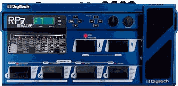
1. Digitech RP7: I've been using this for years after having used a Digitech Twin Tube, RP1 and RP10. Sometimes I use the built in cabinet sim and often I run into an ADA Microcab for a more punchy miked sound. The RP7 has a real tube preamp, but compared to the other devices here just plain sucks! It has virtually no response to picking and colors the sound so every guitar sounds the same through it.
RP7 Blue Tube overdrive
RP7 Blue Tube into ADA Microcab
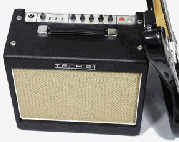
2. Tech 21 Trademark 10: A 10-watt recording amp that's a great bedroom amp and recording tool. It uses all solid state emulation instead of modeling, but its EQ is pretty versatile and is quite punchy thru its little speaker despite its small size. Recorded direct, it loses a lot of its smoothness. Delay was added in the mix, but that's a real spring reverb there. It responds beautifully to picking and playing dynamics, cleaning up when you back off the volume.
Tech 21 Trademark 10 Tweed
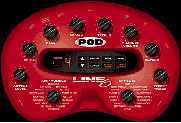
3. Line 6 POD: Tweed, Tweed Blues and Blackface settings. The POD has a less processed sound and plenty of dynamics and response to picking dynamics. There is some latency and a digital quality to it.
POD Tweed
POD Tweed Blues
POD Black Panel
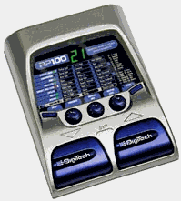
4. Digitech RP100: For $100, not bad at all. Not as responsive to picking dynamics as the POD, but has very usable tones and for this test, had the best attack. Fewer amp models, but the ones it has work well. I wish the tweed setting had a little more gain; I had to max it for this demo! A Zoom 505 killer!
RP100 Tweed and Hot Rod w/ single coil simulation
RP100 Tweed w/o single coil simulation
Well hope you enjoyed it
[email protected]
|
|