Universidad Yacambú
Licenciatura en Información y Documentación
TRABAJO 6
Idioma intermedio
Intensivo
ROSA Durán
c.i. 10103686
Reading
techniques for translations.
Scanning is a
technique you often use when looking up a word in the telephone book or
dictionary. You search for key words or ideas. In most cases, you know what you're
looking for, so you're concentrating on finding a particular answer. Scanning
involves moving your eyes quickly down the page seeking specific words and
phrases. Scanning is also used when you first find a resource to determine
whether it will answer your questions. Once you've scanned the document, you
might go back and skim it.
When scanning, look for the author's use of organizers
such as numbers, letters, steps, or the words, first, second, or next. Look for
words that are bold faced, italics, or in a different font size, style, or
colour. Sometimes the author will put key ideas in the margin.
Hints and
tips for better scanning.
1.
Don't try to read every word. Instead let your eyes move quickly across the
page until you find what you are looking for.
2. Use
clues on the page, such as headings and titles, to help you.
4. If
you are reading for study, start by thinking up or writing down some questions
that you want to answer. Doing this can focus your mind and help you find the
facts or information that you need more easily.
5. Many
texts use A-Z order. These include everyday materials such as the phone book
and indexes to books and catalogues.
6.
There are many ways to practise scanning skills. Try looking up a favourite
recipe in the index of a cookbook, search for a plumber in your local Yellow
Pages, or scan web pages on the Internet to find specific information.
Exercises:
Reading:
Scanning work sheet 1 – Questions
Before
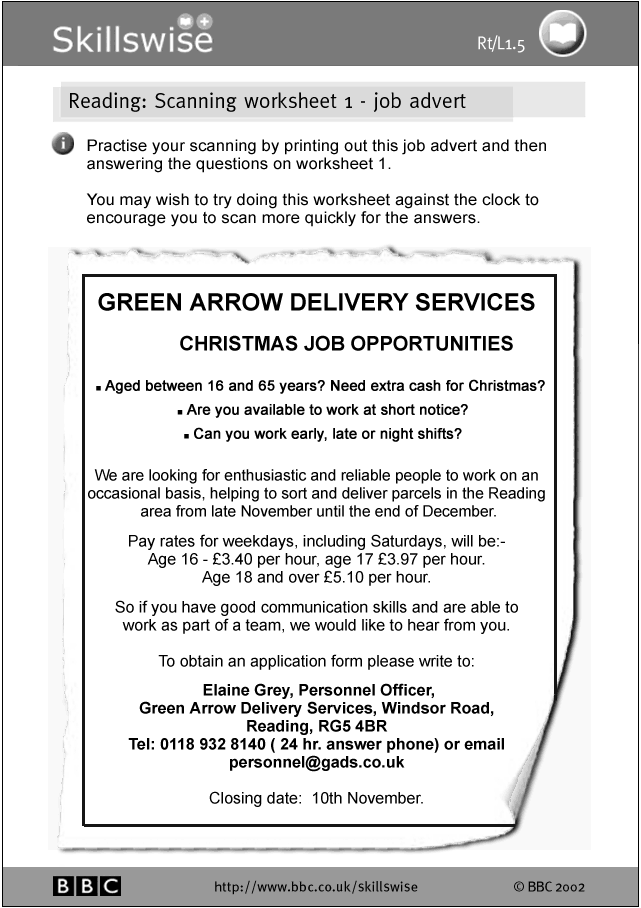
starting the worksheet, print out the “Green Arrow” job advert and have it to
hand.
“Green
Arrow” are looking for extra staff before Christmas. Scan the advert quickly to
try and find the answers to these questions – remember you don´t need to read
every word.
Cuestions
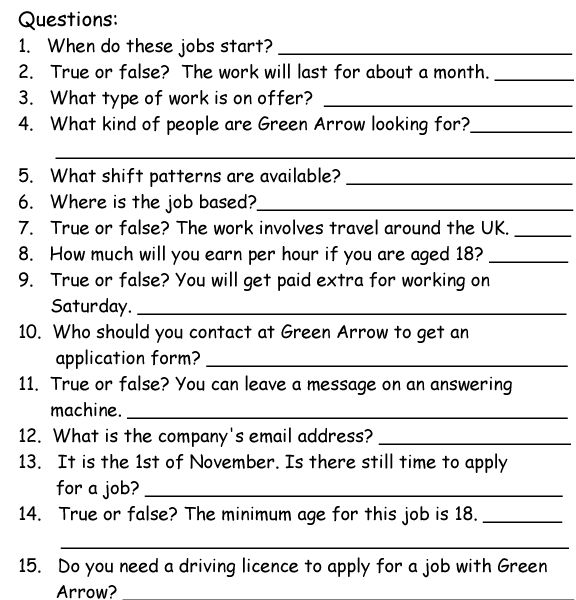
1 .- When did you start
this work?.
This job starts from late November until December.
2 .- True or false? The work
will last for about a month.
True
3 .- What kind of work
that is offered?.
This
job is for help to sort and deliver parcels in the reading area
4 .- What kind of people
are looking for green arrow?.
They are looking for enthusiastic and reliable people
5 .- What patterns
of change are available.
Early,
late or night shifts.
6 .- Where is based on
the job?.
The
job is based in deliver parcels in the reading area
7.- True or false?
The work involves travel throughout the UK.
False, and that is to help
sort and deliver parcels in the area of
reading.
8 .- How much
per hour is going to
win if it
is 18 years old?.
Over
£ 5.10 per hour
9 .- True or false? You
get paid extra for working on
Saturday.
False,
because the paid rates are weekdays including saturdays and per hours
10 .- Who should you contact
green arrow in obtaining an application
form?.
Elaine
Grey, personnel officer
11.- True or
false? You
can leave a message on an answering
machine.
False,
because the phone will be answered 24 hours
12 .- What is
the company's email address?.
The
email of the company is [email protected]
13.- It is Nov. 1. Is there
still time to apply for a job?.
Yes, because
the closing date is the 10th november.
14.- True or false? The
minimum age for this job
is 18.
False, because the minimum age for this job is 16 years old
15.- Do I need a license to apply for
a job with a green arrow?
It’s
not necessary because it’s not specified.
Beauty with Botox
Botox injections are one of the most popular cosmetic
treatments in the world. Celebrities like Madonna, Kylie Minogue and Liz Hurley
are rumoured to be keeping the wrinkles at bay this way.
Sir Cliff Richard admitted to having had the treatment
and now it is an increasingly popular choice for ordinary women looking for a
quick way to look younger.
What is
Botox?
Botox is made from 'botulinum toxin', a poison
produced by the bacterium Clostridium botulinum. This bacterium causes botulism
- a severe form of food poisoning. In smalll quantities, however, Botox merely
interrupts nerve impulses to muscles in the face.
Botox first began to be used in 1980 to treat many
muscle disorders such as lazy eye, eye ticks and uncontrolled blinking. Cosmetic
treatments were pioneered by dermatological surgeons in
Armpit attack
Botox is reportedly a favourite with Oscar nominees
who don't want to work up a sweat on the red carpet. Some stars have injections
in their armpits to paralyse the sweat glands there. This way they can receive
their awards knowing they don't have sweaty patches under their arms and hand
back their couture outfits unstained.
How long does
it last?
Injections take effect about three to seven days after
treatment and the effect lasts three or four months. A treatment costs roughly
£200. With repeated treatments, atrophy or thinning of the muscles occurs,
which produces longer lasting results. Botox may be unsuitable for use around
the mouth as the muscles there are important for facial expressions and eating.
Side effects
Soreness or mild bruising can occur around the
injection site. In rare instances patients may experience a droopy eyebrow or eyelid.
Headaches can also occur. Since it is still a relatively new treatment, any
possible side effects of long-term use are still unknown. Botox should only be
administered by experienced and well-trained doctors or nurses. A high dose
could cause poisoning, or an exaggerated effect.
Botox and
Bollinger
Botox parties are causing concern amongst
practitioners. People are receiving treatments whilst sipping champagne. The
American Academy of Dermatology has warned against this practice. Alcohol and
Botox do not mix well.
Not only can booze intensify bruising but it can also
wash the toxin away from the target muscle.
Choose the right answer.
1: How do Botox injections in the armpits stop some
celebrities from sweating at the Oscars?
Ø
The Botox
causes the armpit muscles to relax.
Ø
The Botox
develops into thin protective layers of gel.
Ø
The Botox
paralyses the sweat glands.
Ø
The Botox
tightens the skin in the armpits.
2: What is another phrase / word meaning
'thinning of the muscles'?
Ø
Clostridium botulinum
Ø
atrophy
Ø
botulinum toxin
Ø
Bollinger
3: Which of the following is NOT a possible side
effect of using Botox?
Ø
headaches
Ø
blurred vision
Ø
droopy eyebrow
Ø
mild bruising
4: Which medical body has warned people
against mixing Botox with alcohol?
Ø
The American Medical Association
Ø
The
American Institute of Cosmetic Surgery
Ø
The
American and Canadian Joint Medical Council
Ø
The American Academy of Dermatology
5: What is botulism?
Ø
a severe form
of food poisoning
Ø
a severe
form of blood poisoning
Ø
a severe
form of liver damage
Ø
a severe form of dermatitis
6: Which of the following is a condition
NOT initially intended to be treated using Botox?
Ø
lazy eye
Ø
eye ticks
Ø
puffy eyes
Ø
uncontrolled blinking
7: According to the article, which of
the following celebrities is rumoured to have used Botox?
Ø
Jerry Hall
Ø
Judy Finnigan
Ø
Liz Hurley
Ø
Barbara Windsor
8: Actors can have problems if they have used too much
Botox because:
Ø
Botox can leave
the face with a lack of expression.
Ø
Botox can
cause the mouth to droop.
Ø
Botox can
lead to a speech impediment.
Ø
Botox can
lead to a nervous tick.
9: For how long does the effect of using Botox last?
Ø
two to three months
Ø
three or four months
Ø
at least
6 months
Ø
nearly a year
10: Which bacterium produces the poison, botulinum
toxin?
Ø
Clostridium botulinum
Ø
Clostride botulius
Ø
Botulinum clostridius
Ø
Botulinum clostridium
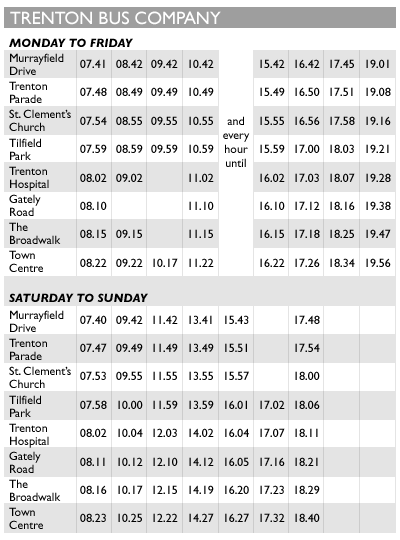
Look at the following Bus
timetable for scanning
Choose the right answer.
1: At what time does the 08.42 bus from Murrayfield
Drive arrive at Trenton Hospital on a Thursday?
Ø
08.59
Ø
09.02
Ø
09.22
Ø
11.02
2: At what time does the 10.49 bus from
Trenton Parade arrive at Gately Road on a Monday?
Ø
11.10
Ø
12.10
Ø
12.15
Ø
11.55
3: If you need to be in the town centre
by 11am on a Saturday morning, which bus do you need to catch from Tilfield
Park?
Ø
07.58
Ø
10.04
Ø
10.00
Ø
11.59
4: If you need to be in the town centre
by 10.30am on a Wednesday morning, which bus do you need to catch from Trenton
Hospital?
Ø
11.02
Ø
08.02
Ø
08.10
Ø
09.02
5: If you want to arrive at The
Broadwalk by 15.30 on a Tuesday, which bus do you need to catch from St.
Clement's Church?
Ø
14.55
Ø
13.55
Ø
13.59
Ø
14.59
6: If you miss the 17.00 bus from
Tilfield Park on a Friday, what time is the next bus?
Ø
17.03
Ø
17.12
Ø
18.03
Ø
18.07
7: If you miss the 08.10 bus from Gately
Road on a Monday, when does the next bus arrive?
Ø
08.15
Ø
09.15
Ø
11.10
Ø
08.22
8: If you need to arrive at Trenton Hospital by 17.15 on a Sunday, which bus do
you need to catch from Murrayfield Drive?
Ø
13.41
Ø
15.43
Ø
16.43
Ø
16.01
9: How long does the 11.42 bus journey take from
Murrayfield Drive to Trenton Hospital on a Saturday?
Ø
19 minutes
Ø
20 minutes
Ø
21 minutes
Ø
22 minutes
10: If you need to be at Tilfield Park by 09.00 on a
Thursday, which bus do you need to catch from Trenton Parade?
Ø
07.48
Ø
08.42
Ø
08.49
Ø
08.55