 |
|
|
|
|
|
|
|
|
|
|
|
|
|
|
|
|
|
|
|
|
|
|
Dabrewing pictures |
|
|
|
 |
|
|
|
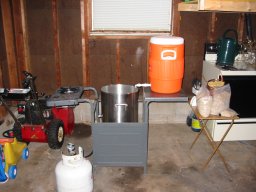
Very Humble Beginings.
Dabrewery started out as gas grill, But has since been modified (for the better) to accomodate a jet style propane burner and a seven gallon brewpot. I also attached a piece of laminate countertop to support the lauter tun. Future modifications will be to hard plumb the propane to the burners, as well as the addition of an electric Hot Liquor Tank, possibly set up on a timer or a thermostat. I'd also eventually like to incorporate a pump to move the liquid between vessels. |
|
|
|
|
|
 |
|
|
|
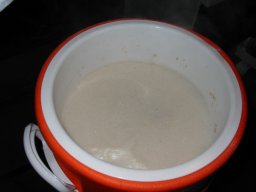
Here's a shot of what the mash looks like right before I put the lid on. For the non-brewer, It's hard to tell what's going on here, but this is where the crushed grain (also called grist) soaks in 155 degree water for about an hour to convert the starches in the grain into sugar. The sugars are what the yeast will eat later on to produce alcohol. |
|
|
|
|
 |
|
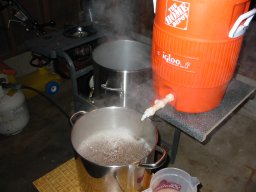
| The next step, is the sparge. Basically that means draining the lauter tun and refilling it with 175 degree water to stop the conversion of starch into sugar. It also serves to rinse the grains and get the most out of them that I can. The liquid that is drained off is now called wort. Inside the lauter tun is a manifold that I built to strain the wort from the grain. |
|
|
|
 |
|
|
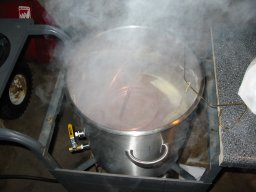
Now, on to the boil. During the boil, hops are added at different intervals, based on what characteristics we want our beer to have. In the picture you can sort of see on the right side of the kettle, there is a piece of coat hanger with a nylon bag tied to it. The hops are in that bag. You can also see a copper coil in there too, that's a wort chiller, which gets hooked up to a cold water supply later to cool things down quickly. |
|
|
|
|
 |
|
|
|
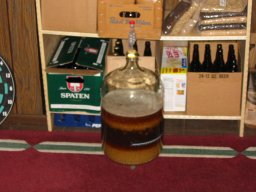
Fermentation Time...once the wort is cooled properly, it's transferred to a glass vessel know as a carboy, and the yeast is added. The carboy is sealed with an airlock, and left to sit for a week or two so the yeast can begin consuming the sugar and producing alcohol. Once fermentation is done, it can be transferred to a secondary carboy to clear, or bottled. I usually let mine clear for a week or two in the secondary carboy. |
|
|
|
|
|
You now know all the basics to brewing your own beer. There are a number of different ways to brew. The method I'm using is the all grain method. However you choose to do it, you will end up with a fresh, hand crafted, great tasting beer. That's all I have for now. I'll take more pictures at bottling time. |
|
|
|
 |
|
|

|
|
|
|
|
|
|
This Page Was Created and Inspired by Homebrew. |
|