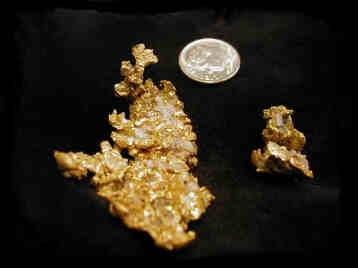
I dont know if you have ever been in a rock shop, or mineral store, and looked at all of the colerfull minerals...they look really cool. The colors, and shapes they make ineresting objects to set on your bookshelf. However, knowing that you found these beauties yourself and better yet, bragging to your friends that you found it can bring one of those special feelings you really cant find anywhere else.
Finding precious and semi precious minerals and gems is very fun. It has always intrigued me. Such valubles are thought by most to be only obtainable with money, to find pieces of gold lying in a creek seems impoterous. However, don't expect to get rich.
Here you can find some of my travels looking for these treasures. The first section, rockhounding, covers minerals. While goldpanning covers searching for metals.
Rock Hounding Gold PanningUnless someone tells you where to look, you can read all of the books and have all of the experiance but it is still 40% knowlege and 60% luck. You may know what types of nooks and cranies to look in but unless your luck or God's good will is with you, you can never be certain what to find.
On our last trip to Colorado, we found a quartz vein running across a small gorge. the left (South) had three audits in it, from as far as we traveled up the gorge. We were able to travel about 75 yards up the right (north) side of the river where the vein is. the vein appeared to go from the top of the gorge to below the level of the creek. Actualy there were numerous quartz veins running up the sides of the gorge. The vein was located on the back of an alcove which had the only audit on the north side of the george. The audit entered the rockface perpendicular to the vein and then turned to the right and followed it. We entered the audit (Entering old mines is extreamly dangerous, what we did was extreamly stupid eventhough we were within a few feet from the portal noxious gases and decaying and loose walls could of easily killed us. going into an old mine and banging on the wall with a chisel isn't a smart idea) and traveled around 10' to where it intersected the vein and collected some samples, more on the samples later. Back ouside, the vein averaged 3/4 of an inch but looked as if it was up to 1 1/4 inches. In the wider spots the quartz clings to the walls leaving the crystals on the walls pointing in to a small cavity, however in most places the quartz is intermeshed together.
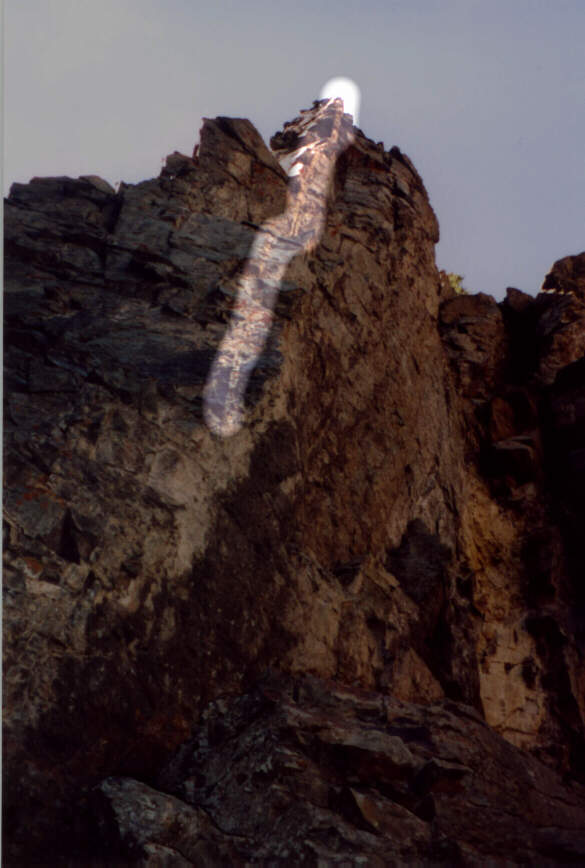
Here you can see the upper part of the vein in the highlighted area...it is the strip of light rock in the middle of the highlighted area. notice in someparts of the vein how there is a dark strip running in it, the strip is a cavity in the quartz.
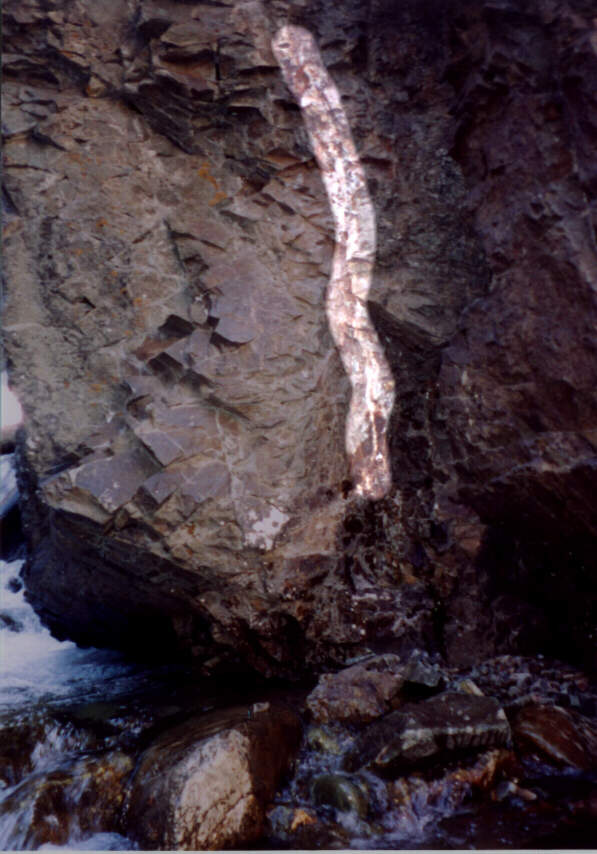
This is the lower part of the vein that is exposed. The lower portion of this vein had some areas that had large cavities, that were filled in with sediment from the creek. the upper part of this is where I pulled out some neet samples.
Inside the mine we found quartz rock (intermeshed and foggy white) it was laced with a silver-gray mineral (lead) and pyrite
Outside I retrieved sections where where the quartz was intermeshed. I also got a good section where the quartz was seperated. This piece has clear quartz and a layer of what I believe to be CORUNDUM on theouside.
A good place to rockhound is at mine tailings. Often times spectacular mineral specimens can be found lying in the rubble. As long as you make shure your not entruding onto private property.
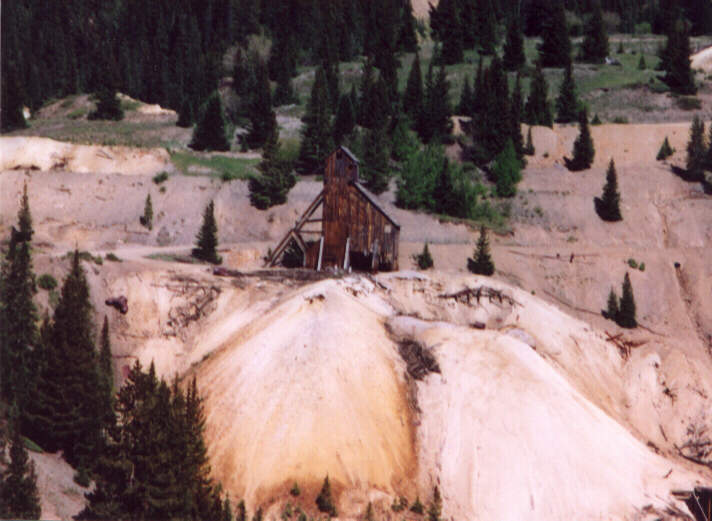
Here is an old headframe sitting ontop of its tailings pile
One spot where my Dad and I found some unique minerals was the seniorita mine. This mine had a unique tailings pile, usually the tailings are yellow to brown due to the oxydisation of irons in the rock. At this mines we found some unique blue crystals on some rocks and what appears to be peacock copper. However, all of the samples were quite small
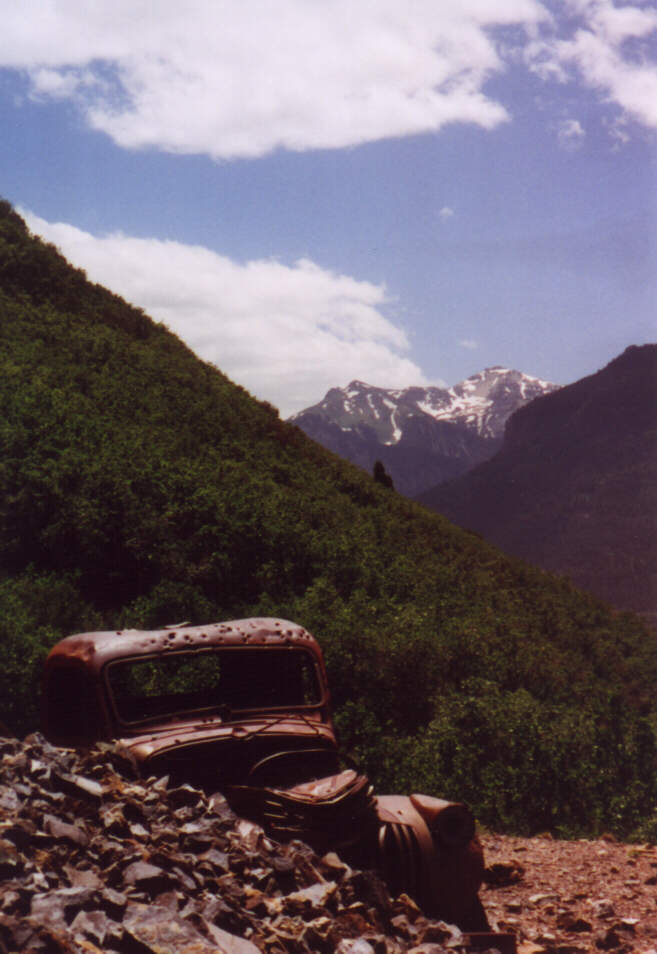
This is the view from the seniorita mine
Goldpanning is an interesting form of rockhounding. If you thought you know how to pan for gold because of what you have seen in the movies, then your chances of striking it rich are impossable. Panning for precious metals makes use of the fact that the rare metals that are valuble are considerably heavier than what your not looking for. Movies always show a swirling action to remove the sand and get your gold this, however, does the opposet. by swirling the pan at such an early stage, slings all of the heavy minerals in your pan out, just like you would be trown off of a mary-go-round if you were to let go while you are spinning. The proper way to do this is to use gravity to your benifit.
First, scoop up some prospective sand (more on how to find this later). The next thing you want to do is to submerge your pan in the water (preferably one with a slight current to sweep away the organic matter) and shake the pan so that the heavy materials settle to the bottom and the light stuff is pushed to the top. Be carefull not to be to violent that the gold is thrown out. You might also want to use a stick to break up any dirt clumps. You should restrain from sticking your fingers into the gravel as much as posible because the oil on your finger will stick to the gold and cause it to float to the surface and down the stream. Also you should be carefull when throwing out any large rocks that are in your pan, make shure they dont have any pieces attached to them.
Now that you feel shure that your gold has been able to settle to the bottom, tilt the pan so that the upper sands are dumped out. (I might add that while your doing this you will probably see all types of sparkly flecs flowing out of your pan, but don't worry if it has any value it will be safely at the bottom when you finish) This pattern of dip, shake, tilt is repeated untill you have gotten your sands down to a fairly small amount. If your pan has riffles (small ridges on one side that prevent the gold from sliding out) then this point is usually where the the amount becomes so small that they prevent the sand from exiting when you tilt your pan.
At this stage shake your pan with it slightly tilted in a direction other than twards the riffles, so that the material left forms a triangle in the bottom. Now, dip the pan in the water and pull it out letting the current pull the upper part of the triangle flow out of the pan, but do not pull the pan out so fast that the current churns up the sands. The idea here is that when you shook the pan, the gold settled into the bottom most lip in the pan. So by letting the upper sands be pulled out by the current, then you can remove even more unnessicary material with your gold saftly tucked away. You should procede with this method until you have about a tablespoon of material left. In many portions of Colorado you will find that most of this remain sand is black magenite, which is a form of Iron ore commonly associeated with gold (a good sign) and it can be pulled away with a magnet (makes you wonder how they came up with the name). You also may find that you will have pyrite and other minerals in your pan, although they are esentially valuless they can often be pretty spectacular.
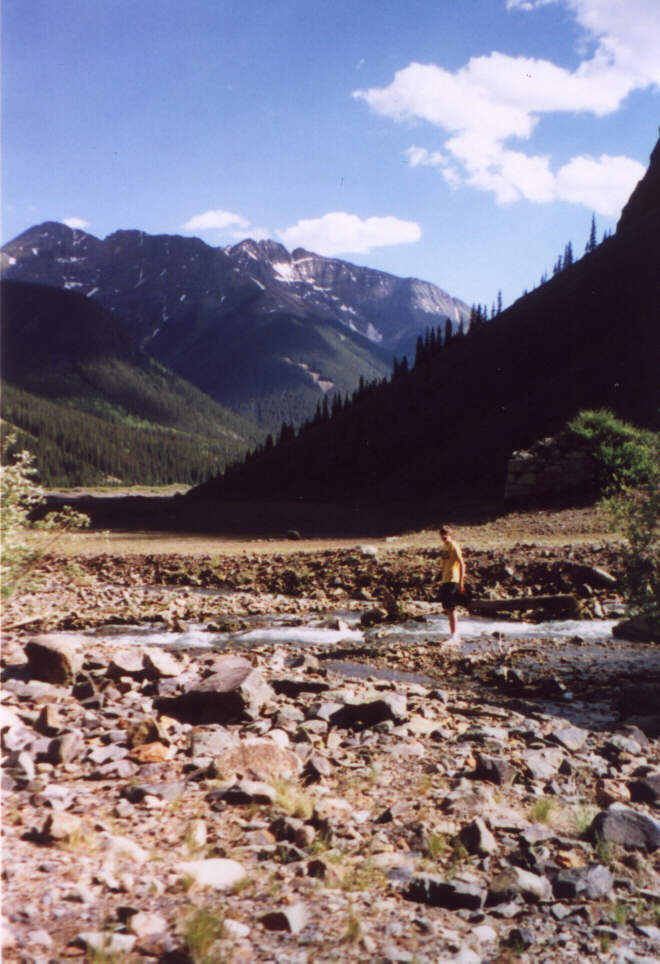
That is me looking for a good spot to pan
Now to see if you have any color (gold) add/remove water so that you have less than an eighth of a pan full. Now gently swirl (yes I said swirl) your pan so that what is left forms a band. If you have any gold in your pan it should be at the back of the band (because its the heavyest).
There are many ways to remove the gold from the pan, the first and most common is with a finger, tweezers, ect, ect. Other methods (not highly recomended) include: using mercury which sticks to noble metals (gold, silver, ect) which is later seperated by using cheese cloth or similar filter, evaporating it off (extreamly not recomended), or other chemical methods; Using cyanide is also and option, however it is also the acting ingreadeant in rat poisen; there are also a plethera of chemicals that are attracted to gold and its friends, but as a beginner I would suggest sticking to the finger and tweezers method.
Now that you know how to pan, you need to know where to look. gold because of its weight, tends to settle where the river slows down. Check in the eddies behind large rocks, and around sandbars and wide spots. Another good spot is in the banks of curves. Goldpanning is more 75% luck and 25% knowledge, so good luck.
One last suggestion for a beginner is to practice with BB's. when you start sprinkle in a few, when you get to the bottom, and you find that there aren't any left then chances are good that your gold is gone too. And remember practice makes perfect, professionals usually can finish a pan in a few seconds so the more pans you can finish the more dirt you can cover, that means the higher the chances are that you will find some gold. Panning also allows you to find silver (usually a grey), copper (green), lead (grey to dull silver), as well as other heavy metals. I have also found agates panning and some other interesting minerals. so Keep your eyes peeled out there!
Back to Top