Basic
Japanese
by
David-Lee
Stevenson
Lesson
1
Let
me first start, by giving a brief explaination as to how I am going
to go about the lessons. Each lesson I will introduce one character
from each of the three different character sets used by the Japanese.
The first is called hiragana. The second is called Katakana. The
third is called Kanji.
Eventually,
we will run out of hiragana and Katakana to introduce, so I will then
switch to three Kanji in each lesson. The Japanese also use Romaji,
which is basically English letters used to spell Japanese words.
I
will use some Romaji as I go along as well, but as the hiragana,
Katakana and Kanji get introduced, I will continually use them more
and more. Eventually, the Romaji will only be used to explain the
pronounciation of new characters being introduced.
To
understand Japanese, we must first understand the three character
sets and what they are used for.
The
first character set is hiragana. It is not an alphabet, but is a
Syllably. A Syllably represents syllables, and not letter, as in
English. So some of the characters will represent �ka�
or �Bo� or �Ge� etc, where as English and
Romaji need two letters to accomplish the saem thing.
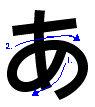
The
first letter we will learn from hiragana is the syllable 'a'.
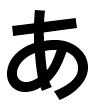
It's
a very short 'ah' sound. Like in 'father', but shorter. Think of it
like you are about to interupt someone and stop yourself short, so
you go �Ah!� really quick. Whenever there is a word or
syllable with
in
it, the pronounciation will not change. The good thing about
Japanese, is this is true for all hiragana and katakana. Once you
learn the character the pronounciation never changes. (Kanji is a
little different. As we will discover later). hiragana means
�Womans Hand�, and was invented by women who didn't like
using the long Kanji system used by men at that stage.
Katakana
is also a syllably. Katakana has more square (or boxy) looking
characters. Katakana is mainly used to represent foreign (loan)
words or foreign names. As we learn the hiragana, we will learn the
Katakana equivalent. So the first katakana also represents the
syllable 'a'.
It
is pronounced exactly the same as the hiragana.

Next
we come to the Kanji. This is the tricky bit in the Japanese writing
system. Kanji is based on the Chinese writing system, and is not a
syllably, so the pronounciation of the character can change with
context. Our first Kanji is :
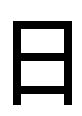
The
first pronoucniation I will teach is 'ni'. Pronounced like 'Knee'.
If you've seen Monty Python and the Holy Grail, think of the scene
with the Knights who say �Ni�. The 'i' sound is the same
as the end of the word Hawaii.
Kanji
represent ideas, so I will explain that this symbol represents the
sun with a sun spot in the middle. Eventually, the round sun became
more square, and the sun spot changed from a dot to a stroke across
the middle.
The
�ni� pronounciation is used in words such as Nihon, which
means Japan. In the next lesson, I will introduce the Kanji for �Hon�
so that you will be able to write the word for Japan. In this
context, the �Ni� means Sun. You've heard fo Japan being
refered to as the �Land of the Rising Sun�. Well, this
is where that term comes from.
The
second pronounciation is �nichi�. The 'Chi' sound is
pronounced like �Chee�. The same as in the word
�cheese�, but shorter. Nichi means Sun, or Day, as do
the next two pronounciations, �Jitstu� and �hi�.
Jitsu
is ponounces �JeeTsoo�, it might be hard for you to get
the Tsu bit correct at first. The �Hi� bit is pronounced
�Hee� as though you are laughing. Hee hee! Never �Hi�
as though you are greeting someone you know.
As
you vocabulary increases in Japanese, you'll begin to recognise where
each of these different pronounciations occurs.
There
is one last pronounciation and that is �ka�. It's
pronounced like the �ah� we have already learned, but
with a �k� on the front. So �ka�, as though
you are going to say Car, but with no �R� on the end.
This also means �Day�, but only in the context of it
being a �day of the month� or in reference to the/a
�number of days�.
Okay,
let's through a few of these into some context. The Capitals will
indicate the Kanji being used in Romaji. Don't worry too much about
the pronounciation of the bits we haven't learnt yet. We'll pick the
up later.
|
Japanese
Kanji
|
Meaning
|
Romaji
|
|
曰hon
|
Japan
|
NI-hon.
|
|
曰node
|
Sunrise
|
HI-node
|
|
Hon曰
|
Today
|
hon-JITSU
|
|
yok曰
|
four
days/fourth day
|
yok-KA
|
Table
1.
This
Kanji will become useful once we start to refer to things Japanese,
dates, or whether we did somethings today, or some other day.
Exercises:
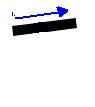
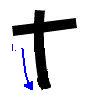
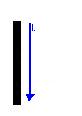
Practice
stroke order for all three of todays lessons. It is important to
get stroke order correct when learning to write the letters by hand.
Below are some tables which you can use to practice, as well as
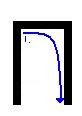
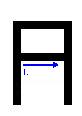
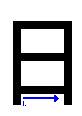
stroke order for each letter. Each stroke starts at the number 1
and follows the arrow. Where the are two or more arrows (indicating
continuation of the flow of the stroke), the arrows go in numerical
order.
Print
off these letters and make some cards from them. (Either print them
onto cardboard and cut them out, or print on paper & glue them
on cardboard). Use them to play one of the 'memory' games listed.
GAME
1 � CONCENTRATION
In
concentration, you turn all of the cards over face down. Each
player takes turns to turn over two cards. As they turn each card
over, they say the character revealed aloud. If they get two
characters which match, then they keep the cards and score a point.
This continues till all cards have been matched. (Not an exciting
game with only three characters, but as our character base builds it
will get more difficult, and more fun).
GAME
2 � Go Fish
Use
the cards you print off to play Go Fish. In case you don't know the
rules Grab a partner or two, deal seven cards (if possible, probably
only two in the first game). Ask the other person if they have a
match for a cord in your hand. (like, say, �Do you have a
Nichi?�) If they say yes, you get the card and make a match.
If they don't have the card, they say, �No, go fish�.
At which point you pick up the first card off the top of the deck.
Whoever makes the most matches wins the game.
GAME
3 � Memory Game
Simply
place the cards face down. As you turn them over, pronounce the name
out loud. If you get it right, you score the card. If you get it
wrong, place it on the bottom of the pile. If more than one person
is playing, then take it in turns. Game ends when you run out of
cards. Most cards wins.
That
concludes the first lesson.