
| Habitat | Endangerment | Diet | Appearance | Behavior |
|
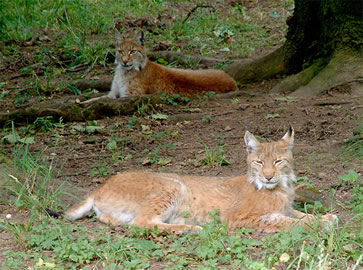
The lynx inhabits the high altitude forests with dense cover of shrubs, reeds, and grass. Though the cat hunts only on the ground, it can climb trees and swim.The Canadian lynx ranges in Alaska, Canada, and the states of Montana, Idaho, Washington, and possibly some New England states such as New York and Maine in the United States. They inhabit the forested areas of their range. |
 |
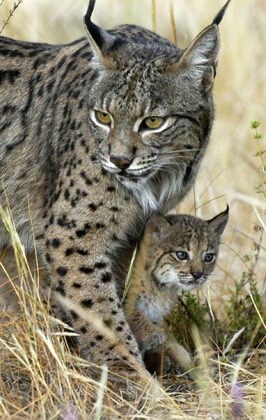
Hunting lynxes is illegal in many countries.The Canadian Lynx is an endangered species in the United States.This cat is found in northern forests across almost all of Canada and Alaska. In addition there are large populations of this lynx in Montana, Idaho and Washington. The Canadian Lynx is rare and reintroduction efforts in Colorado have been ongoing since 1999, with the first wild-born kittens confirmed in 2003, with many successful kindles thereafter. It is considered to be threatened in the contiguos United states.
|
 |
|
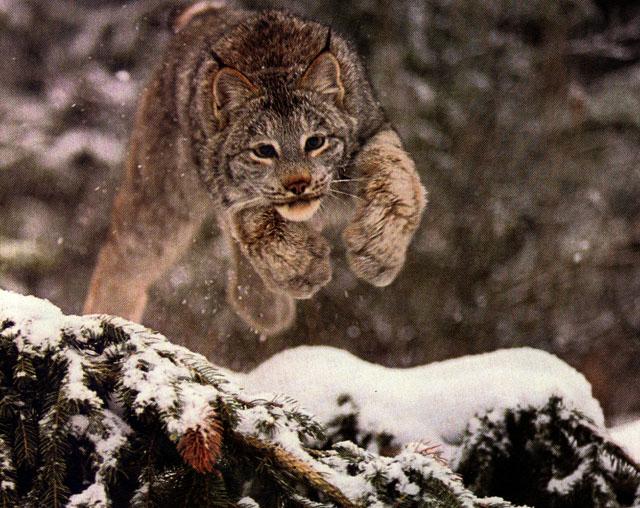
The Canada lynx feeds primarily on small mammals and birds, and is especially dependent on snowshoe hare as prey. It relies mainly on hearing and sight to locate prey. |
 |
|
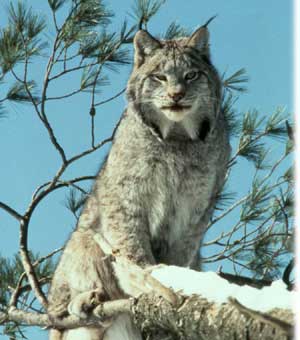
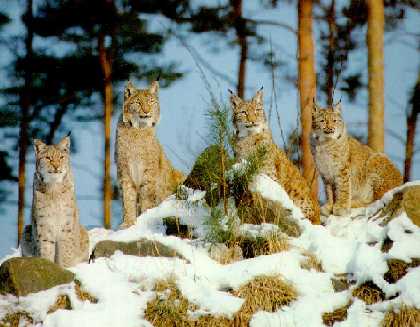
Lynxes have short tails and usually a tuft of black hair on the tip of the ears. They have a ruff under the neck which has black bars (not very visible) and resembles a bow tie. They have large paws padded for walking on snow and long whiskers on the face. The color of the body varies from light brown to grey and is occasionally marked with dark brown spots, especially on the limbs. They range from about 15 kg (33 pounds) to about 30 kg (66 pounds). The Eurasian Lynx is significantly larger than the other species. The Iberian Lynx is significantly smaller than the other species. |
 |
|
Lynx are usually solitary, although a small group of lynx can travel and hunt together. The Canadian Lynx is a solitary and secretive animal, usually active at night, and requires a large territory. Mating takes place in the late winter. Their desired resting place is in crevices or under ledges, and it gives birth to 2 to 4 kittens once a year.
|
 |
Resources |