|
|
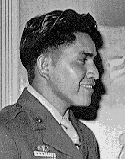
Ira Hamilton Hayes, a full blooded Pima Indian, was born on the Gila River Indian Reservation, just a few miles south of Chandler, Arizona, on January 12, 1923. He was the oldest of eight children born to Nancy and Jobe Hayes. By all accounts Ira was a quiet, solemn little boy, brought up by his deeply religious Presbyterian mother, who read the Bible aloud to her children, encouraged them to read on their own and made sure that they got the best available education. Ira attended the elementary school in Sacaton and had good grades. Upon completion, he entered the Phoenix Indian School, where he also did very well for a while. However, at the age of 19, in August of 1942, he quit school and enlisted in the Marines. When he enlisted, he had hardly ever been off the Reservation. Such a move was quite out of character for this shy, aloof young man of few words, who was never known to be competitive or enterprising. Apparently, he followed the war reports closely. After the Japanese attack on Pearl Harbor, he felt it his patriotic duty to serve. The Tribe approved, His Chief told him to be an "Honorable Warrior" and bring honor upon his family. After a proper sendoff he left for boot camp.
|
|
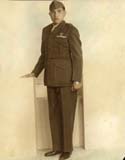
It is a matter of fact, and a matter of pride, that Marine training is the toughest, the most demanding of all military preparations. Ira appreciated the discipline, the challenge, and the camaraderie. The slight young man soon became the sturdy warrior. He applied for parachute training and was accepted, when lesser candidates failed and were weeded out. James Bradley, in his book "The Flags of our Fathers," said that his buddies dubbed him "Chief Falling Cloud." Ira was sent to the South Pacific and lived the terrors and the horrors engulfing all the young men who fought the battles, who died, who were maimed and who survived. Ira was a dedicated Marine. Quiet and steady, he was admired by his fellow Marines who fought alongside him in three Pacific battles.
|
|
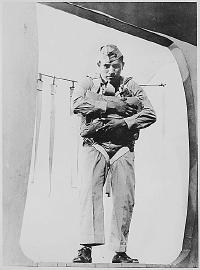
Marine Corps Paratroop School
Iwo Jima is a minuscule volcanic island about 700 mi. south of Tokyo. Its area is 8 square miles. Mount Suribachi is the highest peak at an elevation of 516ft. It was a possible supply point for the allies and it was important to prevent the enemy from using it as such. On February 19, 1945 a rather large contingent of Marines landed on the island, facing an equally substantial army of Japanese defenders, well dug in and camouflaged. One of the bloodiest, fiercest four days of combat ensued, in the course of which the Marines took more casualties than in several months of battle at Guadalcanal. This is where events took an unexpected turn for Ira Hayes.
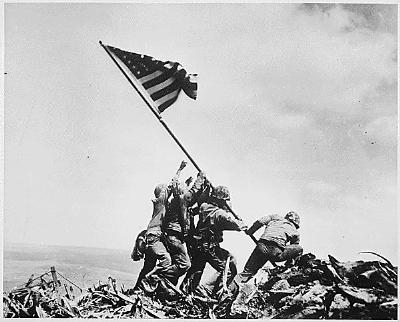
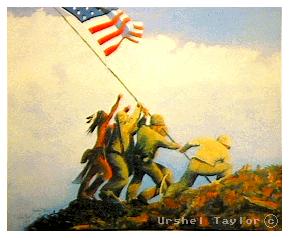
On February 23, 1945, forty Marines climbed Mount Suribachi in order to plant the American Flag on the top of the hill. Joe Rosenthal, an AP photographer took several shots of the event. One of them became the famous photograph that you see below, the picture which soon became the universal symbol that it still is today. Joe Rosenthal received the Pulitzer Prize. The six marines planting the flag in the photo were Mike Strank from Pennsylvania, Harlon Block from Texas, Franklin Sousley from Kentucky, John Bradley from Wisconsin, Rene Gagnon from New Hampshire and Ira Hayes from Arizona. Strank, Harlon, and Sousley died in combat.
|
|
The three survivors stayed alive to battle their own demons. Soon the heroes' parades began. The War Department needed visible, tangible heroes. These men were chosen. They went to Washington and met President Truman. The Treasury Department needed money and so the bond drive began. The heroes were paraded through 32 cities. They were applauded. They shook hands. They attended memorial unveilings. They appeared at banquets prepared in their honor. They signed many thousands of autographs. They gave interviews. They drank toasts, lots of toasts. All this while knowing full well that heroes and heroism had little to do with the brief moment of raising the flag. When Ira learned that the President wanted him and the other survivors to come back to the US to raise money on the 7th Bond Tour, he was horrified. To Ira, the heroes of Iwo Jima, those deserving honor, were his "good buddies" who died there. At the White House, President Truman told Ira, "You are an American hero." But Ira didn't feel pride. As he later lamented, "How could I feel like a hero when only five men in my platoon of 45 survived, when only 27 men in my company of 250 managed to escape death or injury?" The Bond Tour was an ordeal for Ira. He couldn't understand or accept the adulation. "It was supposed to be soft duty, but I couldn't take it. Everywhere we went people shoved drinks in our hands and said 'You're a Hero!' We knew we hadn't done that much but you couldn't tell them that." Both John Bradley and Hayes resented the public displays in which they were the pawns. Rene Gagnon enjoyed it and hoped to build his future on it. He died some time later, bitterly disappointed.
|
|
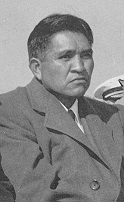
Died - January 24, 1955 Bapchule, Arizona
When all the hoopla was over, they went home. John Bradley married his sweetheart, raised a family and never talked about the war. It is said that he cried in his sleep. Ira Hamilton Hayes returned to the reservation more turned inward, more enigmatic than ever. Whatever he saw and experienced remained locked within him. It devoured him. Ira attempted to lead an anonymous life. But it didn't turn out that way. "I kept getting hundreds of letters. And people would drive through the reservation, walk up to me and ask, Are you the Indian who raised the flag on Iwo Jima?" Ira tried to drown his "Conflict of Honor" with alcohol. Arrested as drunk and disorderly, his pain was clear. "I was sick. I guess I was about to crack up thinking about all my good buddies. They were better men than me and they're not coming back. Much less back to the White House, like me." He felt guilty that he was considered a hero although so many had sacrificed so much more.
|
|
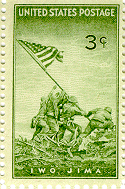
In 1954, Ira reluctantly attended the dedication of the Iwo Jima monument in Washington. After a ceremony where he was lauded by President Eisenhower as a hero once again, a reporter rushed up to Ira and asked him, "How do you like the pomp and circumstances?" Ira just hung his head and said, "I don't." Ira worked at menial jobs and tried to forget, but the phone calls and the tourists did not let up. He drowned his sorrow and sought salvation in the bottle. He was arrested about fifty times for drunkenness. On January 24, 1955, Ira died after a night of drinking. As Ira drank his last bottle of whiskey he was crying and mumbling about his "good buddies." He was found dead just a short distance from his home. The coroner said it was an "accident."
|
|
celebrate the 50th Anniversary of the first Iwo Jima stamp.
|
|
~~~~~~~~~~~~~~~~~~~~~~~~~~~~~~~~
The Ballad of Ira Hayes - Written by Peter LaFarge
Recorded by Johnny Cash on March 5th, 1964
It went to #3 on the Country Charts
Ira Hayes, Ira Hayes
CHORUS: Call him drunken Ira Hayes
He won't answer anymore
Not the whiskey drinkin' Indian
Nor the Marine that went to war
Gather round me people there's a story I would tell
About a brave young Indian you should remember well
From the land of the Pima Indian
A proud and noble band
Who farmed the Phoenix valley in Arizona land
Down the ditches for a thousand years
The water grew Ira's peoples' crops
'Till the white man stole the water rights
And the sparklin' water stopped
Now Ira's folks were hungry
And their land grew crops of weeds
When war came, Ira volunteered
And forgot the white man's greed
CHORUS
There they battled up Iwo Jima's hill,
Two hundred and fifty men
But only twenty-seven lived to walk back down again
And when the fight was over
And when Old Glory raised
Among the men who held it high
Was the Indian, Ira Hayes
CHORUS
Ira returned a hero
Celebrated through the land
He was wined and speeched and honored;
Everybody shook his hand
But he was just a Pima Indian
No water, no crops, no chance
At home nobody cared what Ira'd done
And when did the Indians dance
CHORUS
Then Ira started drinkin' hard;
Jail was often his home
They'd let him raise the flag and lower it
like you'd throw a dog a bone!
He died drunk one mornin'
Alone in the land he fought to save
Two inches of water in a lonely ditch
Was a grave for Ira Hayes
CHORUS
Yeah, call him drunken Ira Hayes
But his land is just as dry
And his ghost is lyin' thirsty
In the ditch where Ira died