February 24, 1991 G-Day
The War Begins
February 24, 1991 G-Day
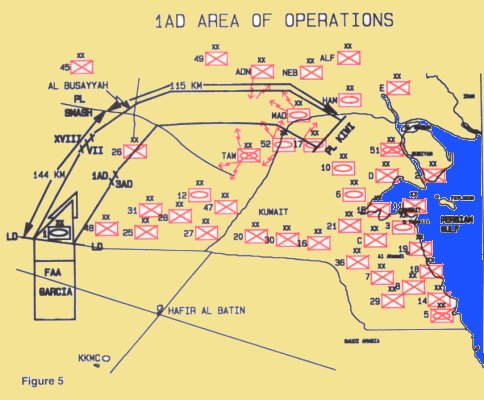
At approximately 6:30 a.m. 19th Engineers began berm breaching operations. By midafternoon more than 250 eight-meter-wide lanes were constructed along the division's 18 km front. Earlier in the day the VII Corps Headquarters received word of unexpected success of offensive operations already underway in the XVIII Airborne Corps sector (to the far west) and US Marines' (MARCENT) sector (near the coast) of the allied front. The Corps instructed 1st Armored Division to be prepared to launch its attack at noon, a full 18 hours ahead of schedule. At noon, the Corps further placed the division on a two-hour alert to initiate the attack. When ordered, the division crossed its assigned line of departure (LD) at 2:34 p.m. when lead elements of 1-1 Cavalry crossed the border berm.
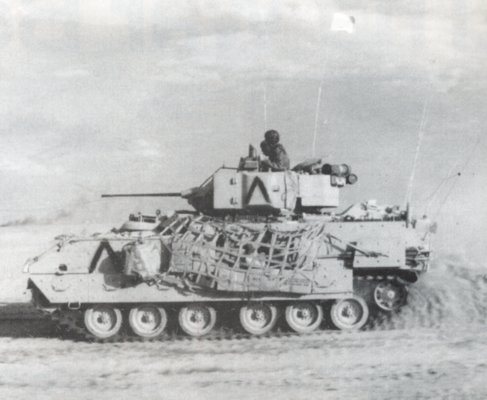
In spite of limited visibility caused by an intense sand and dust storm, 1st AD moved rapidly northward in a narrow front employing a compressed "division wedge" formation. 3rd Armored Division accompanied the division on its eastern flank as the main effort of the Corps' deep envelopment of Iraqi defenses west of the Wadi Al Batin. 1st Brigade (the PHANTHOM Brigade: TF 1-7 Infantry, TF 4-7 Infantry, TF 4-66 Armor, 26th Support Battalion and 2-41 Field Artillery) the division advance guard, followed 10 km behind the 1-1 Cav screen. Accompanying the Phantom Brigade was 2nd Lt. Nora Ramirez, the brigade's signal platoon leader from 141st Signal, one of the first women in the division to cross the line of departure. 2nd Brigade (the IRON Brigade: TF 6-6 Infantry, TF 1-35 Armor, TF 2-70 Armor TF 4-70 Armor, 47th Support Battalion and 2-1 Field Artillery) followed on the left (west) of sector and 3rd Brigade (the BULLDOG Brigade: TF 7-6 Infantry, TF 1-37 Armor, TF 3-35 Armor, 125th Support Battalion and 3-1 Field Artillery) followed on the right (east) as Maj. Gen. Ronald Griffith, commander, 1st AD, centered the Force Artillery behind the 1st Brigade and between the wing brigades. The division's support elements (including 123rd Support Battalion), totaling nearly 1000 vehicles of tailored logistics support, brought up the rear of the division's battle formation.
The division moved forward with 2nd Brigade encountering
difficult terrain in the west which combined with the poor
weather conditions to briefly slow its movement. Foreward of the
division, 1-1 Cav reported the division's first battle
casualties-three soldiers wounded by fragments from unexploded
ordinance encountered in sector. At 3 p.m. the Corps shifted the
fire support coordination line out to PL Pear to ease control of
artillery fires and U.S. Air Force close air support. Soon after
that the division encountered its first enemy prisoners of war
(EPW), the processing of which also slowed the attack somewhat.
At 4 p.m. the division air force liaison officer (ALO) reported
that deteriorating weather conditions precluded the use of close
air support for the rest of the day though selected air
engagement areas remained open in case the weather improved. At
4:20 p.m. 3rd AD, in the east, reported crossing the 30 East-West
gridline, somewhat behind the 1st AD. The division's advance
reached the area just north of PL Apple (see Figure 6), 30 km
past the LD, at 6:05 p.m. Nearing dark the division received
instructions from Corps to halt its attack so that it could
realign flank units (3rd AD and 3rd Armored Cavalry Regiment in
the west). 1st AD units took advantage of the pause to conduct
refueling operations and prepare to continue the attack.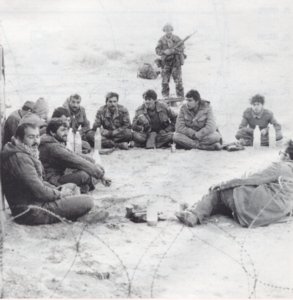
With elements of Iraqi 26th Division believed to be in the vicinity PL Colorado (northwest of Al Thamarya) the CG decided to continue the attack the following morning at 6:30. At 10:22 p.m. intelligence reports indicated that the Iraqi III Corps commander had ordered his units in Kuwait to begin a withdrawal, the first indication that Iraqi defenses were cracking.